

6-minute read
Robotic process automation (RPA) gained traction in the early 2020s as organizations pursued quick efficiency gains and cost reduction. Many of those initiatives delivered mixed results, not because the technology underperformed, but because teams automated processes that were poorly suited for it.
The conversation has evolved. In 2026, automation efforts are evaluated less on task-level efficiency and more on measurable operational impact. As AI and intelligent workflows become more common, process selection requires greater precision. Not every repetitive task is a good candidate, and not every automation effort produces meaningful value.
The core question has shifted. Instead of asking where RPA can be applied, organizations are taking a closer look at which processes can deliver meaningful business outcomes when automated.
To help organizations make more informed automation decisions, we use a structured approach to evaluate and prioritize opportunities.
This framework focuses on three key phases: assessing process suitability, estimating business value, and prioritizing initiatives based on impact and complexity.
While the underlying principles remain consistent, the way these phases are applied continues to evolve alongside advances in AI and intelligent automation.

Created for C-suite leaders, our playbook distills real-world experience into a practical framework for driving enterprise-wide AI momentum.
We will never sell your data. View our privacy policy here.
Phase 1: Assess candidate suitability
When selecting processes for robotic process automation, the first consideration is suitability, as not all processes are equally good candidates.
When assessing a process for RPA, we traditionally ask three questions as a first step:
- Is it repetitive and rules-based? Does the process contain a defined set of tasks required for execution?
- Is it software-based? Can the data required for the process be accessed electronically?
- Is it documented? Is the process transcribed with appropriate details?
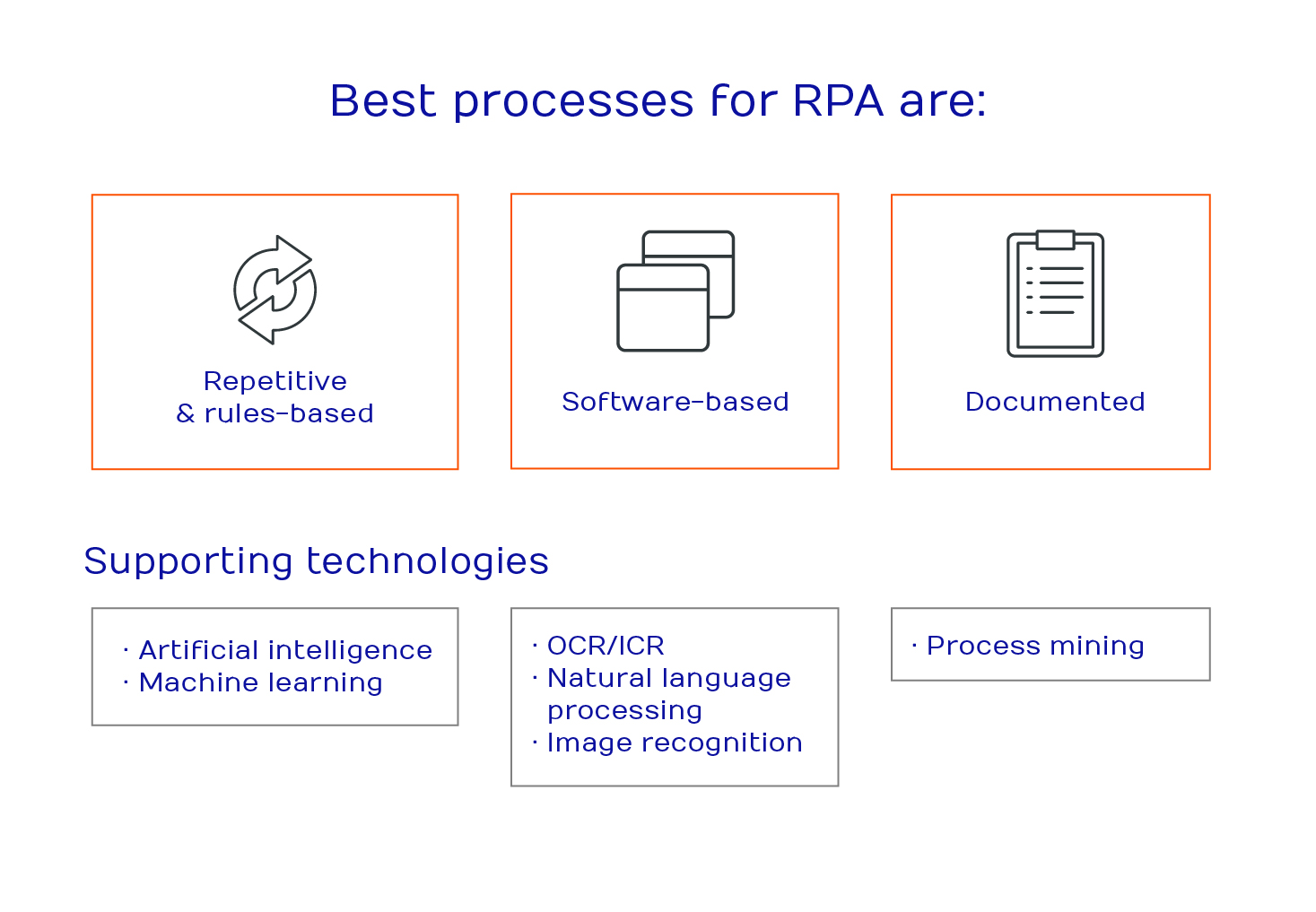
As intelligent tools become more advanced and more accessible to businesses of all sizes, the approach to these criteria is evolving. Machine learning is enabling digital workers to perform more cognitive tasks that may not be based on a defined set of rules. For processes that are not 100 percent software-based, technology such as optical and intelligent character recognition (OCR/ICR), natural language processing (NLP), and image recognition can be leveraged to accommodate handwriting, speech, photos, and other nondigital data. And for processes not yet documented, process mining technology can use event logs to map out precise flows showing how processes execute via standard and variant paths.
Let’s look at an example from the call center — specifically, accessing a caller’s account.
- Repetitive/rules-based: When the caller is positively identified, his or her record should appear on the agent’s screen. AI can be leveraged to also display applicable offers that the agent can recommend to the customer during the call.
- Software-based: The call system can access IVR and caller ID data to identify the customer using his or her phone number, or leverage voice or face recognition technology for identification.
- Documented: While this criterion will vary by organization, the account lookup process can be easily documented, or process mining can be leveraged to create a precise process flow.
For processes that meet all three criteria, possibly with “help” from smart technology, we move on to evaluate how each adds value to the organization and how it will benefit the bottom line.
Phase 2: Estimate business value
Even if a process meets all criteria (and/or if the use of intelligent tools exempts the need for one or more criteria), implementing RPA will only yield substantial benefit if the process is positioned to drive value for the organization. For this step, we look at questions in four key areas: efficiency, cost avoidance, quality improvement, and growth/scalability.
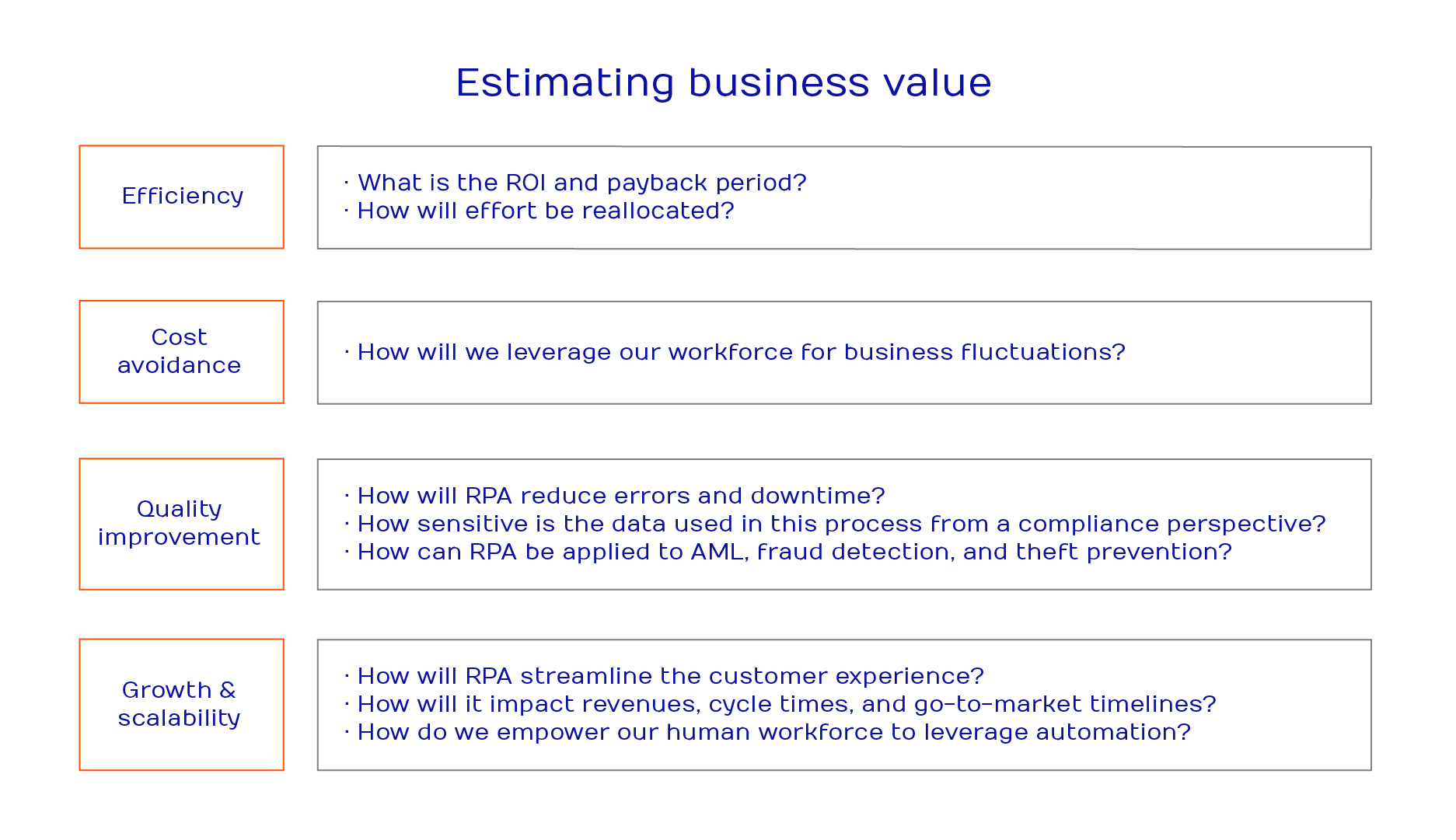
As RPA becomes more common, we are experiencing a paradigm shift that is bringing about benefits organically. Organizations are becoming empowered to reallocate their efforts towards value-add activities that contribute to the bottom line. Call center agents can focus on building customer relationships rather than tracking down information, and data scientists can focus on extracting insights instead of aggregating data, to cite just two examples. Businesses are also beginning to adopt an “automation first” mindset, addressing new, repetitive tasks by asking “How many bots do we need?” before considering other approaches.
Returning to the call center example, the high cost of live customer support has been well documented across industries. RPA can shave time off customer calls, offering the potential to reduce per-call costs and allowing agents to focus on delivering personalized service. In a large call center, a one-minute reduction in average handle time (AHT) across the board could result in up to $5 million in cost avoidance annually.
Of course, streamlining customer service through RPA is about more than alleviating pressure on agents. Customers who experience fast, frictionless service are more likely to have a positive impression of your brand and to keep coming back.
Phase 3: Prioritize the short list
Once an organization creates a short list of good candidates for RPA, the next question is usually “Where do we start?” Consider the following criteria in determining which processes to prioritize, and keep in mind that as robotic process automation programs mature, the weight of each factor is likely to evolve as well.
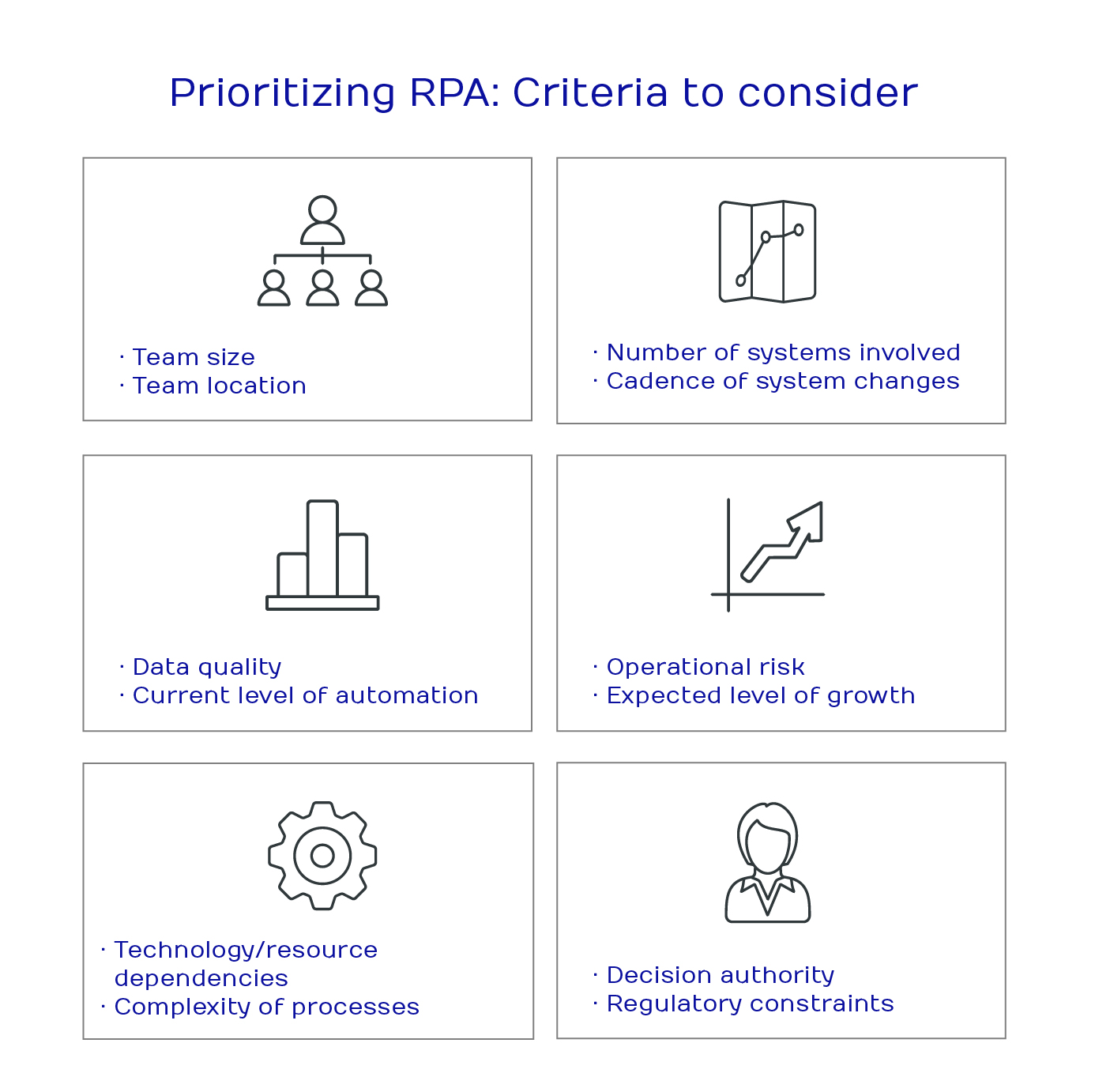
In our call center account lookup example, the priority of automating the process will depend on the organization. Businesses that receive relatively few phone calls will see lower overall cost savings from automation and may want to place the initiative further down on their priority list, while those that receive thousands of calls per day have a greater incentive to assign a higher priority.
Putting it all together: process selection matrix
When selecting processes for RPA implementation, the goal is evaluating speed to value and prioritizing processes where automation can deliver the greatest value, while mitigating risk, in the shortest time frame. It can be helpful to visualize processes within a dynamic matrix of complexity versus business value and prioritize accordingly:
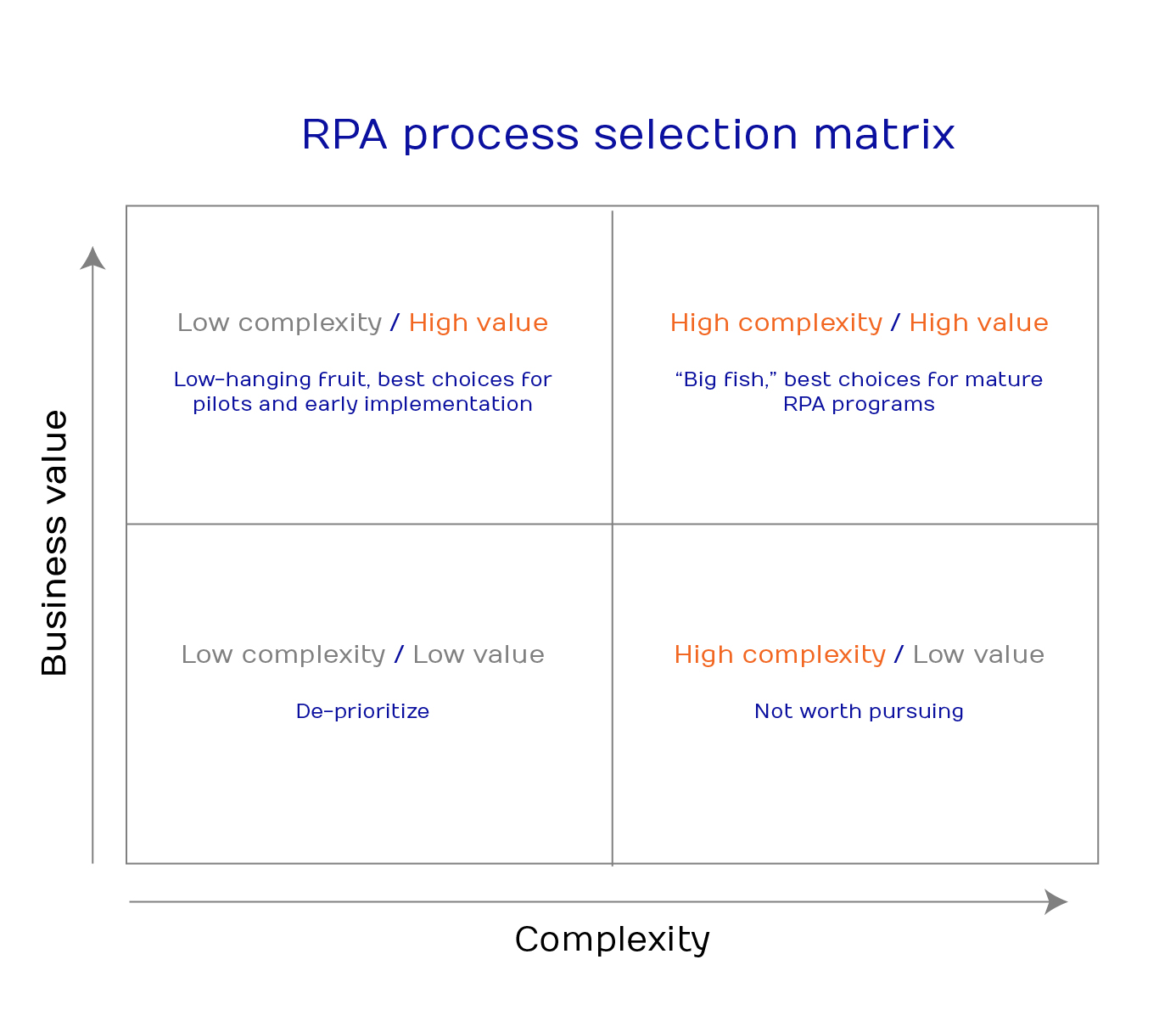
As computations of complexity and value change over time, processes can slide from one quadrant to another. Because of this fluidity, organizations will want to re-visit the matrix and adjust their RPA priority list accordingly each time they approach a decision.
What’s changed: from RPA to intelligent automation
When RPA first gained traction, many teams focused on automating repetitive, rules-based tasks as quickly as possible. Early results often looked promising. But in many cases, automation was applied to processes that were poorly defined or delivered limited business value.
Automation strategies have matured since then. Three shifts are shaping how organizations approach automation today:
1. From task automation to outcome-driven automation
Teams are placing greater emphasis on processes that influence customer experience, operational performance, or revenue. Back-office efficiency still matters, but it is no longer the primary measure of success.
2. From rules-based logic to AI-enabled decisioning
Traditional RPA performs well in stable, structured environments. Many high-value processes, however, involve unstructured data, variability, and human judgment. AI capabilities are expanding what automation can handle, but they also raise the bar for selecting the right use cases.
3. From speed to selectivity
Early programs often prioritized volume—automating as many processes as possible. More mature organizations take a narrower approach, focusing on opportunities where automation can deliver clear, measurable impact.
Process selection now plays a central role in automation success. Organizations seeing meaningful results are not necessarily automating more. They are making more deliberate choices about where automation fits and what it is expected to achieve.
“Give me six hours to chop down a tree and I will spend the first four sharpening the axe.”
Abraham Lincoln
Process selection can make or break an RPA implementation program, and it’s not a simple undertaking. It requires a deep understanding of your organization’s existing processes, in terms of both complexity and perceived business value. The good news is, the more strategically you plan your implementation, starting with process selection, the greater your chances of success.
Not sure which processes are worth automating?
We help organizations identify high-impact opportunities that deliver measurable operational value.