

Executive summary: Distribution-connected flexible loads may trigger upstream transmission constraints, creating an operational challenge that existing planning processes on either domain alone cannot resolve. Because the real-time impacts at T&D interfaces are difficult to forecast, utilities need stronger coordination across planning, interconnection, and grid operations to support large load interconnection. The approach also needs to account for how required T&D investments will be funded. As more large flexible loads connect to the distribution system, utilities will need to modernize T&D interface coordination and establish clear operational and investment frameworks to maintain reliable and affordable grid operations.
Flexible service connections (FSCs), a form of flexible interconnection, allow utilities to connect new customers without waiting for infrastructure upgrades by dynamically managing load or generation within distribution network operating parameters. As FSC adoption expands across more sites and larger loads, however, the constraints that determine those operating limits may extend beyond the distribution system to include upstream transmission constraints.
Addressing upstream transmission constraints requires decisions regarding:
- When transmission analysis is required
- How transmission constraints affect site operating requirements
- Which functions make and communicate operating decisions
- How required T&D investments will be funded
- How changing system conditions feed back into those decisions
Existing distribution-side FSC practices provide a foundation for addressing these questions, but integrated modeling alone does not resolve them. Scaling FSC across the T&D boundary requires a coordinated approach that carries transmission considerations from planning and approval into operations and ongoing review.

Maximize grid capacity with flexible service connections
Download our white paper to explore how utilities can use flexible service connections to accelerate interconnection, optimize available grid capacity, and support growing load demand.
We will never sell your data. View our privacy policy here.
How large loads change FSC coordination
Analysis for an individual flexible service connection begins with the distribution capacity available to serve the proposed load. A single large load connected through FSC may create material impacts on upstream transmission constraints, requiring coordination beyond the distribution interconnection process. The threshold for defining a large load varies by utility.
As FSC programs scale, multiple participating sites may share the same distribution constraint. Operating distribution-connected sites independently could cause the shared constraint to be exceeded and violate upstream transmission limits. Capacity analysis must then account for other current and prospective flexible sites rather than evaluating each connection independently.
Shared distribution constraints also introduce operational decisions. Utilities need rules governing the order and degree of capacity adjustments across affected sites. Approaches include establishing priority based on request order or allocating available capacity proportionately across participating DERs.
Integrated T&D modeling is only part of the solution
Integrated T&D modeling can help identify how distribution-connected FSC sites may affect upstream transmission constraints. However, designing an integrated analytical framework with the appropriate level of detail to represent both domains remains a principal challenge.
Utilities are exploring connected modeling approaches that:
- Link existing transmission planning and distribution planning tools
- Establish common scenario definitions and consistent input assumptions
- Enable information and data to flow between planning models
- Represent large FSC sites and multiple sites sharing a common constraint
- Evaluate how different operating conditions could trigger transmission constraint violations
- Use scenarios and sensitivities to test uncertainty, including load growth, FSC behavior, system conditions, and available network capacity
Modeling identifies potential impacts, but it does not, by itself, determine how FSC sites should be coordinated operationally, how shared capacity should be allocated, who should make curtailment decisions, or how required T&D investments should be funded.

Strengthening coordination for flexible grid operations
Explore how utilities can advance DSO capabilities through improved operational visibility, cross-functional coordination, and more effective management of distributed energy resources.
Coordinate T&D throughout the FSC lifecycle
Utilities must coordinate potential transmission impacts throughout the FSC lifecycle, from site assessment and approval through real-time operations and performance review. An adaptable T&D coordination workflow connects planning, interconnection, customer agreements, grid operations, and ongoing performance management without assuming that every FSC site requires the same level of T&D involvement.
The workflow follows four stages: plan and assess, approve and prepare, operate and coordinate, and review and adapt. Existing distribution-side FSC practices provide a starting point for each stage, although transmission considerations introduce additional analytical, operational, and coordination requirements.
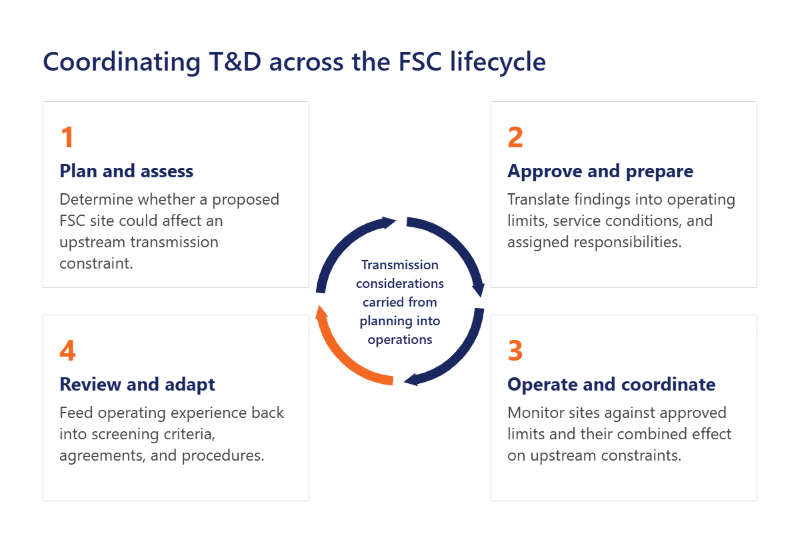
1. Plan and assess
The first stage of the workflow determines whether a proposed FSC site could affect the T&D interface or contribute to an upstream transmission constraint violation.
Existing FSC analysis begins by identifying the constrained distribution element and evaluating available capacity based on the type of constraint. Line-section constraints, for example, require power-flow analysis to identify potential overloads. T&D screening extends that assessment to potential upstream transmission constraints.
A risk-based screening process considers factors such as:
- Size and operating profile of the proposed flexible load
- Location of the site within the distribution network
- Relationship between the affected distribution facilities and upstream transmission constraints
- Presence of other existing or proposed FSC sites that could affect the same constraint
- Forecast load growth, planned outages, system topology, and other changing system conditions
- Potential for coincident operation across multiple sites
The coordination workflow should establish clear thresholds or triggers for determining when:
- A distribution-level assessment is sufficient
- Additional transmission analysis is required
- A joint T&D assessment should be performed
- A proposed FSC arrangement requires additional operating conditions or controls
- Changes to a previously assessed FSC site require the analysis to be refreshed
Process and workflow impact
Transmission considerations become an explicit part of the FSC screening and assessment process rather than an informal escalation after the distribution study is completed. The level of coordination can remain proportional to the potential system impact, allowing straightforward applications to proceed efficiently while directing more complex cases into a joint T&D review. Existing efforts to integrate FSC analysis into distribution planning workflows—including standardized processes, automated data pulls, planning-team training, and integration with tools used by distribution engineers—provide a foundation for this coordination.
Are your FSC processes prepared for coordination across the T&D boundary?
Explore opportunities to strengthen coordination between transmission and distribution planning, clarify operating responsibilities, and manage upstream constraints as flexible load connections increase.
2. Approve and prepare
Once potential T&D impacts are understood, analytical findings must be translated into service conditions, operating requirements, and clearly assigned responsibilities.
The approval process should determine:
- The operating limits applicable to the FSC site
- Whether operating limits must account for an upstream transmission constraint
- Whether limits may vary by season, time, outage condition, or system configuration
- The conditions under which the utility may restrict or curtail the site
- Which telemetry, monitoring, control, and communication capabilities are required
- How changes in system conditions will be communicated to affected functions and customers
- Who has the authority to approve, modify, or override operating limits
- When transmission planning, distribution planning, or grid operations must be consulted
For multiple FSC sites that may affect the same upstream constraint, the purpose is not necessarily to introduce a formal orchestration mechanism. Operating requirements must account for the combined effects of multiple FSC sites on the same upstream constraint. Without appropriate coordination, independent site approvals and operating decisions could collectively create an unacceptable impact at the T&D interface.
The resulting requirements should be incorporated into the appropriate interconnection or service agreements, operating procedures, system configurations, and customer communication protocols before the FSC site becomes operational.
Process and workflow impact
FSC approval becomes a coordinated, cross-functional decision rather than a distribution-only technical determination. Defined handoffs are needed among distribution planning, transmission planning, interconnection teams, grid operations, customer-facing functions, and the FSC program.
The workflow must also ensure that analytical assumptions are carried forward into enforceable operating requirements. Otherwise, the potential T&D impacts identified during planning may not be adequately addressed during operations.
3. Operate and coordinate
Once FSC sites are in service, the coordination challenge shifts from estimating potential impacts to managing actual operations across the T&D interface.
Operating procedures should enable the utility to:
- Monitor individual FSC sites against their approved service limits
- Assess the combined effects of multiple FSC sites that may influence the same upstream constraint
- Maintain awareness of changes in transmission and distribution system conditions
- Identify when normal site operations could contribute to an upstream limit being exceeded
- Communicate changing operating conditions to the appropriate planning, operations, program, and customer functions
- Initiate restrictions or load curtailment when required to protect reliability
- Manage telemetry, communications, control, and data-quality exceptions
- Restore normal operating limits when the system condition has been resolved
The workflow must define which function identifies a potential constraint, which function validates the need for action, who communicates the operating instruction, and who confirms that the required response has occurred. These decision rights and handoffs become increasingly important when a transmission condition is affected by activities across several distribution-connected sites.
Process and workflow impact
Operations shift from monitoring each FSC site only against its individual service limits to also considering whether the site’s operation contributes to a broader T&D interface condition.
Considering broader T&D conditions does not require centralized control of every FSC site. The operating workflow must provide sufficient visibility, coordination, and authority to prevent independently operated sites from collectively contributing to a transmission constraint violation.
When can a utility curtail a flexible load?
When required to protect reliability, under conditions that should be set before the site becomes operational. The approval process should determine the conditions under which the utility may restrict or curtail an FSC site, and those requirements should be incorporated into the appropriate interconnection or service agreements. Operating procedures should then enable the utility to initiate restrictions or load curtailment, and to restore normal operating limits when the system condition has been resolved.
4. Review and adapt
Because system conditions, customer behavior, load growth, and network configuration change over time, T&D coordination cannot be treated as a one-time interconnection activity.
Existing FSC practices already account for changing inputs as projects progress. Planned energization dates contain uncertainty, newly energized sites provide updated utilization data, and planning forecasts refresh over time. Current practices include periodic review of utilization and peak data and alignment with distribution planning refresh cycles.
The workflow should include periodic and event-driven reviews of:
- Actual site performance compared with planning assumptions
- The combined effects of FSC sites associated with the same constraint
- Changes in load forecasts or customer operating patterns
- Planned or completed transmission and distribution upgrades
- Changes in network topology or outage exposure
- The frequency and cause of operating restrictions
- Telemetry, communications, and control performance
- Whether existing operating limits remain appropriate
- Whether planning models, procedures, or customer agreements should be updated
Operating experience should inform future planning assessments, screening criteria, forecasting methods, service agreements, and operating procedures. This feedback loop allows the coordination approach to evolve as the number, size, and complexity of FSC sites increase.
Process and workflow impact
The FSC lifecycle becomes iterative rather than linear. Planning assumptions carry into operations, while operating results provide updated information for subsequent assessments and approvals.

Scaling flexible interconnection beyond the pilot
Discover how utilities can establish repeatable planning, operational, and customer-facing processes as flexible interconnection programs grow.
Foundational capabilities
The T&D coordination workflow depends on several enabling capabilities:
- Governance and standards: Criteria for T&D coordination and consistent requirements for its application
- Connected modeling: Appropriate connections between transmission and distribution analyses without requiring a single monolithic model
- Shared assumptions: Consistent scenarios, forecasts, system conditions, and analytical inputs
- Data exchange: Timely movement of relevant planning and operating information between functions
- Situational awareness: Visibility into site behavior and changing T&D system conditions
- Defined roles and decision rights: Clear ownership of assessment, approval, operating instructions, customer communication, and exception management
- Interoperability: Reliable and secure information exchange between relevant planning and operational systems
- Repeatable workflows: Standard triggers, handoffs, approvals, escalations, and feedback loops
- Adaptability: The ability to increase or reduce the level of T&D coordination based on site characteristics and system risk
Existing FSC practices illustrate the distinction between visibility and execution. Line sections without SCADA, for example, lack real-time loading data and require power-flow analysis to identify potential overloads. Other challenges involve the processes, roles, and systems required to respond once a constraint is identified. Addressing T&D coordination therefore may require changes to existing processes or system integration, as well as new technology or analytical capabilities.
FSC coordination must evolve with the portfolio
The operating model for FSC will continue to evolve as experience reveals where existing planning, operational, and technical capabilities are sufficient and where additional coordination is required.
That need for adaptation becomes more important as FSC portfolios grow. A process designed around individual connections may not remain adequate when multiple sites interact with shared constraints or distribution-connected large loads affect transmission conditions. Experience from planning and operations gives utilities the evidence to refine screening criteria, operating requirements, decision rights, and supporting capabilities as those interactions become more complex.
An adaptable operating model builds on existing FSC experience while allowing T&D coordination to evolve as large load interconnection requests grow and grid interactions become more complex.
Is your FSC program prepared for growing coordination demands across transmission and distribution?
Let's explore strategies for strengthening T&D coordination, establishing clear operating responsibilities, and managing the combined impacts of flexible loads as your FSC portfolio expands.
Learn more about flexible large load interconnection

Building grid flexibility under accelerating change
Five grid operations trends shaping how utilities respond to large-load growth, evolving T&D constraints, and increasing demands for operational flexibility

Building the foundation for coordinated distribution operations
How utilities can strengthen planning discipline, system visibility, and constraint awareness to support more flexible and reliable grid operations

Unlocking grid capacity through flexible interconnection
How a major utility used DERMS-enabled flexible interconnection to dynamically allocate capacity, accelerate customer connections, and improve infrastructure utilization

Michael Emmanuel is a Manager of Grid Operations with over 10 years of experience in utilities. He previously worked as a research engineer at the National Renewable Energy Laboratory, where he helped utilities implement DERs and hosted capacity studies on non-wire alternatives and economic dispatch models. Michael’s areas of expertise include DER hosting capacity analysis, DERMS, ADMS, and production cost modeling.

Alec Kostovny is a Senior Consultant in Logic20/20’s Grid Operations practice. A highly skilled mechanical engineer with a background in designing and analyzing scientific-research satellites, he also has a strong knowledge base in clean energy. Alec brings in-depth experience on projects related to wind turbine design, solar cell development, hydrogen electrolyzer and battery design, and RES grid dynamics.