

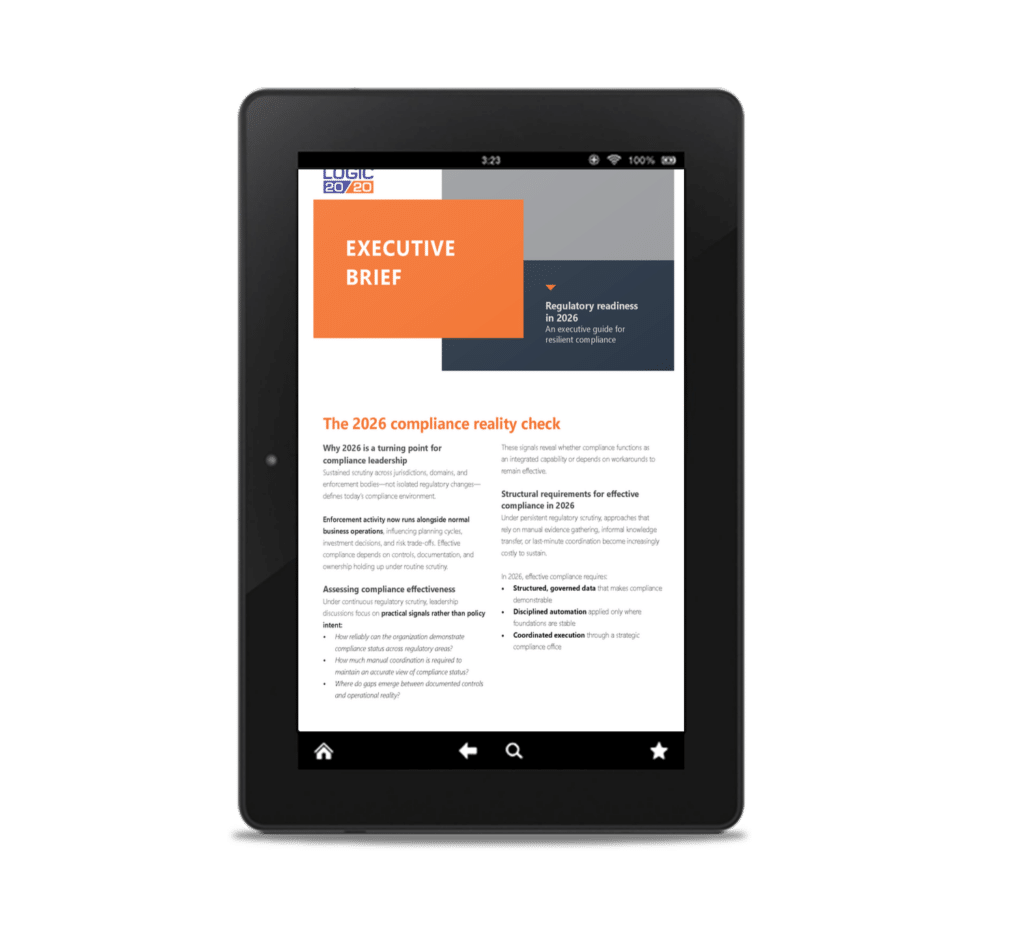
Regulatory scrutiny is no longer episodic—it’s continuous. For compliance leaders, the challenge isn’t simply responding to change. It’s building compliance capabilities that remain effective under sustained oversight across jurisdictions, domains, and enforcement bodies.
Regulatory readiness in 2026 An executive guide for resilient compliance outlines what resilient compliance looks like in 2026, with a practical focus on the structural foundations that enable predictable execution and demonstrable readiness.
Inside, you’ll explore three requirements for sustained compliance effectiveness:
Data foundations
that make compliance status easy to demonstrate without repeated manual evidence gathering
Disciplined automation
that reduces coordination effort and exception handling instead of shifting work elsewhere
Strategic compliance office
that aligns standards, ownership, and execution across the enterprise
A glimpse into Regulatory readiness in 2026: An executive guide for resilient compliance
Why 2026 is a turning point for compliance leadership
Sustained scrutiny across jurisdictions, domains, and enforcement bodies—not isolated regulatory changes— defines today’s compliance environment.
Enforcement activity now runs alongside normal business operations, influencing planning cycles, investment decisions, and risk trade-offs. Effective compliance depends on controls, documentation, and ownership holding up under routine scrutiny.
Assessing compliance effectiveness Under continuous regulatory scrutiny, leadership discussions focus on practical signals rather than policy intent:
- How reliably can the organization demonstrate compliance status across regulatory areas?
- How much manual coordination is required to maintain an accurate view of compliance status?
- Where do gaps emerge between documented controls and operational reality?
These signals reveal whether compliance functions as an integrated capability or depends on workarounds to remain effective.
Structural requirements for effective compliance in 2026
Under persistent regulatory scrutiny, approaches that rely on manual evidence gathering, informal knowledge transfer, or last-minute coordination become increasingly costly to sustain.
Ready for more?
Download your copy of Regulatory readiness in 2026: An executive guide for resilient compliance today.