
Executive summary: Digital twin initiatives in utilities often stall after early pilots when the underlying systems, data, and workflows do not support their use in day-to-day operations. Achieving business impact depends on making data consistent across systems so that digital twins can inform planning, operations, and capital allocation decisions.
10-minute read
Investment in digital twin capabilities across the utilities sector continues to accelerate. The global market for digital twins in utilities reached $8.6 billion in 2024 and is projected to grow to $25.1 billion by 2033.
Despite that momentum, some digital twin efforts do not influence how the grid is planned, operated, or maintained because the data and models remain disconnected from the systems used to make those decisions. Data feeds are in place and models reflect current conditions, but core decisions still rely on separate planning, operational, and asset management systems.
Digital twin infrastructure determines whether the twin remains isolated from operational systems or is used in planning and operational decisions. Disconnected systems, data, and operating processes limit it to visualization. When those elements operate as a connected, governed environment, the twin can support planning, operations, and investment decisions across the grid.
Table of contents (click to expand)
- What is a digital twin and how are utilities using it?
- What makes digital twin infrastructure operational
- When digital twins do not extend into operations
- Core components of digital twin infrastructure
- Where digital twin infrastructure drives operational decisions
- Designing digital twin infrastructure for scale
- How digital twin infrastructure shapes next-generation utility operations
- Frequently asked questions
Where digital twin initiatives break down in utilities
Digital twin initiatives often break down when organizations try to connect models to the systems and workflows used to run the grid. While many utilities can build accurate representations of assets and networks, integrating those models with planning, operational, and asset management systems is significantly more complex.
When digital twins are successfully integrated, utilities use them to support decisions that depend on multiple systems. Planning teams use them to evaluate load growth and infrastructure needs. Operations teams use them to monitor grid conditions and respond to outages. Asset teams use them to assess performance and prioritize maintenance. In each case, the digital twin provides a view of the network that extends beyond any single system.
The intended value is not the model itself, but how it supports decisions across planning, operations, and asset management. A digital twin becomes useful when it helps teams understand current conditions, evaluate options, and act with a clearer view of system behavior. That expectation is driving continued investment across the sector.
Addressing these challenges requires more than new tools. It requires a coordinated approach to how data, systems, and operational processes come together across the organization.
This is where many digital twin initiatives begin to overlap with broader efforts to operationalize advanced technologies like AI.

Most digital twin efforts break down at the point where systems, data, and operations need to come together.
The same challenges show up in AI adoption. The difference is how leading utilities address them.
We will never sell your data. View our privacy policy here.
What makes digital twin infrastructure operational
While often defined as a real-time digital representation of a physical asset, that definition does not address what allows the twin to be used in planning, operations, and maintenance decisions.
Digital twin infrastructure includes the data, integration, and governance required to connect physical assets with the systems that monitor and operate them. This foundation integrates real-time and historical data, reconciles differences across systems, and maintains consistent asset definitions.
In many utility environments, data remains distributed across platforms, systems exchange information without shared context, and operational teams rely on separate tools to plan and respond. The result is a digital twin that remains outside the systems and workflows used to plan and operate the grid.
When utilities address the underlying data and integration issues, the role of the twin begins to change. Systems exchange data with consistent definitions and timing. Asset information becomes consistent across planning, operations, and maintenance. The model reflects current conditions in context.
The twin becomes part of the operating environment rather than an overlay.
A digital twin delivers value when it connects to the systems used to plan, operate, and maintain the grid, and when its outputs are used in those decisions. Without that connection, it remains a visualization.
Building a digital twin is only the beginning
Connect with our team to explore the data, integration, and operational foundations that help digital twins deliver measurable value.
When digital twins do not extend into operations
Even with a strong model, many digital twin efforts struggle to move beyond early success. The issue is rarely a single factor. More often, challenges in data, systems, and ownership limit how far the twin can extend into operations.
Fragmentation across the asset lifecycle
Planning, engineering, operations, and maintenance teams often rely on different systems, each with its own view of assets. A digital twin built on top of that environment inherits the same fragmentation, which prevents it from reflecting a consistent view of the grid across teams.
Limited interoperability across core systems
Core platforms such as GIS, SCADA, asset management, and outage management systems are designed for specific functions. Connecting them requires more than basic data exchange. Differences in structure, timing, and context must be resolved before data can support coordinated decisions.
Inconsistent data and unclear governance
Asset records are often incomplete or inconsistent. Sensor data can vary in accuracy and frequency. Without clear ownership and data standards, the information feeding the twin cannot reliably support operational and regulatory decisions, especially in high-stakes situations.
Siloed ownership across teams
Responsibility for systems, data, and outcomes is often distributed across operations, IT, and engineering. Without shared ownership, integration efforts slow down, and the digital twin remains tied to a specific team or use case rather than expanding across the enterprise.
Pilot success that does not scale
A model can perform well within a defined scope, using curated data and controlled integrations. Scaling across the grid introduces variability in systems, data quality, and processes that are not present in pilot environments.
Each of these challenges is manageable on its own. In combination, they limit the twin’s ability to support operational decisions.
Until systems are connected, data is consistent across platforms, and ownership is clear, the twin remains a visualization layer rather than a system used to support operational decisions.
Core components of digital twin infrastructure
A digital twin becomes useful in operations only when the underlying environment supports it. Readiness depends on how well data, systems, and workflows are connected and aligned.
In practice, digital twin infrastructure consists of several core elements. Each one addresses a different requirement for making the twin usable in planning, operations, and decision-making.
Data consistency across the grid
Real-time operational data from SCADA, historical records, sensor inputs, and asset information all need to map to the same grid. Asset, connectivity, and device-state data must align across substations, feeders, and network segments. Without that alignment, the twin cannot reflect grid conditions with sufficient consistency to support outage planning or operational response.
Integration across core systems
Digital twin infrastructure depends on connections across utility systems such as GIS, SCADA, outage management, and asset management. Data must move between platforms with context intact, including network topology and asset relationships. Teams need a shared view of the grid rather than separate system perspectives.
Governance and trust
Data quality, ownership, and common definitions determine whether the twin is credible. In a utility environment, trust is critical. Decisions tied to reliability, resilience, and regulatory requirements depend on that trust.
Modeling and simulation
Once data is aligned and connected, the model becomes more than a representation. It reflects the current state of the grid and supports scenario analysis for conditions such as load shifts, equipment failures, or extreme weather events. Teams can test conditions and evaluate response options before acting.
Decision support in operations
The final step is connecting the twin to how work gets done. Analytics and AI can support this layer, but only when grounded in trusted data. As organizations extend these capabilities, some are beginning to incorporate more advanced analytical layers, sometimes referred to as "digital triplets," which combine the digital twin with AI models to support scenario evaluation and recommendation. The twin begins to inform outage response, asset planning, and operational decisions.

Building grid flexibility under accelerating change: 5 grid operations trends
How utilities are strengthening coordination, improving grid-edge intelligence, and evolving planning and operating capabilities to manage uncertainty, control risk, and sustain reliability as system conditions change.
Where digital twin infrastructure drives operational decisions
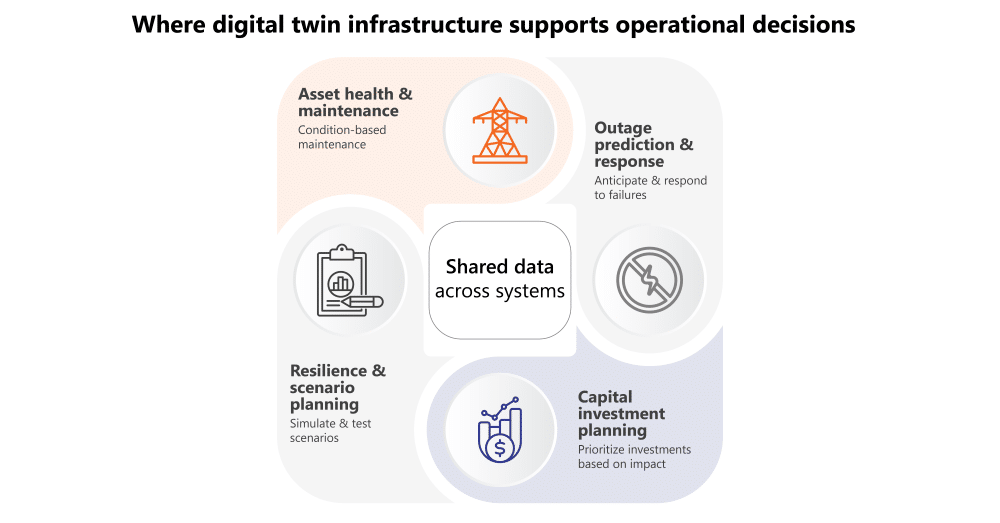
Digital twin infrastructure becomes meaningful when it informs the decisions that run the grid. The value is not in improved visibility alone, but in how planning, operations, and response draw from shared underlying data.
In utility environments, this influence appears across a set of core decision domains.
Asset health and maintenance timing
Maintenance decisions often rely on periodic inspections and partial data. With a connected digital twin, condition data, sensor inputs, and historical performance align in a single asset view. Teams can identify emerging issues earlier and schedule maintenance based on actual conditions rather than fixed intervals.
Outage prediction and response
Outage management depends on understanding current grid conditions and likely failure points. When systems share a consistent view of the network, teams can anticipate outages, assess impact, and coordinate response using the same data.
Capital investment prioritization
Capital planning requires tradeoffs across reliability, cost, and risk. When asset performance, load data, and environmental factors are connected, planners can evaluate scenarios and prioritize investments based on quantified impact rather than fragmented inputs.
Resilience and scenario planning
Extreme weather and grid complexity require forward-looking analysis. A digital twin with integrated data supports scenario simulation, allowing teams to test mitigation strategies and evaluate potential outcomes before making decisions.
Across these use cases, the pattern is consistent. A model provides a view of current conditions. A decision system connects that view to planning, operations, and investment choices.
For utility leaders, value comes from that connection. The digital twin becomes useful when it supports decisions that improve reliability, reduce risk, and guide investment across the grid.
Designing digital twin infrastructure for scale
Many digital twin efforts show early promise, then stall as teams try to extend them across the utility. What works in a pilot does not always hold up across regions, asset classes, and operational workflows.
Building a scalable digital twin infrastructure requires deliberate design choices.
Start with a defined use case, not the full model
Efforts often begin with building a comprehensive digital twin model of the grid. Progress is faster when the focus is narrower. Starting with a defined use case helps clarify the data, systems, and integrations the digital twin needs to support. The model can expand from there.
Align governance early
Digital twin infrastructure depends on consistent, trusted data across systems. When governance is addressed late, inconsistencies in asset definitions and data quality limit how the twin can be used.
Establishing ownership, standards, and validation processes early improves trust as the digital twin scales.
Design for interoperability from the outset
A digital twin relies on data from systems such as GIS, SCADA, and asset management platforms. If those systems are not aligned, the twin reflects inconsistencies rather than a unified view.
Designing for interoperability upfront reduces rework and allows the twin to operate more effectively across domains.
Scale incrementally
Expanding a digital twin introduces variability in data, systems, and processes. Large, one-time deployments increase risk and delay value.
An incremental approach allows the twin to expand across use cases and regions while validating assumptions along the way.
Balance centralization with domain ownership
Digital twin infrastructure requires shared standards but also depends on domain expertise. Over-centralization slows progress, while fragmented ownership leads to inconsistency.
Effective approaches define a common foundation while allowing domain teams to manage the data and workflows they understand best.
How digital twin infrastructure shapes next-generation utility operations
Utility operations are becoming harder to manage. DER growth, electrification, and weather volatility are increasing the number of variables affecting grid performance.
In this environment, fragmented system views and periodic analysis create delays and inconsistencies. Planning, operations, and response depend on a shared understanding of current conditions.
Digital twin infrastructure changes how that understanding is established and used.
A consistent view of the network becomes available across systems. Asset data, connectivity, and real-time state align, so teams are no longer working from partial or conflicting perspectives. Grid conditions are easier to interpret, and changes in one part of the network can be understood in context.
Coordination across teams also improves. Outage response, DER management, and capital planning no longer rely on manual reconciliation across systems. Operations, engineering, and planning teams work from shared information, reducing delays and improving decision consistency.
As a result, disruption response, asset utilization, and investment prioritization draw from the same underlying data. Response to disruptions becomes faster and more coordinated. Asset utilization improves as decisions reflect current conditions rather than static assumptions. Planning aligns more closely with operational reality, which supports more accurate prioritization of long-term investments.
Frequently asked questions
How is a digital twin different from GIS or asset management systems?
GIS, asset management, and similar systems each serve a specific function. GIS provides geospatial context. Asset management systems track condition, maintenance, and lifecycle data. A digital twin does not replace these systems. It connects them.
The difference is in scope. A digital twin aligns data across systems and reflects the current state of the network in context. It supports decisions that require input from multiple systems rather than a single source.
Which systems need to connect first?
Start with the systems that support the decision or use case in scope. In most utility environments, required systems typically include a combination of:
- GIS for network structure
- SCADA for real-time state
- Asset management for condition and history
Outage management, ADMS, and other systems follow as the scope expands.
How do you move from a pilot to an operational twin?
Pilots often rely on limited scope, curated data, and controlled integrations. Scaling introduces variability across systems, data quality, and processes.
Moving to an operational twin requires:
- Consistent data definitions across systems
- Reliable integration with operational platforms
- Governance that supports ongoing data quality
- Alignment with how teams plan, operate, and maintain the grid
The shift is less about expanding the model and more about embedding the twin in day-to-day workflows.
What makes a digital twin trustworthy for decision-making?
Trust comes from consistency and context. Data must align across systems, reflect current conditions, and maintain clear relationships among assets, events, and grid conditions. Governance ensures that definitions remain consistent and issues are addressed.
When those conditions are in place, teams rely on the twin because it reflects how the grid operates, not just how it is modeled.
Ready to put digital twins to work?
Let's discuss how your utility can scale digital twin capabilities from isolated pilots to enterprise-wide operational impact.
Learn more about the future of utility operations

Digital twin modeling insights: How models improve decision-making
How digital twin insights help leaders move beyond the idea of a digital replica toward disciplined decision support

What the Common Information Model (CIM) means for U.S. utilities
The Common Information Model offers a shared structure for representing network data, providing a clearer, more actionable view of operations.

Meeting data center demand: How utilities can modernize operations for a high-load future
Surging data center growth is reshaping planning across T&D networks. Learn what utilities are doing to keep pace.