

3-minute read
A large Midwest utility partnered with Logic20/20 to move beyond early AI experimentation and establish a repeatable, governed approach to building and scaling AI agents. Within seven months, our team built and deployed 60+ production-ready agents across business functions, while helping expand adoption through structured training, reusable development frameworks, and ongoing support. Across these efforts, the program delivered measurable operational impact, including approximately 70,000+ hours unlocked through deployed agents and expanded Copilot and agent adoption.
We brought our expertise in
- AI strategy and use case prioritization
- Microsoft Copilot Studio and enterprise AI platforms
- Agent design and lifecycle management
- Governance frameworks and quality standards
- Workflow optimization in regulated utility environments
- Training, enablement, and co-development
Delivering energy across a complex, highly regulated network
Our client generates, transmits, and distributes electricity and natural gas to millions of customers across several states. The organization manages a diverse energy portfolio and extensive transmission and distribution infrastructure, while advancing long-term investments in grid modernization and cleaner energy sources within a highly regulated operating environment.
Scaling AI beyond early experimentation
The utility had already adopted Copilot and begun developing initial AI use cases, but those efforts did not consistently improve how work moved across the organization. While early adoption showed promise, the organization faced barriers in scaling more advanced use cases, particularly in agent development, governance, and consistent intake processes.
Core processes, including regulatory filings, project delivery, and field operations, still relied on manual coordination, fragmented data, and repeated validation steps. Teams generated insights faster, but execution timelines remained largely unchanged.
Several challenges limited progress:
- AI use cases were evaluated inconsistently, without a standard method to prioritize based on value or feasibility.
- Agent development lacked defined ownership, lifecycle stages, and quality controls.
- Teams followed different approaches, leading to rework and uneven results.
- Workforce interest in AI was growing, but teams lacked a clear path to build and scale solutions within their workflows.
Article continues below.
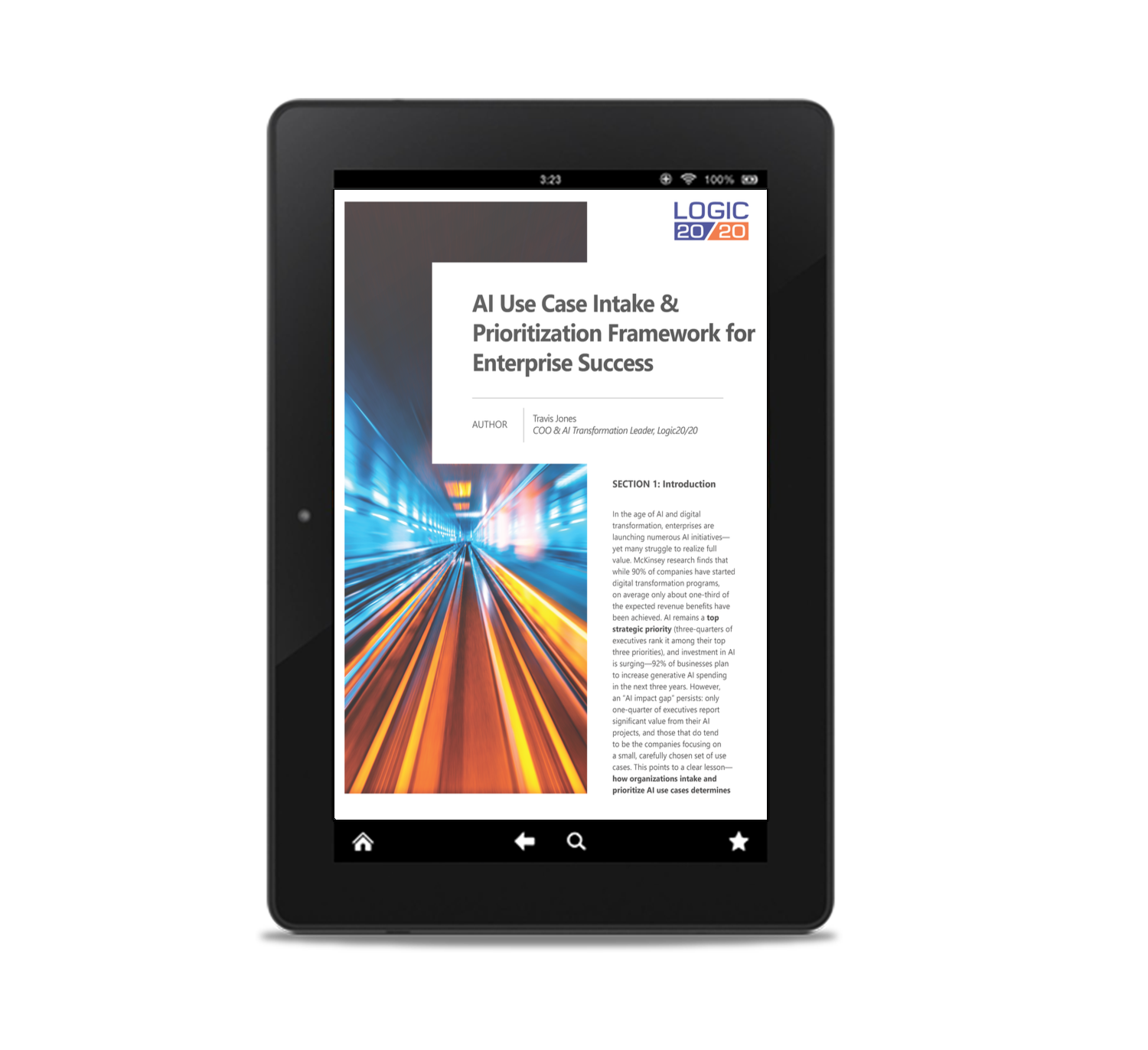
Discover a practical framework for transforming AI from a scattered set of pilot projects into a scalable portfolio of business drivers.
We will never sell your data. View our privacy policy here.
Building a repeatable model for AI delivery
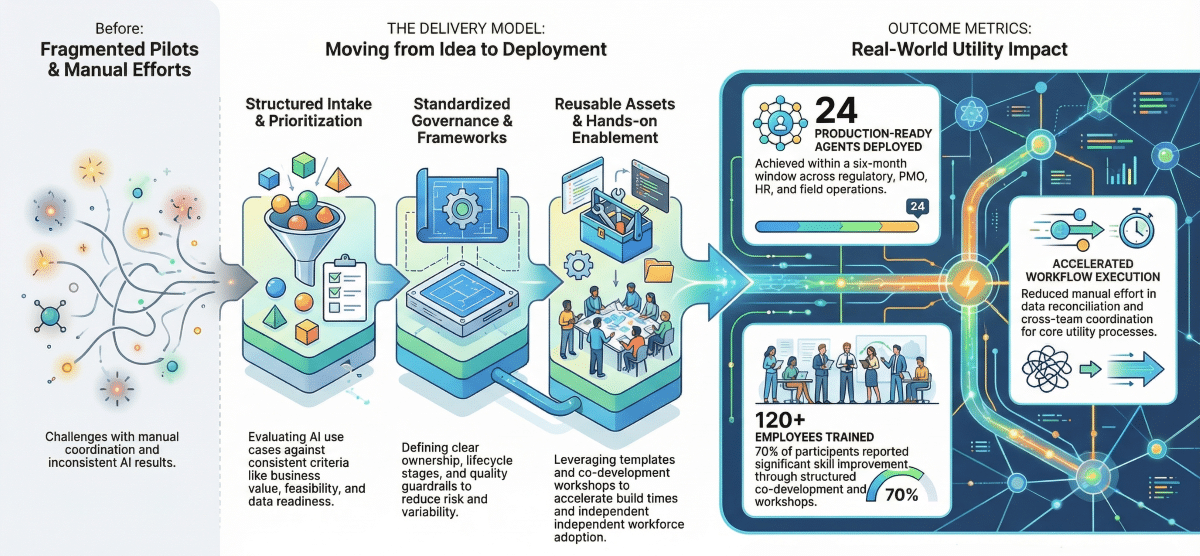
Logic20/20 worked with the utility to embed AI directly into high-impact workflows, focusing on reducing delays in data assembly, validation, and cross-team coordination.
We established a repeatable delivery model that aligned AI development with business execution.
Creating a clear path from idea to deployment
We designed a structured intake and prioritization process that evaluates AI use cases against consistent criteria, including business value, feasibility, data readiness, and scalability. This approach replaced manual, document-based intake with an AI-assisted workflow that captures requests, prioritizes them based on business value, and generates initial architecture and requirements before stakeholder review.
Standardizing development and governance
We defined how agents are built, reviewed, and deployed across the organization. The model includes ownership roles, lifecycle stages, and quality standards, along with governance guardrails to improve consistency and reduce risk as adoption scales.
Accelerating development with reusable assets
We delivered templates, architecture frameworks, design patterns, and reusable components that gave teams a practical starting point for building agents. These assets reduced the need to rebuild solutions from scratch and enabled faster, more consistent development across functions. The team also developed tools to support agent creation, including an agent that helps build other agents and a solution for generating adaptive cards—interactive prompts in tools like Microsoft Teams that help guide workflows and capture structured input.
Enabling adoption through hands-on delivery
We paired solution delivery with workforce enablement. Through workshops, build-a-thons, and co-development sessions, teams built agents within their own workflows. These sessions produced working solutions that teams continued to extend beyond the initial engagement. Ongoing support, including office hours and shared resources, reinforced adoption and helped teams continue development independently. A shared model for reusable components and cross-team visibility helped reduce duplicate development and accelerate delivery across business units.
Article continues below.
From isolated agents to coordinated, production-ready delivery
Within seven months, Logic20/20 built and deployed 60+ production-ready AI agents, while supporting the development of more than 20 additional agents across the organization.
Additional key outcomes include:
- Approximately 70,000+ hours unlocked through deployed AI agents
- Reduced manual effort in processes that require data reconciliation and cross-team coordination
- Accelerated execution across regulatory, PMO, HR, and field operations workflows
- Trained more than 120 employees in AI agent development and usage
- Achieved a 70 percent reported improvement in participant skill levels
- Expanded AI adoption across the organization, supported by increased Copilot licensing and active usage
- Build-a-thons and workshops produced agents that remain in active use and generated substantial additional time savings
- Increased the number of AI solutions delivered as teams built and extended agents within their own workflows
- Reduced rework and variability by establishing a more consistent path from idea to deployment
AI is now embedded within workflows where work previously slowed due to fragmented data and cross-team dependencies, allowing teams to move from idea to deployment with fewer delays. These improvements resulted in fewer compliance-related issues and a more consistent user experience across workflows.