

Executive summary: As capital programs grow, regulatory operations increasingly determine how efficiently organizations execute across an entire portfolio of projects. Organizations that modernize the operating model behind regulatory work can expand regulatory capacity, improve coordination, and support larger capital portfolios without proportional growth in manual effort.
5-minute read
Large capital programs rarely stall because engineering teams can’t design them or construction teams can’t build them. More often, progress slows when hundreds of regulatory activities spread across multiple projects begin competing for the same people, information, and time.
Many regulatory teams now manage capital portfolios using operating models that were designed for individual projects. When a design changes, a technical study shifts, an agency asks a question, or a project scope adjusts, work fans out across multiple contributors, review cycles, and documents. On a growing portfolio, it compounds fast.
Engineering, project controls, and construction management have had decades of operational attention. Regulatory operations have received far less attention, and that gap shows up directly in how predictably capital programs move.
In this article, we explore the operational shift behind this trend, examine the characteristics of regulatory operating models that scale effectively, and discuss practical approaches for modernizing regulatory operations across growing capital portfolios.
Table of contents (click to expand)

Modernizing compliance: a playbook for governing technology-driven risk
Learn how leading organizations are modernizing compliance practices to keep pace with evolving technology risk and regulatory expectations.
We will never sell your data. View our privacy policy here.
An inflection point for regulatory operations
Regulatory teams now support more projects, more contributors, and more interdependencies than their current approaches were designed to handle.
Design revisions, technical studies, agency questions, and internal reviews move through multiple projects at the same time. Each activity creates dependencies that ripple across workstreams. Regulatory teams must keep every project moving while maintaining consistency across the broader portfolio. Operating practices that worked well for discrete projects become harder to sustain as portfolios expand.
Additional funding can accelerate engineering and construction. Regulatory work does not scale as easily. Bringing in more specialists helps, but headcount alone doesn't fix manual coordination, fragmented information, or repeated work across projects.
Regulatory teams were built to support individual projects. Today they’re expected to support entire portfolios.

AI-native regulatory operations and the future of infrastructure permitting
Learn how AI-native regulatory operations help infrastructure organizations scale permitting execution while improving review readiness and regulatory consistency.
When coordination becomes the limiting factor
Throughout the life of a capital project, regulatory teams coordinate work across engineering, environmental, legal, land, and other disciplines. Every design revision, study update, agency request, or project change creates new work that must remain consistent across a growing body of technical information and regulatory documentation.
Many teams still manage those dependencies through spreadsheets, email, shared drives, meetings, and manual follow-up. Specialists spend time locating current information, assessing the impact of project changes, reconciling differences across documents, and tracking work across multiple review cycles.
Coordination becomes its own significant workload that grows with every additional project. Each new contributor adds reviews, handoffs, and dependencies that must remain aligned across the broader portfolio.
Ready to modernize regulatory operations?
Our regulatory operations and AI specialists can help you evaluate your current operating model, identify opportunities to reduce coordination effort, and build a roadmap for scaling regulatory execution across growing capital portfolios.
The coordination challenge behind every major capital project
Consider a major capital project entering regulatory review. Engineering identifies a design issue that requires a revision. The technical change may appear straightforward, but its effects extend well beyond the design itself:
- Environmental specialists update supporting studies.
- GIS data and maps are revised.
- Consultants revise technical analyses.
- Technical reviewers verify that related information remains consistent.
Every update must remain consistent across project documentation. A discrepancy in one document can trigger additional review, create avoidable rework, or delay subsequent regulatory milestones.
This sequence repeats throughout the life of a project. Regulatory teams manage the same coordination across an entire portfolio of projects, often with multiple review cycles underway at the same time. The details vary by industry, but the operational challenge remains remarkably consistent.
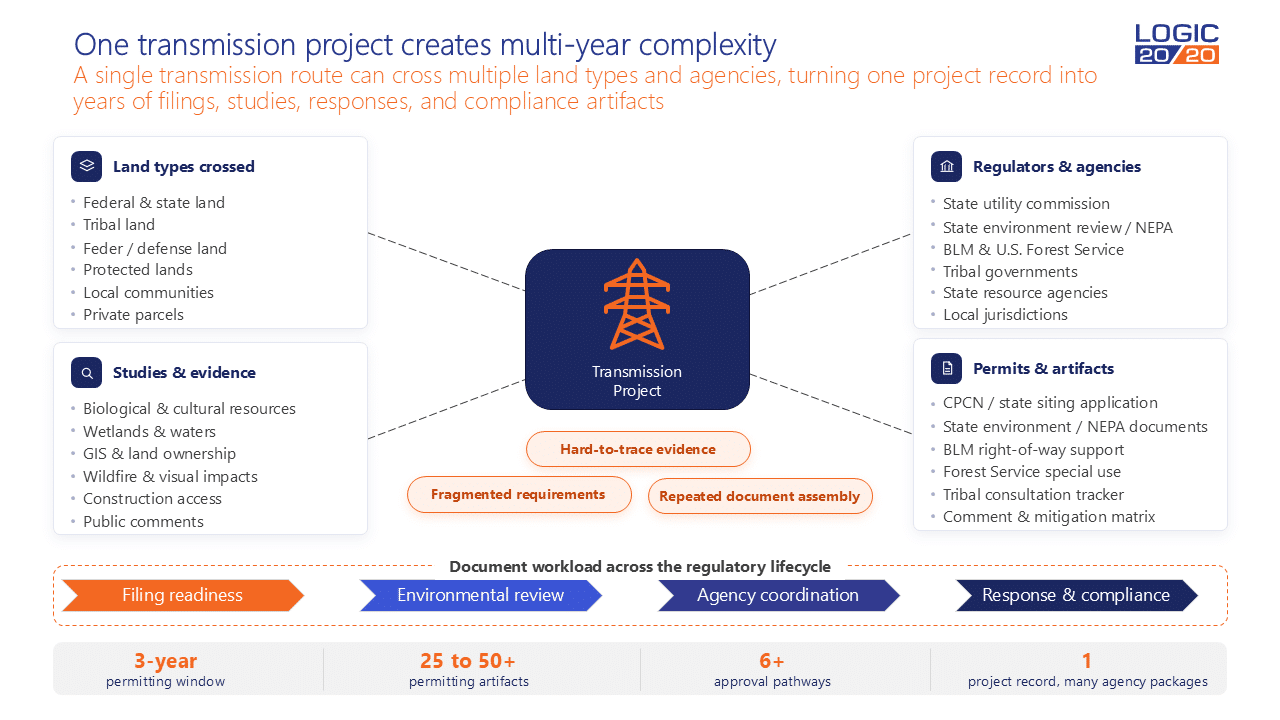
The following graphic illustrates a representative transmission project. Although industries and regulatory frameworks vary, large capital projects often create similar coordination challenges.
A closer look at the regulatory operating model
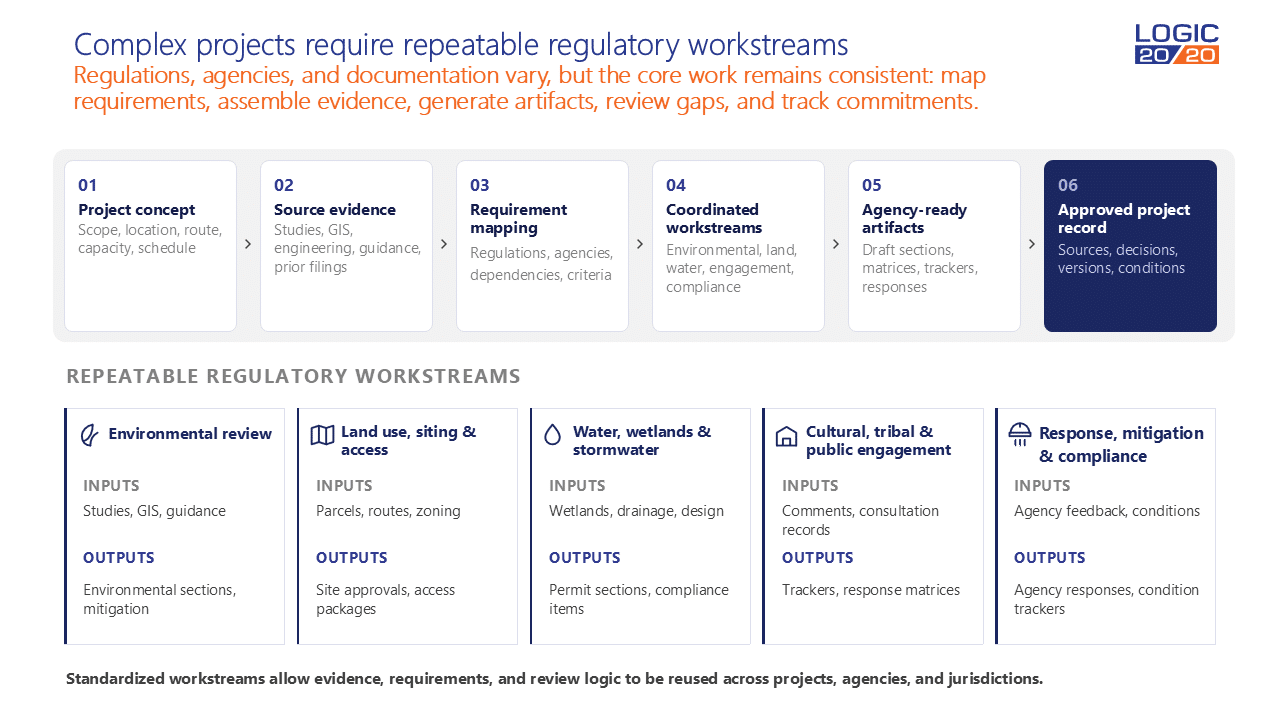
Expanding regulatory capacity demands an operating model that supports consistent execution across the portfolio. Organizations making this transition share several common traits:
- They standardize the regulatory work where consistency creates efficiency, without overriding what's specific to each project.
- They connect engineering, environmental, legal, land, GIS, consultants, and regulatory teams throughout the review process rather than passing information between them in handoffs.
- They give contributors a shared view of current project status, open items, and regulatory artifacts, so people aren't working from different versions of the same information.
- They surface dependencies, review progress, and emerging issues early, across the portfolio.
Workflow orchestration, automation, integrated information management, and AI provide the technical foundation for a scalable regulatory operating model. Combined with the right operating model, these technologies reduce manual coordination, strengthen consistency, and enable regulatory teams to support larger portfolios.

Compliance automation in practice: Insights from an evolving platform
Explore how structured workflows reduce manual coordination, improve visibility, and help regulatory teams manage growing compliance workloads.
A new operating environment for regulatory work
We developed the Regulatory Acceleration Platform to expand regulatory capacity across large capital portfolios. The design combines AI with governed workflows, connected enterprise data, verified organizational content, and human oversight to support consistent regulatory execution.
Core capabilities include:
- Generating regulatory narratives, technical documentation, and other regulatory artifacts using project data, engineering studies, environmental information, applicable regulations, historical filings, and approved organizational content
- Reviewing submissions against regulatory requirements, agency guidance, internal standards, and prior precedent to identify gaps, inconsistencies, and potential deficiencies before filing
- Coordinating drafting, research, review, refinement, approvals, and agency response workflows through configurable, human-governed orchestration rather than disconnected manual handoffs
- Connecting engineering systems, GIS, environmental datasets, enterprise applications, and regulatory knowledge libraries so teams work from current project information and approved source material
- Maintaining evidence traceability from every significant claim back to the supporting regulation, project document, engineering study, or historical filing, creating an auditable record throughout the review process
Teams using the platform work from a shared environment that keeps people, information, and workflows aligned throughout the regulatory lifecycle. Experienced specialists spend less time assembling and validating information. They spend more time applying technical judgment, responding to regulators, and moving projects forward.
Looking beyond today's capital programs
Engineering, construction, project controls, and supply chain management command executive attention because each one directly affects delivery of capital programs. Regulatory operations belongs in that same conversation.
Organizations that strengthen regulatory capabilities will be better prepared for the next generation of capital investment. Regulatory operations will increasingly distinguish organizations that translate ambitious capital strategies into delivered capital programs.
Expand regulatory capacity without expanding coordination effort
Whether you're modernizing regulatory processes, evaluating AI opportunities, or supporting larger capital programs, Logic20/20 can help you build the operating model and technology foundation for consistent regulatory execution at portfolio scale.
Learn more about regulatory operations

The next frontier of AI in regulatory reporting isn’t document generation
Learn how organizations are using AI to improve regulatory review, governance, and institutional knowledge beyond document drafting.

Building a framework for regulatory response readiness
Explore how a regulation-agnostic operating framework improves organizational readiness for evolving regulatory requirements.

Compliance automation in practice: Insights from an evolving platform
Learn how modern workflow automation improves visibility, coordination, and execution across complex compliance programs.

John Beerman is a Senior Manager in Logic20/20’s Digital Strategy & Transformation practice. He specializes in helping organizations modernize operations through AI strategy, digital transformation, and enterprise program management, with experience leading initiatives across highly regulated industries. John partners with clients to develop practical roadmaps that improve operational efficiency, strengthen decision-making, and prepare organizations to responsibly adopt emerging technologies.