

Executive summary: Utilities face increasing complexity and rising expectations for resilience and transparency, yet core operational systems still function in silos. The Common Information Model (CIM) offers a shared structure for representing network data, giving leaders a clearer, more actionable view of their operations.
5-minute read
The U.S. distribution grid is managing far more complexity than it was designed for. Distributed energy resources (DERs) continue to grow, and power now flows in multiple directions. From 2024 to 2025, utility-scale solar alone grew by 32 percent, while distributed solar increased by 15 percent. Meanwhile, wildfire exposure is rising and many assets are operating well past their intended life. Many leaders across the industry face rising operational risk and growing regulatory expectations around transparency, data quality, and grid resilience.
Across many systems, critical operational platforms maintain their own data structures and interpretations of the network. Over time, these differences create friction—slowing updates, complicating integrations, and obscuring a unified operational view. Against this backdrop, many utilities are taking a closer look at CIM.
Table of contents (click to expand)
The cost of systems that don’t speak the same language
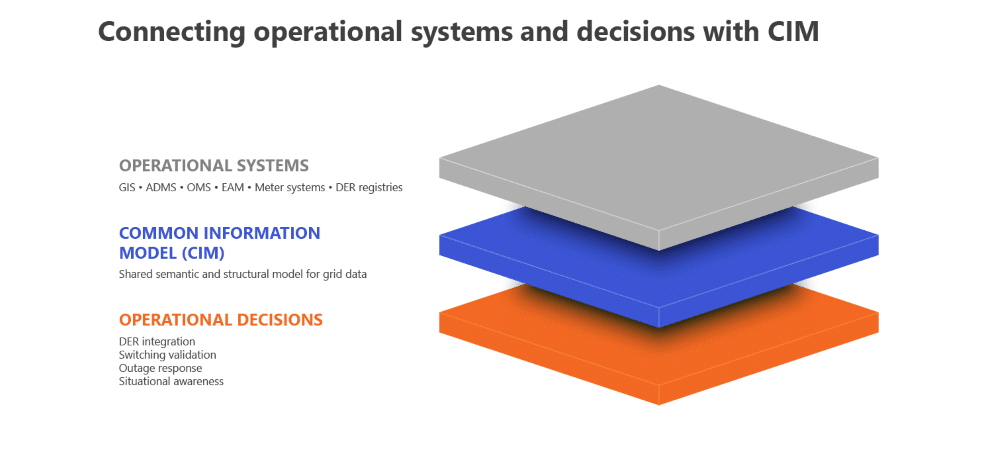
Most utilities already gather the data required to strengthen reliability and operational awareness. But much of this data is produced and stored by systems that were not designed to work together. Each platform—such as GIS, ADMS, outage management, meter systems, and DER registries—represents equipment and connectivity in different ways.
Frequent changes in field conditions make it difficult for platforms like GIS and ADMS to stay aligned. Switching activity, maintenance work, and device replacements can introduce discrepancies that slow operational workflows and reduce confidence in system outputs. When upstream data is inconsistent, even advanced platforms such as ADMS struggle to deliver their intended value, underscoring the need for a standardized model utilizing CIM.
This fragmentation appears in familiar operational gaps:
- GIS typically contains detailed as-built information about grid assets, but it is not designed to represent real-time connectivity.
- ADMS captures connectivity and switching states, yet it often lacks the attributes and field details maintained in GIS.
- EAMs typically contain as-built data but no connectivity or spatial information.
- In many cases, meter systems provide customer usage and status data but do not show how those customers connect within the physical network.
- DER registries record where devices have been approved or installed, although they usually do not reflect how those devices influence circuit conditions.
CIM creates a shared standard for representing grid assets and connectivity. With a shared structure in place, utilities spend far less time reconciling data and more time applying it.
For operations teams, the benefits translate directly into improved workflows:
- Faster and more reliable mapping of DERs to substations
- More reliable switching order validation
- Clearer outage triage
- Better-informed event response

Connected data supports scalable AI
The AI Playbook for Utility Leaders explores the governance, data foundations, and operating models that help utilities extend data interoperability investments into enterprise AI initiatives.
We will never sell your data. View our privacy policy here.
A common language for describing the grid
CIM gives utilities a shared semantic model for describing equipment, connectivity, and operational data, enabling consistent representations of assets and network relationships across systems.
It also defines the structural model that supports these representations, specifying consistent models for grid assets and connectivity across platforms. Utilities gain a shared foundation for interpreting and exchanging operational information.
The Common Information Model is not a database or a software platform. It functions as a blueprint layer that any tool can interpret, enabling data to move more freely among systems.
What international utilities can teach us about CIM in practice
While CIM adoption is still emerging in the United States, several international utilities offer clear examples of how a common data structure can improve grid visibility and customer transparency. In the U.K., distribution operators have used CIM to publish open network data, giving customers, developers, and third parties better visibility into available capacity and planned upgrades.
Across parts of Europe, some multi-utility providers have used CIM to support more advanced operational modeling. In these environments, CIM enables creation of digital twins that reflect how electric, gas, and telecom infrastructure interact, enabling more coordinated planning in shared corridors and complex urban settings. While few U.S. electric utilities operate across multiple domains, these projects show that CIM can scale to support large, multi-system environments when needed.
Lay the foundation for more connected grid operations
Logic20/20 helps utilities evaluate system interoperability, align operational data structures, and establish integration approaches that support scalable grid modernization initiatives over time.
Why operational leaders are taking a fresh look at CIM
Increasing demands on grid visibility
Operational demands are shifting quickly, and many utilities are finding that traditional data structures no longer keep pace. The rapid growth of DERs is intensifying the need for real-time visibility from the substation to behind the meter. Leaders need clearer insight into the impact of new devices on loading and reliability.
Heightened resilience expectations
In many utilities, wildfire management and broader resilience planning depend on integrated modeling. Utilities increasingly combine data from vegetation, weather, grid assets, and customer devices to understand evolving risks.
Growing interest in digital models
In many organizations, interest in digital twins continues to rise, and these models rely on accurate, connected representations of the network. CIM supports this need by defining consistent representations for assets and connectivity across systems.

Designing the roadmap to utility grid modernization
How a well-planned data science roadmap can enable utilities to achieve their grid modernization goals—and realize additional benefits along the way
A practical path to early progress
CIM adoption does not require a system overhaul. Utilities can begin within the systems they already rely on by introducing more consistent structures where they will have the greatest operational impact. A key early step is to identify priority use cases—often visibility gaps or recurring integration challenges—and determine where a shared data model could remove friction.
Teams can then map current data sources and pinpoint areas where inconsistent definitions slow down operational workflows. Even a small, well-chosen CIM-informed initiative can demonstrate value quickly. Examples include creating more consistent representations of feeder-level DER data or improving the alignment of information shared between GIS and ADMS.
The goal is steady progress toward higher data maturity, not a large-scale system replacement. By starting with targeted improvements, utilities can build momentum and create a foundation that supports more connected, data-driven operations over time.

Leveraging AMI data for future-ready infrastructure
By leveraging AMI data, utilities are uncovering new possibilities for enhancing efficiency, reliability, and customer service, marking a transformative shift in utility management and customer engagement.
Positioning for the next era of grid operations
As the grid evolves, the ability to connect information across systems will become as important as the data itself. CIM provides a practical foundation that enables utilities to use existing platforms more effectively. The most successful early adopters treat CIM as a way to prepare for expanding DER portfolios, rising resilience expectations, and more data-intensive operational models.
Small, targeted steps can reveal where a shared model adds measurable value and highlight areas where deeper alignment will pay dividends over time. These improvements help build a data environment that supports current priorities and the innovations shaping the grid’s future.
Connect systems across the modern grid
Logic20/20 helps utilities improve data consistency, support cross-platform interoperability, and create implementation approaches that align modernization efforts with long-term operational goals.
Learn more about utility data interoperability
Digital twin infrastructure for utilities: Why interoperability determines operational impact
How digital twin infrastructure helps utilities connect data across systems and apply digital twins to planning, operations, and investment decisions
4 essential DERMS use cases for a smarter, more resilient grid
Four powerful DERMS use cases that help utilities boost grid reliability, optimize energy distribution, and accelerate the clean energy transition

Webinar: Grid-edge DERMS for utility resilience and modernization
How grid-edge DERMS help utilities respond to regulatory shifts, integrate customer-owned assets, and coordinate DERs

Stephan Segraves is a Senior Manager in Logic20/20’s Grid Operations practice, where he advises utilities on modernizing operational platforms and data foundations to support a more complex, distributed grid. He brings more than a decade of experience leading mission-critical energy and utility solutions, spanning DERMS, EAM, outage management, network modeling, and large-scale systems integration. Known for translating complex operational challenges into practical, scalable solutions, Stephan works closely with utility leaders to strengthen reliability, visibility, and decision-making across grid operations.