

7-minute read
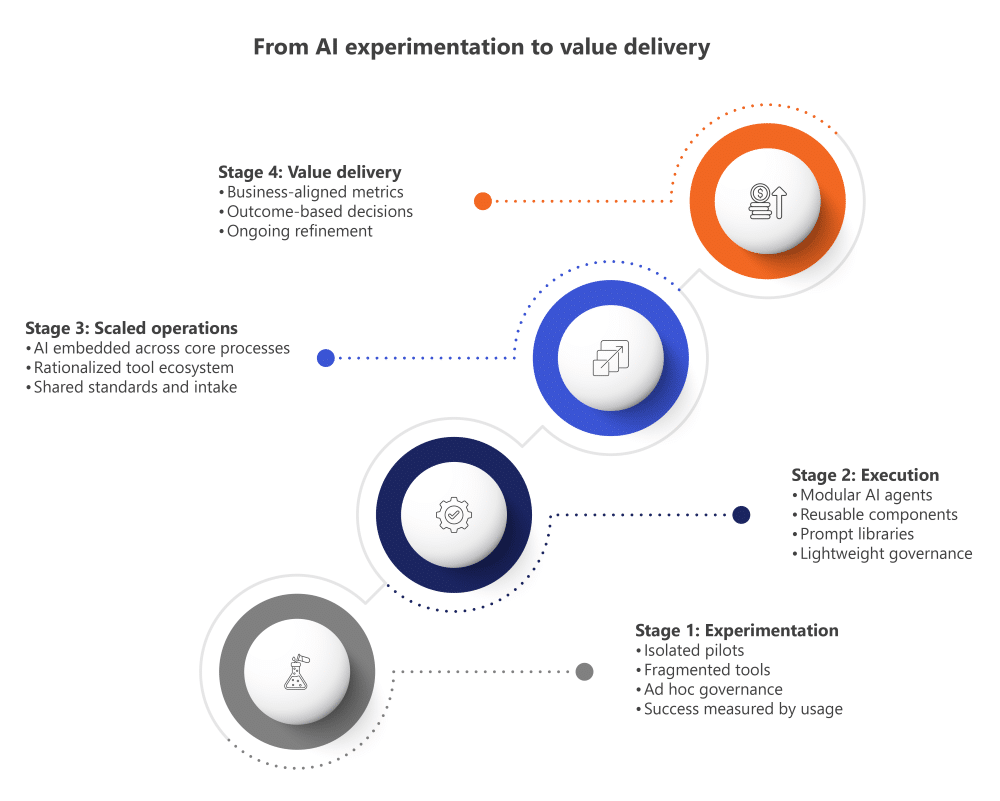
As organizations enter 2026, digital strategy is moving decisively from experimentation to execution, with AI driving changes across core workflows. Leaders are shifting away from isolated pilots and toward operating models that embed AI into core business processes and day-to-day decision-making. The focus is on the business areas where AI can deliver measurable outcomes, along with the organizational, governance, and talent changes required to scale.
Budget pressure is still shaping decisions, often surfacing in efforts to reduce tool sprawl or eliminate repeated work through shared approaches and reusable assets. Governance expectations are shifting toward models that support innovation, while compliance requirements continue to influence system design and daily practices.
The following trends reflect what we’re seeing across Logic20/20 engagements and in the broader market. Together, they highlight the trajectory of digital strategy in 2026 and the implications for organizations focused on practical, value-driven transformation.
Table of contents (click to expand)
- Trend #1: Modular AI agents reshape how business processes are designed and executed
- Trend #2: Reusable AI components become a strategic differentiator
- Trend #3: Enterprise prompt libraries evolve into next-generation knowledge management
- Trend #4: Governance evolves to accelerate AI adoption
- Trend #5: Organizations rationalize AI tools to combat “tool fatigue”
- Bonus trend: Leaders demand proof of value, not just activity
- Where digital strategy goes from here
Trend #1: Modular AI agents reshape how business processes are designed and executed
More organizations now favor modular, task-specific AI agents as they look for practical ways to automate work. Rather than leaning on large, multi-purpose “super agents,” teams are finding that smaller, single-purpose agents deliver more consistent results and are easier to maintain over time.
The modular pattern delivers several advantages:
- Narrowly scoped agents tend to avoid hallucinations and produce more reliable outputs.
- Orchestration enables clean handoffs between tasks, making it easier to connect components to perform more complex tasks without relying on a large, multi-function system.
- Incremental automation becomes easier because each agent can be updated independently, minimizing the risk of affecting the broader workflow.
CIM creates a shared standard for representing grid assets and connectivity. With a shared structure in place, utilities spend far less time reconciling data and more time applying it.
One of our utility clients is moving away from a single, monolithic automation tool and experimenting with smaller agents that each perform a defined task within its document-handling workflow. The team can adjust or retrain individual agents as requirements shift without pausing the full review and approval process.
Article continues below.
PLAYBOOK
We will never sell your data. View our privacy policy here.
Trend #2: Reusable AI components become a strategic differentiator
Reusable components are becoming essential as organizations look for faster, more scalable ways to deliver AI solutions. Rather than treating every AI agent or workflow as its own custom build, teams are shifting toward a model where core elements are shared across departments and use cases.
Organizations are investing in assets that speed development, such as:
- Reusable agent templates that provide a consistent starting point for new builds
- Shared building blocks that capture repeatable patterns used across the organization
- Standardized intake frameworks that streamline how teams evaluate, design, and prioritize opportunities
Focusing on reuse shortens delivery timelines by reducing how much net-new work each build requires. It also helps contain costs by cutting duplicate development efforts and improves consistency across teams by reinforcing shared standards and best practices.
Some teams are aiming for a design approach in which most of an agent draws from reusable components, with only modest tailoring for a specific user group or workflow. This model helps teams scale AI more quickly while keeping development focused and efficient.
Article continues below.
Trend #3: Enterprise prompt libraries evolve into next-generation knowledge management
AI output quality depends heavily on prompt design, which is driving enterprises to formalize prompt libraries: centralized repositories where vetted prompts are curated, tagged, and maintained. These libraries give employees reliable starting points, reducing the effort required to craft effective prompts and resulting in more consistent outputs and greater trust in the tools. Housing this knowledge in one governed location creates an enterprise asset that can scale across different teams and roles.
We’re seeing common elements emerge in these early libraries, including:
- Tagging and metadata that allow users to filter by persona, department, task type, or complexity
- Governance checks that ensure prompts follow organizational guidelines for quality, accuracy, and compliance
- Version control to ensure teams always have access to current, approved prompts
Another client is developing a prompt library that uses tagging and persona-based filters to help employees find prompts suited to their role or task. As the library takes shape, the team is identifying where multiple groups had been writing different versions of similar prompts, highlighting opportunities to reduce duplication and improve consistency across the organization.
In a 2025 survey, 57 percent of enterprise IT leaders said they began implementing AI agents within the past two years.
Among organizations with high AI maturity, 45 percent now keep their AI initiatives in production for at least three years—evidence that these solutions are moving past pilot mode and into long-term operating models.
Trend #4: Governance evolves to accelerate AI adoption
AI is becoming part of everyday work, prompting organizations to reconsider how governance should function. Teams are retiring heavy frameworks that create bottlenecks and implementing processes that make it easier to quickly assess opportunities, shape designs, and manage AI solutions throughout their lifecycles.
Elements such as standardized intake, readiness scoring, blueprinting, and lifecycle oversight are being refreshed to improve cross-team alignment and speed. These changes reflect a growing recognition that governance can accelerate AI adoption when it takes some of the guesswork out of how to develop safe, compliant solutions while also avoiding additional overhead for teams.
One of our clients is establishing a unified path for proposing, designing, and maintaining AI agents. The process brings intake scoring, design blueprinting, governance checks, and lifecycle guidance into a single workflow. Consolidating these steps gives teams clearer direction on an idea’s progression from concept to deployment.

AI use case intake and prioritization: A strategic framework for enterprise ROI
Discover a practical framework for transforming AI from a scattered set of pilot projects into a scalable portfolio of business drivers.
Trend #5: Organizations rationalize AI tools to combat “tool fatigue”
AI tools have proliferated across organizations, and many teams now juggle multiple tools without clear guidance on appropriate use cases. Pilots often launch independently and new features arrive faster than work processes can absorb them. The result is an overwhelming mix of options that slows adoption and dilutes the impact of enterprise AI investments.
Tool fatigue often stems from inconsistent adoption patterns and unclear expectations about each tool’s intended purpose. When teams choose tools based on personal preference rather than shared guidance, usage becomes fragmented and trust in outputs declines. Leaders are responding by consolidating their toolsets and clarifying the roles.
Organizations that rationalize their tool ecosystem are seeing improvements such as:
- Fewer redundant solutions across teams
- Clearer guidance on approved tools and expected use cases
- Reduced operational overhead from streamlined licensing and security reviews
- Better fit between the overall toolset and business goals
Many companies are now centering their AI capabilities on a small set of enterprise-supported tools while phasing out tools that add complexity without delivering meaningful value. This consolidation helps employees navigate AI with greater certainty and gives organizations a more stable platform for scaling AI.
Bonus trend: Leaders demand proof of value, not just activity
After several years of rapid experimentation, executives are shifting their focus from adoption metrics to clear business outcomes. In organizations that have piloted agents and deployed early workflows, leaders want visibility into areas where AI produces measurable value. The conversation has moved away from theoretical potential and toward the specific use cases that are showing real results.
The C-suite is looking for ROI evidence rather than conceptual success stories. Teams are beginning to assess agent performance with business-focused indicators—such as reductions in cycle time or manual effort—rather than usage statistics alone. Leaders also want clearer visibility into the business impact of agents and the durability of those gains over time.
Traditional adoption dashboards that highlight outputs only (e.g., usage or completion counts) are not enough to show business value. Organizations are introducing analytics that highlight bottom-line results. Performance dashboards surface these insights, helping end users trust the outputs and giving leaders a clearer perspective as they weigh investment decisions.

Scaling AI starts here: 5 foundations every enterprise needs
Five foundational focus areas that enable organizations to move beyond pilots and turn AI into a sustainable, enterprise-wide capability
Where digital strategy goes from here
The organizations poised to make real progress in 2026 will treat AI not as a collection of tools, but as a capability that reshapes the flow of work. Emerging patterns across industries tell a clear story: advantage is shifting from those who experiment fastest to those who invest with intention.
Executives who succeed in the coming year will focus on three priorities.
First, they will simplify, not by slowing innovation, but by cutting through unnecessary complexity. Rationalized tool ecosystems, curated prompts, and reusable assets reduce friction and help teams scale with less effort.
Second, they will build the foundations that make innovation sustainable. Governance frameworks, embedded compliance, performance measurement, and shared standards give organizations the confidence to deploy AI in high-value workflows and adapt it as conditions change.
Finally, they will focus on outcomes, not activity. Leaders are moving beyond usage metrics to understand areas of measurable AI impact. Those insights enable targeted reinvestment, faster iteration, and smarter allocation of talent and resources.
Bold leaders will shape 2026 by choosing discipline over hype. They will look past bigger models and flashier demos and focus on the systems and practices that turn AI’s potential into real advantage. Organizations that invest with purpose will set the pace for everyone else—while those that chase experimentation without direction will spend the year watching others pull ahead.
You might also be interested in …

Beyond the POC: The five control planes of enterprise AI
Practical guidance on intake, risk review, performance monitoring, and adoption for moving from AI prototypes to enterprise services with confidence

Operationalizing AI governance: Moving from principles to policies
Discover how to transform AI principles into actionable policies that drive innovation, ensure safety, and build trust through effective AI governance.

AI workforce enablement: The missing link in your AI strategy
How AI workforce enablement bridges the gap between technology and adoption, empowering teams to use AI at scale

Claim your competitive advantage
We create powerful custom tools, optimize packaged software, and provide trusted guidance to enable your teams and deliver business value that lasts.

Claire Raskob is a Manager in Logic20/20’s Strategy & Operations practice. Claire specializes in driving the successful development and adoption of new processes and technologies, with a strong focus on the human side of change. She has experience implementing large-scale projects that promote efficiency and lower compliance risk in complex regulatory environments.

Tom Cunnie is a Manager in Logic20/20’s Digital Strategy and Transformation practice, specializing in AI readiness, strategy, and governance. He leads initiatives that help enterprises move confidently from AI exploration to execution, with a focus on building the infrastructure, processes, and guardrails needed to scale responsibly. Tom has hands-on experience with generative AI platforms, including Copilot and ChatGPT, and is certified in SAFe Product Ownership, Scrum Mastery, and Databricks Generative AI Fundamentals. Drawing on a background in systems analysis, stakeholder management, and technical project leadership, he brings both business and technical acumen to designing practical AI strategies that deliver measurable value.