

Executive summary: DER integration is reshaping where and how the grid must operate, turning distribution into the new center of complexity and control. In this first article of a two-part series (see Part 2 here), we focus on DSO readiness for operational planning and coordination and why it begins with planning discipline, visibility, and constraint awareness. A phased, adoption-driven maturity model offers utilities a practical way to align strategy with system realities.
6-minute read
Nearly 2,300 gigawatts of generation and storage capacity are now waiting to connect to the grid, a bottleneck that signals utility operating models need to adapt.
Interconnection demand continues to surge, load patterns are becoming less predictable, and distributed energy resources are reshaping power flows in ways traditional planning models were never designed to handle. The result is a growing gap between how the grid is planned and how it now behaves.
In response, many utilities are exploring operating models that position them at the center of a high-DER future. Distribution System Operator (DSO) concepts have moved from theory into practical discussion, driven by the need for planning confidence, constraint visibility, and safer coordination in a DER-rich environment. This shift does not imply a single definition or fixed end state. It’s about understanding which capabilities matter first, and why.
In this article, the first in a two-part series, we focus on the initial steps in the DSO journey. We explore what DSO readiness means in practice, why it starts in planning rather than the control room, and how most organizations evolve through a maturity path that reflects real-world adoption patterns.
Redefining distribution operations: What DSO means in practice
Amid the growing complexity of the grid, utilities are expanding their role to that of system integrator. A DSO model reflects that evolution, enabling a utility to identify and address local constraints proactively, often by activating DERs as part of routine operations.
There is no single definition of Distribution System Operator. Instead, the model takes shape based on what a utility aims to achieve and the expectations it must meet, whether that involves integrating more non-wires solutions or improving reliability in a DER-rich environment. Often, the push for and design of the DSO model originates with regulators, as seen in the UK under Ofgem’s guidance.
In the United States, aggregators are already participating in wholesale markets, and the scale of committed-but-not-operating capacity (queue backlog) is growing: projects representing more than 400 gigawatts already have interconnection agreements but are not yet delivering power. At the same time, the median time from interconnection request to commercial operation now exceeds four years in many regions, highlighting the need for better distribution-level insight, planning, and coordination.
Against this backdrop, DSO models offer a structured approach to aligning planning, operations, and coordination with the realities of a DER-rich grid. The need is already evident in the widening gap between interconnection demand and operational readiness.
Article continues below.
White paper: Unlocking the ROI of AMI 2.0
A strategic approach to prioritizing use cases for maximum impact
We will never sell your data. View our privacy policy here.
Why DSO readiness starts before the control room
Conversations about DSO often start at the control room, but the foundation lies in planning. Traditional utility models often assume static conditions and long lead times, an approach that struggles to keep pace with increasingly variable net load, rapid DER growth, and shifting customer behaviors.
Compounding this challenge is the prevailing utility financial model, which favors capital investment because it expands the rate base. Transitioning to a DSO framework requires a shift in this mindset toward valuing flexibility, operational efficiency, and non-wires solutions alongside traditional infrastructure.
This dynamic exposes a growing gap between planning assumptions and real-world system needs. Without a clearer view of where constraints emerge and how flexibility can be deployed, utilities risk investing based on outdated assumptions and missing low-cost alternatives. A planning-led DSO strategy addresses this gap by aligning investment decisions with evolving grid dynamics rather than reacting after the fact.
An early indicator of this trend is the growing use of flexible interconnection as a bridge strategy. Some utilities are moving beyond worst‑case assumptions toward dynamic operating envelopes that reflect current grid conditions. This approach not only unlocks more capacity but also builds DSO-aligned capabilities in constraint management, DER coordination, and planning discipline.
Three planning questions set the tone for DSO readiness:
- Where are constraints likely to emerge first, and how should they shape hosting capacity forecasts and capital plans?
- What kinds of services or operational flexibility can DERs provide, and what governance or compensation approaches make participation viable at scale?
- What level of coordination is required at the transmission-distribution interface to avoid conflicting instructions and maintain reliability?
Answering these questions effectively doesn’t require a new market structure on day one. It requires treating planning and investment as active enablers of future operating models—not just as compliance exercises or long-cycle studies.

DERMS: Essential strategies for implementation
4 starting steps to help utilities ensure optimized integration of a distributed energy resource management system (DERMS) with their existing data platforms
A maturity path that reflects real utility adoption patterns
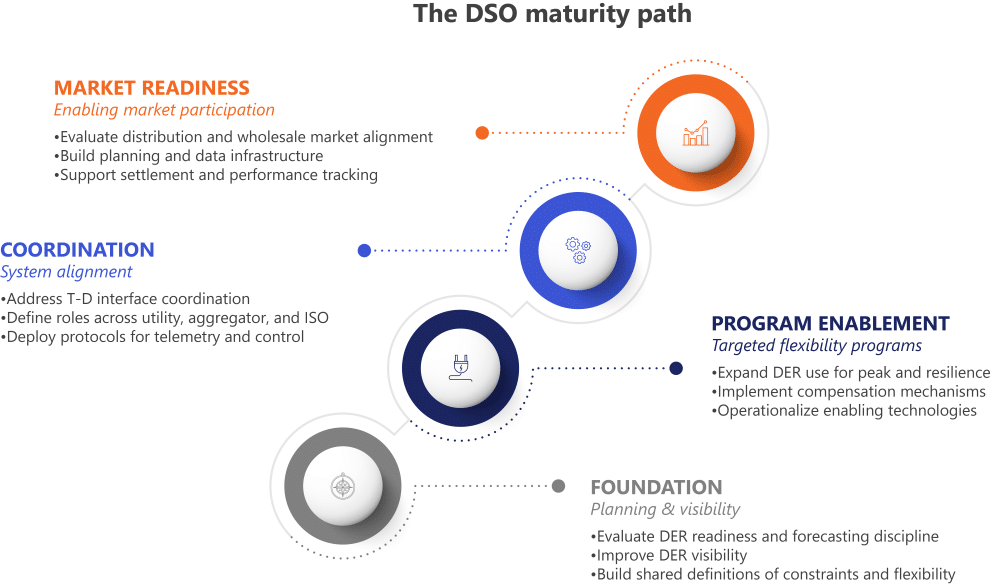
DSO readiness develops incrementally, shaped by each utility’s infrastructure, regulatory environment, and stakeholders. Most start by building the foundational capabilities needed to manage a DER-rich grid, long before engaging in formal market structures or taking on new operational roles.
Foundation stage: Planning discipline, visibility, and readiness assessment
Utilities begin by strengthening the core capabilities that support confident planning and early coordination:
- Assess readiness to support DER- and aggregator-enabled services, focusing on planning and forecasting discipline.
- Improve operational DER visibility to address hard-to-predict impacts on both distribution and transmission systems.
- Evaluate long-term DER growth scenarios to inform infrastructure investment and cost allocation strategies.
- Establish shared definitions of grid constraints, flexibility needs, and distribution services across planning and operations teams.
Program enablement stage: Using DER-provided services to meet local grid needs
With planning foundations in place, utilities can begin deploying targeted programs that deliver near-term value:
- Expand the use of DERs for peak reduction, for resilience, and as non-wires alternatives.
- Operationalize enabling technologies and processes (e.g., DERMS, AMI, DER gateways) that align with DER engagement goals.
- Implement fair and transparent compensation mechanisms through tariffs or program-based approaches.
- Test coordination practices that align DER contributions with both local and system-level objectives.
Coordination stage: Redefining roles and interfaces as DERs serve multiple purposes
As DERs take on dual roles in local and bulk systems, coordination requirements become more formalized:
- Address transmission-distribution (T-D) interface challenges common in high-DER environments, such as conflicting dispatch signals and data gaps.
- Clarify roles and responsibilities among utilities, system operators, aggregators, and DER providers.
- Deploy interfaces and protocols that support telemetry, dispatchability, and grid safety.
- Define operational coordination processes that respect jurisdictional boundaries and meet reliability standards.
Market-ready stage: Preparing for evolving distribution and wholesale interactions
Some utilities may advance to supporting market-based models, depending on their regulatory and operational context:
- Evaluate whether existing market structures support equitable DER participation for both distribution and wholesale services.
- Consider alternative models—consolidated, layered, or coordinated—based on policy direction and system needs.
- Build internal capabilities for planning, operations, and data exchange that support value signals, performance tracking, and settlement.
- Position market readiness as a progressive capability, not a prerequisite, building on previous investments in coordination and flexibility.
Article continues below.
Planning is the point of leverage
DSO readiness does not start with markets, control systems, or organizational charts. It begins with planning choices that reflect how the grid is actually changing. Utilities that build visibility, scenario awareness, and a shared understanding of constraints early are better positioned to respond as DER participation accelerates.
The maturity path outlined here shows that progress is incremental and purposefully sequenced. Each phase builds confidence and creates options for what comes next. By the time questions about coordination models or market structures arise, the groundwork is already in place.
The next phase of our discussion moves from planning foundations to execution. As utilities advance along the maturity path, questions of coordination, governance, and operational alignment move to the foreground, where DSO readiness begins to deliver tangible value.
Read Part 2, “Operationalizing DSO: Executing coordination at scale”
You might also be interested in …
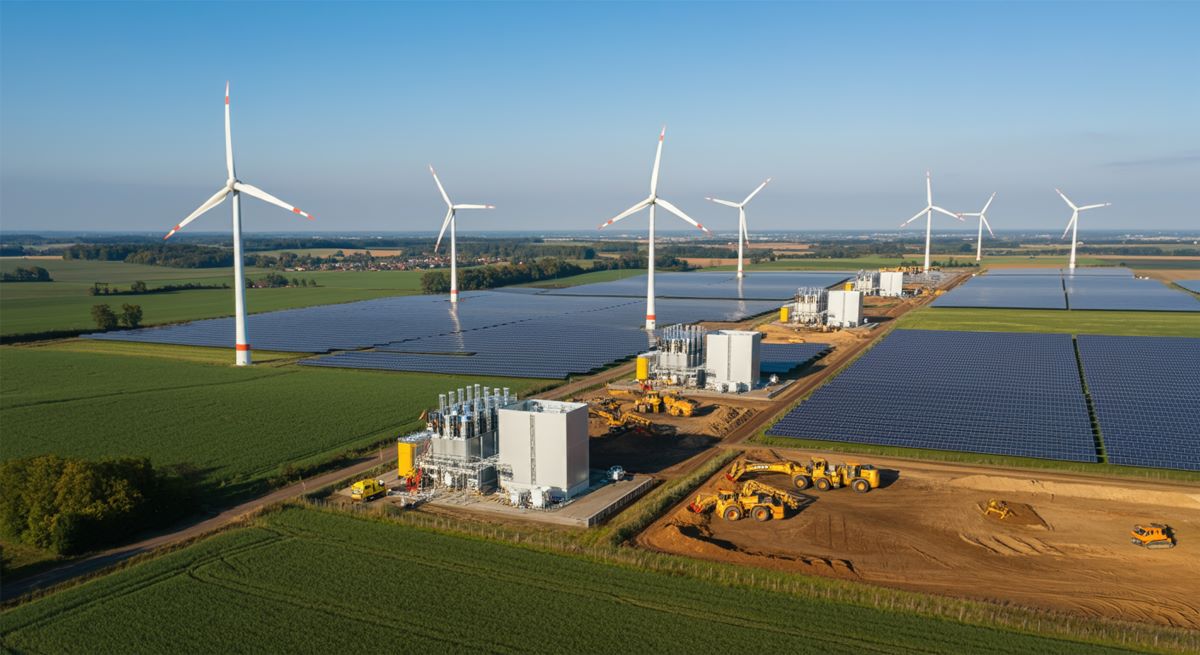
4 essential DERMS use cases for a smarter, more resilient grid
Four powerful DERMS use cases that help utilities boost grid reliability, optimize energy distribution, and accelerate the clean energy transition

AMI 2.0 and DERMS: A powerful combination
Learn how integrating AMI 2.0 with DERMS enhances grid visibility, voltage management, and operational control as utilities expand distributed energy resources.

Webinar: Grid-edge DERMS for utility resilience and modernization
How grid-edge DERMS help utilities respond to regulatory shifts, integrate customer-owned assets, and coordinate DERs

Powering a sustainable tomorrow
We partner with utilities to help them build a more resilient grid and move towards a cleaner, brighter future through
- AI-driven automation
- Asset image analytics
- DERMS implementation
- Analytics & predictive insights
- Cloud optimization