

5-minute read
In Part 1 of our series on the Common Information Model (CIM), we explored what CIM is and why U.S. utilities are taking a closer look at it. We also looked at how a shared semantic and structural model reduces fragmentation across operational systems, creating a stronger foundation for grid data. For operations leaders evaluating modernization initiatives, the more urgent question now is where that foundation produces measurable results.
CIM’s value surfaces when new platforms and modeling initiatives collide with existing data realities. DER growth is accelerating. Resilience requirements continue to expand, and utilities are investing in systems designed to improve visibility and control. Yet implementation timelines often lengthen as teams reconcile inconsistent representations of assets and connectivity across GIS, meter systems, and asset repositories. Structural misalignment turns into a direct constraint on modernization.
Two CIM use cases illustrate where the model delivers operational value. Utilities implementing distributed energy resource management systems (DERMS) frequently encounter integration complexity that slows time-to-value. Growing interest in advanced operational modeling and digital twins depends on consistent network representation across systems. In both contexts, CIM directly affects how quickly technology investments translate into operational capability.
Table of contents (click to expand)
Use case 1: Accelerating DERMS time-to-value
DERMS programs often stall when underlying data structures are inconsistent. Operational systems frequently represent assets and connectivity differently. Common sources of misalignment include:
- Equipment and connectivity modeled differently across GIS, meter systems, customer platforms, and asset repositories
- Transformer-meter relationships maintained in multiple systems with conflicting definitions
- Connectivity logic embedded in one platform that does not match representations used elsewhere
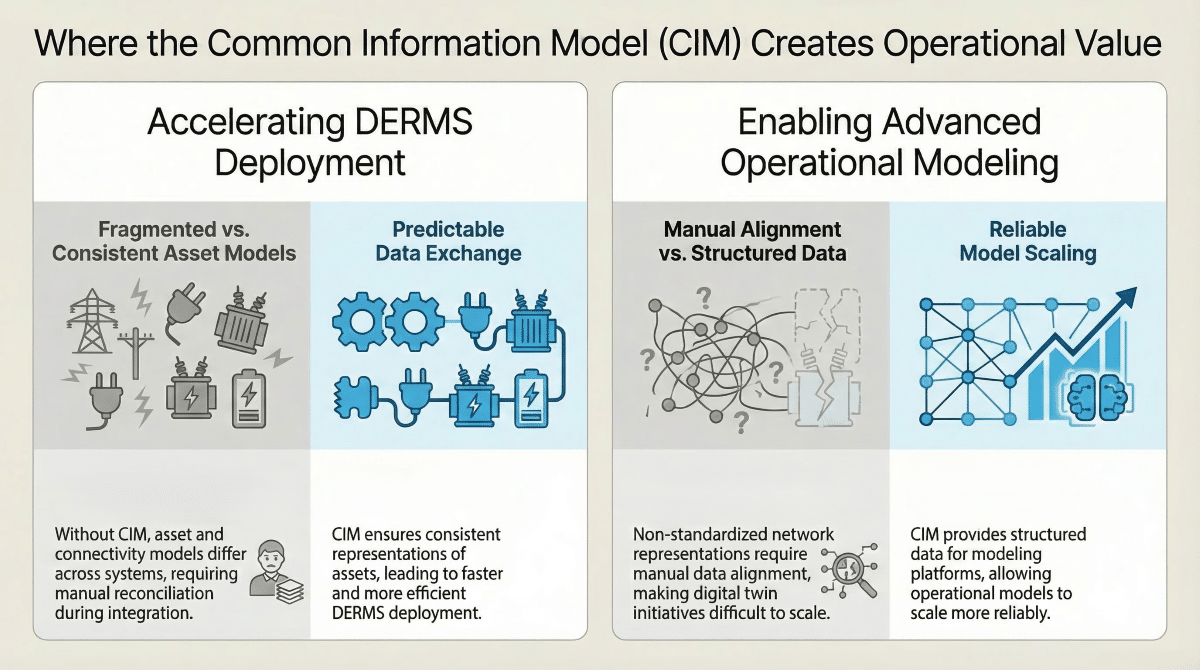
During integration and testing, these differences surface and require reconciliation before DERMS can operate reliably.
Integration effort is commonly underestimated at program outset. Teams often assume existing data can be exchanged directly. In practice, implementation teams encounter a familiar progression:
- Initial integrations expose mismatched asset and connectivity models
- Extensive mapping and correction are required to produce a consistent network model
- Additional testing cycles emerge as teams reconcile those definitions across systems
Testing timelines extend, and implementation milestones move accordingly.
CIM introduces consistent representations of assets and connectivity before data is exchanged with DERMS. When upstream systems align to a shared structural model, relationships between meters, transformers, and distributed resources are defined once and interpreted consistently. Data exchange becomes more predictable. Integration work centers on aligning models rather than repeatedly translating between them. Existing platforms remain in place, but their outputs conform to a common representation.
When alignment is established early, integration revisions and downstream rework are reduced. Deployment timelines stabilize, and DERMS functionality can be introduced without repeated pauses to correct upstream data structures.
Article continues below.
White paper: Unlocking the ROI of AMI 2.0
A strategic approach to prioritizing use cases for maximum impact
We will never sell your data. View our privacy policy here.
Use case 2: Enabling advanced operational modeling
Utilities are exploring digital twins to represent circuits, feeders, or broader network segments with greater fidelity. In more complex environments, modeling efforts extend beyond electric infrastructure to account for interactions across multiple domains.
Structural challenges in modeling environments
These initiatives depend on a consistent representation of the network. Modeling environments often draw from the same systems that support operations, including GIS and asset repositories. Inconsistent or incomplete connectivity data forces additional reconciliation before model outputs can be trusted. Teams may find themselves manually aligning modeling inputs with operational data sources, introducing additional effort and limiting scalability. Pilot environments can demonstrate value, but expansion across larger portions of the network becomes more difficult when structural inconsistencies persist.
Where CIM provides a foundation
CIM provides a stable foundation for these efforts by defining consistent representations of assets and connectivity across systems. Modeling platforms that ingest data structured according to a shared model require far less manual alignment. Network relationships are interpreted consistently across operational monitoring, planning analysis, and simulation environments. As modeling scope expands, that structural consistency supports more reliable scaling across systems and geographies.
As analytics capabilities mature, the quality of underlying network relationships becomes increasingly important. Advanced applications, including AI-driven analysis, depend on accurate and consistent structural data. CIM establishes the structural integrity that allows advanced analytics and AI applications to operate reliably at scale.
Article continues below.
The real modernization decision: Structure before software
Utilities rarely struggle because they lack technology. More often, modernization slows when new platforms expose legacy assumptions embedded in existing data structures.
DERMS platforms, digital twins, and advanced analytics promise improved visibility and control. Yet the speed at which those promises translate into operational capability hinges on structural alignment, not just software selection. When asset relationships and connectivity models vary across systems, modernization requires repeated reconciliation and ongoing monitoring to maintain alignment. Structural alignment reduces that friction across initiatives.
The Common Information Model shifts the modernization conversation from tool adoption to data discipline. It transforms integration from a downstream task to an architectural decision made early in the lifecycle of an initiative. Utilities that treat structural consistency as core infrastructure, rather than as a technical afterthought, position themselves to move faster with each subsequent investment.
Consistent structural models affect more than a single implementation. With aligned data structures in place, utilities can:
- Scale DER programs more predictably
- Expand modeling environments with less rework
- Introduce advanced analytics without rebuilding core relationships
Over time, structural alignment through CIM reduces the effort required to introduce each successive initiative.
You might also be interested in …

What CIM means for U.S. utilities
How CIM offers a shared structure for representing network data, giving leaders a clearer, more actionable view of their operations
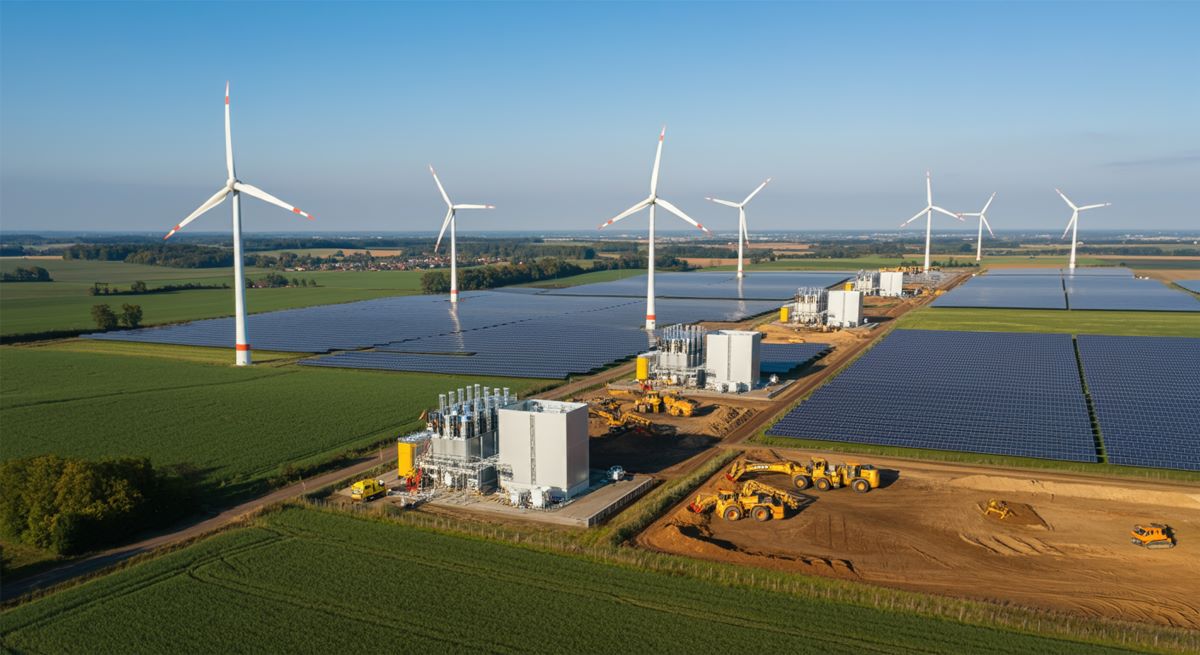
4 essential DERMS use cases for a smarter, more resilient grid
Four powerful DERMS use cases that help utilities boost grid reliability, optimize energy distribution, and accelerate the clean energy transition

AMI 2.0 and DERMS: A powerful combination
Learn how integrating AMI 2.0 with DERMS enhances grid visibility, voltage management, and operational control as utilities expand distributed energy resources.

Powering a sustainable tomorrow
We partner with utilities to help them build a more resilient grid and move towards a cleaner, brighter future through
- AI-driven automation
- Asset image analytics
- DERMS implementation
- Analytics & predictive insights
- Cloud optimization