

Executive summary: AI is compressing operational timelines, but regulatory timelines continue to unfold over years. Utilities that design AI initiatives for both clocks are better positioned to scale innovation while supporting governance, cost recovery, and long-term regulatory readiness.
7-minute read
A utility planning team uses an AI-powered interconnection study tool that compresses six weeks of analysis into minutes. The investments supported by that analysis, however, may not receive regulatory approval for years as they move through the rate case process.
AI is compressing operational timelines while regulatory timelines remain largely unchanged. That divergence has become one of the defining strategic challenges facing utility leaders. As planning, engineering, and field operations accelerate, regulatory approval, cost recovery, and the governance required to support them continue to unfold over years rather than months.
Many utilities discover this tension only after an AI pilot demonstrates measurable value. Operational results arrive quickly, while the governance and supporting evidence needed to sustain those gains take much longer to develop. What begins as a technology initiative often becomes an operating model challenge.
Organizations making the most durable progress treat operational performance and regulatory readiness as complementary design requirements. They build AI initiatives with both objectives in mind from the beginning rather than treating regulatory support as a downstream activity.
Connected data supports scalable AI
The AI Playbook for Utility Leaders examines how utilities are approaching governance, operational coordination, data strategy, and enterprise execution to support scalable AI adoption across critical infrastructure operations.
We will never sell your data. View our privacy policy here.
The two clocks
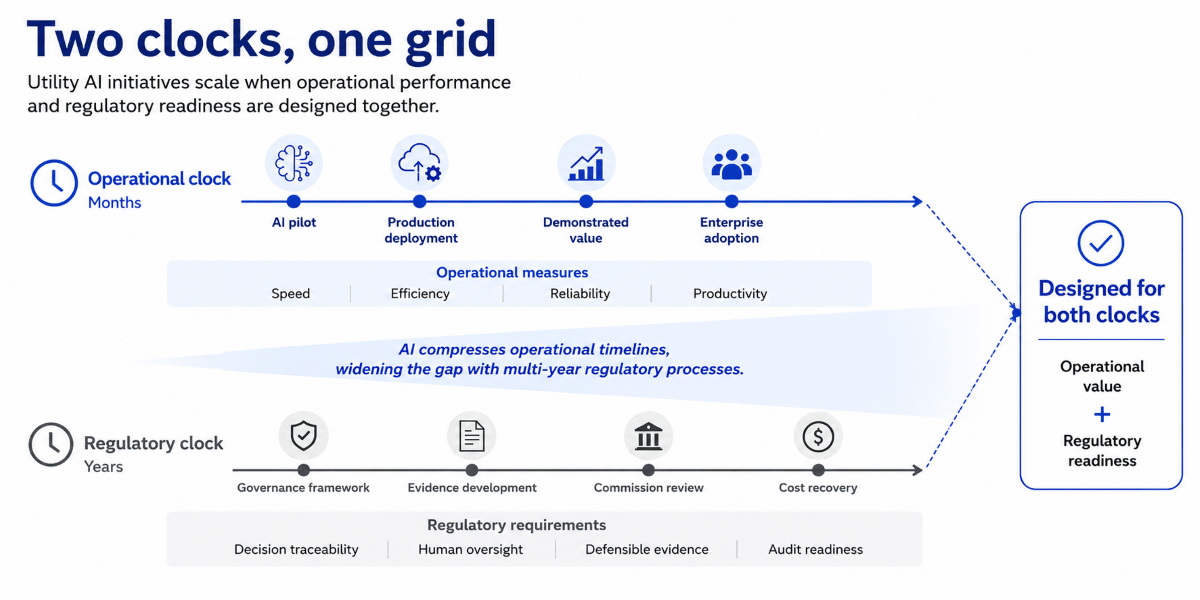
Every utility AI initiative operates within two distinct timelines.
The operational clock
Most utility AI initiatives are calibrated to the operational clock. Vendor selection happens in months. Pilots launch within a quarter. Production deployments follow in 12 to 18 months. Progress is measured in familiar operational metrics: interconnection studies completed faster, vegetation inspections performed more efficiently, outage response accelerated, and demand-response programs optimized.
The regulatory clock
The same initiative is evaluated differently under the regulatory clock. Regulators evaluate whether model decisions are traceable, training data appropriate, human oversight documented, methodologies defensible during commission review, and investments eligible for cost recovery.
Both clocks are essential because they define different dimensions of value. Operational performance creates business value, while regulatory readiness determines whether that value can withstand commission review and ultimately scale across the enterprise.
For years, utilities could tolerate some separation between the two because operational change occurred at roughly the same pace as regulatory oversight. AI has accelerated operational change far beyond the pace of regulatory adaptation, creating a widening divergence between the two. That divergence is the two-clock problem.
Where the gap becomes visible
Utilities encounter three recurring challenges as AI initiatives move from pilot to enterprise deployment.
1. AI deployment is outpacing governance
Generative AI and machine learning capabilities are reaching production environments faster than many governance processes were designed to accommodate. Risk management, model documentation, audit practices, and review procedures often lag implementation, leaving teams to retrofit governance after operational value has already been demonstrated. Scaling often requires substantially more documentation, oversight, and cross-functional coordination than anticipated.
2. Business cases are evolving faster than regulatory processes
AI is changing the economics of utility investment as well as utility operations. Internally, AI can reduce manual effort, improve planning accuracy, and accelerate engineering workflows. Externally, AI-driven electricity demand is contributing to an unprecedented utility investment cycle, with roughly $1.4 trillion in capital expenditures planned over the next five years. Yet demonstrating the value of those investments within regulatory proceedings follows a much longer timeline.
As AI becomes embedded in planning and operations, utilities increasingly need evidence that supports investment decisions, cost recovery, and long-term accountability. Building that evidence after deployment is considerably more difficult than incorporating it into the program from the outset.
3. Enterprise adoption depends on organizational alignment
Many AI initiatives begin within individual business functions because local teams can demonstrate measurable value quickly. Enterprise adoption, however, depends on broader coordination across technology, regulatory affairs, finance, legal, cybersecurity, and operational leadership.
Without that alignment, organizations often accumulate isolated AI capabilities that improve individual workflows but remain difficult to scale consistently across the enterprise.
Build AI initiatives that scale
We help utilities design AI operating models that support both operational performance and regulatory readiness.
The wrong question
When AI initiatives stall, organizations often look first at the technology: model accuracy, user adoption, or implementation.
Those questions matter, but they rarely explain why an otherwise valuable capability struggles to move beyond a successful pilot.
More often, the obstacle lies in the operating model. As AI becomes embedded in planning, engineering, customer operations, and regulatory workflows, utilities need repeatable processes for governance, documentation, model oversight, and evidence management. Without those capabilities, operational improvements become difficult to defend, scale, and sustain.
This distinction explains why two organizations can deploy similar AI capabilities yet achieve very different outcomes. Both may deliver comparable pilot results, but the organization that develops governance, evidence, and operational capabilities alongside the technology is better positioned to scale AI across the enterprise.
The difference is treating regulatory readiness as part of the implementation rather than work that follows it.
Designing for both clocks
Designing for both clocks does not mean slowing operational progress to match regulatory timelines. It means building AI initiatives that enable governance, documentation, and regulatory evidence to develop alongside operational capabilities.
Governance evolves with the solution
Governance works best when it is part of the implementation rather than a review conducted after deployment. Documentation standards, model oversight, decision traceability, and human review processes are established early and mature alongside the AI capability.
This approach reduces rework while giving regulatory, legal, and operational stakeholders greater confidence in the decisions the system supports.
Evidence is managed continuously
Every AI initiative generates evidence: model documentation, testing results, assumptions, approvals, performance metrics, and operational outcomes. Organizations that manage this information intentionally are better prepared to support regulatory filings, respond to commission questions, and demonstrate how AI contributes to measurable business outcomes.
Instead of assembling that evidence at the end of a project, they capture it throughout the implementation lifecycle.
Cross-functional ownership replaces functional handoffs
Enterprise AI initiatives rarely belong to a single department. Engineering, operations, regulatory affairs, finance, cybersecurity, legal, and technology all contribute to long-term adoption.
Organizations that design for both clocks establish shared accountability early, allowing governance, implementation, and regulatory planning to progress together instead of moving sequentially from one team to another.
Technology supports the operating model
Technology remains an essential enabler, but it delivers the greatest value when it reinforces disciplined operating practices. Platforms that centralize documentation, improve traceability, and connect operational data with regulatory processes help reduce the friction between the operational and regulatory timelines.
The goal is not simply to deploy AI faster. It is to build capabilities that utilities can govern, defend, and expand over time.

Build AI governance into every implementation
Explore how responsible AI governance, model oversight, and documentation practices help utilities deploy AI with confidence in regulated environments.
Reducing regulatory friction
Utilities cannot compress the timelines associated with rate cases, commission review, or regulatory approval. They can, however, reduce the effort required to support those processes.
Many regulatory activities depend on information that already exists across planning, engineering, finance, and operations. The problem is rarely a lack of data. More often, the information is dispersed across teams, applications, and documentation repositories, making it difficult to assemble a complete and defensible record when it is needed.
This gap is where regulatory operations capabilities become valuable. Rather than treating regulatory support as a periodic reporting exercise, leading organizations are creating repeatable processes that connect operational activities with the evidence required for regulatory review.
Logic20/20 developed the Regulatory Acceleration Platform around this operating model. The platform helps utilities organize documentation, improve traceability, and connect operational work with the information needed for regulatory filings and commission inquiries. Instead of recreating evidence for each proceeding, organizations can build and maintain it as part of day-to-day operations.
Within the two-clock framework, the platform is not intended to make the regulatory clock move faster. Its value comes from reducing the operational burden of working within regulatory timelines while strengthening the connection between operational decisions and regulatory evidence.
Organizations that design for both clocks do not wait until a rate case begins before they assemble documentation and justify AI-enabled investments. They build those capabilities continuously, making regulatory readiness part of day-to-day operations rather than work that begins when a filing is due.

AI-native regulatory operations and the future of infrastructure permitting
Learn how AI-native regulatory operations help infrastructure organizations scale permitting execution while improving review readiness and regulatory consistency.
The implications for utility leaders
The gap between operational and regulatory timelines is unlikely to narrow on its own.
At the same time, regulatory expectations surrounding transparency, governance, accountability, and cost recovery will continue to evolve. Utilities will need to demonstrate not only that AI improves operational performance, but also that decisions are explainable, investments are appropriately governed, and business outcomes can be supported throughout the regulatory process.
As a result, long-term AI adoption will depend on more than identifying promising use cases. Organizations will also need operating models that allow innovation, governance, and regulatory readiness to evolve together. Utilities that establish those capabilities early will be better positioned to expand AI initiatives as regulatory expectations evolve.
A different design discipline
AI is changing more than the speed of utility operations. It is changing the discipline required to design, implement, and scale new capabilities within a regulated industry.
For years, utilities could evaluate new technologies primarily through operational performance. As AI becomes embedded in core business processes, organizations also need to treat governance, documentation, traceability, and regulatory readiness as part of solution design.
The two clocks are not competing forces. Together, they define the environment in which utility AI must operate. Organizations that recognize both timelines early can make implementation, governance, and regulatory planning part of the same conversation rather than separate phases of a project.
Utilities have always operated within regulatory constraints. AI hasn't changed that reality; it has changed the pace of innovation around it. Organizations that design for both clocks will be better positioned to scale AI while maintaining the governance and regulatory support needed for long-term adoption.
Ready to design AI beyond the pilot?
Our utility AI specialists can help you build the governance and operating model needed to scale AI across the enterprise.
Learn more about AI in utilities

AI-native regulatory operations and the future of infrastructure permitting
Discover how AI-native regulatory operations help infrastructure organizations improve permitting execution, regulatory consistency, and review readiness.

Utilities don't need more AI use cases—they need a better starting point
Learn why successful utility AI programs begin with enterprise priorities and operating models rather than isolated use cases.

The IT/OT PMO: Governance as the catalyst for utility modernization
See how governance enables utilities to scale modernization initiatives while improving coordination, accountability, and long-term execution.

Ryan Einbender is a Senior Manager in Logic20/20's Digital Strategy & Transformation practice, where he helps organizations develop and scale enterprise AI capabilities that align technology investments with business strategy and governance. Before joining Logic20/20, Ryan led global AI, product, and digital transformation initiatives at PwC and Deloitte, overseeing large-scale Generative AI programs, enterprise technology platforms, and analytics solutions that supported thousands of users worldwide. His experience spans AI strategy, product management, enterprise transformation, and change management, with a focus on helping organizations translate emerging technologies into measurable business outcomes.