

Executive summary: Utilities generate large volumes of inspection imagery, but most cannot use it effectively in planning and asset management. Linking images to assets and enabling access through image viewer applications makes visual data usable in day-to-day decision-making.
6-minute read
“The electric industry sector is facing an ‘explosion’ of data from a variety of sources. … For the electricity sector to fully utilize these vast new datasets, it must undergo a transformation in how it manages data quality, storage, and processing.”
National Renewable Energy Laboratory (NREL)
Most utilities have no shortage of asset images. The challenge is using them in day-to-day decisions.
Drone programs are now routine. LiDAR scans cover entire corridors. Satellite imagery fills in gaps, and field crews upload photos from mobile devices. For a single asset, teams often have multiple sets of images, captured at different times, from different perspectives, and stored in different places.
As imagery volume increases, utilities expect clearer visibility into asset condition and stronger support for maintenance planning.
Engineers and planners know the images exist, but assembling them for a single decision often requires locating files across systems, confirming the most recent inspection, and reconciling different views of the same asset.
As a result, utilities are focusing on organizing imagery and making it usable across the organization. Image viewer applications deliver the ability to search, navigate, and apply imagery within day-to-day workflows, supporting faster planning cycles and more effective allocation of maintenance resources.
Table of contents (click to expand)
Where image-based inspection programs break down
In some cases, utilities do not have image data at all. In others, capture methods do not produce consistent coverage or comparable views, limiting downstream use.
Inconsistent capture introduces gaps at the point of collection. Image sets vary in angle, resolution, and completeness across drones, LiDAR, satellite, and field capture. Required views are often missing, and repeat inspections do not always produce comparable views over time. Standard shot guidance is uneven or absent. The result is an incomplete view of assets, limiting manual inspection effectiveness and creating inconsistent inputs for analytics and model development.
Unstructured data limits comparability. Names of assets, components, and defects follow different conventions across functions and tools, with uneven alignment to asset registries and underlying data models. Comparing conditions across inspections or aggregating results becomes difficult, and image reuse across functions remains limited.
Fragmented storage slows retrieval. Imagery sits across local hard drives, cloud storage, and vendor platforms, often without a consistent link to asset records. Different image types and data sources are often owned by separate functions. Without consistent standards across systems and functions, utilities cannot fully use that data or capture its full value. In many cases, images remain isolated within team-level or individual repositories. Engineers and planners spend time locating and validating images, and the same files are pulled and reviewed multiple times.
Limited access restricts broader use. Engineering, planning, and asset management often rely on summaries or manual handoffs instead of working directly with the images. Context can be lost or reinterpreted through handoffs, and decisions are made based on secondhand information.
These constraints extend beyond inspection workflows and limit broader application of imagery.

How image analytics is reshaping inspections, reliability, and asset visibility
Utilities are using image data from drones, satellites, and LiDAR to expand inspection coverage and prioritize decisions with consistent visual data. Our experts outline strategies for structuring and deploying these capabilities across the enterprise.
We will never sell your data. View our privacy policy here.
Making imagery usable across the organization
Utilities are expanding the use of imagery beyond inspection workflows, with increased focus on image viewer applications that allow users to interact directly with asset images. Engineering, asset management, and planning functions can rely on visual data to support design validation, condition assessment, and maintenance planning.
That broader use requires consolidation of images into a centralized repository, bringing together data from multiple sources and aligning it with asset records to create a unified view of each asset. Access shifts from file-based retrieval to asset-based navigation. Users search by asset, location, and time, and review current and historical imagery in context.
Centralized storage and asset-based access enable imagery use in operational and planning decisions across the organization. In many cases, the image viewer application serves as the entry point for broader image analytics programs, providing a tangible interface before introducing advanced analytics or machine learning.
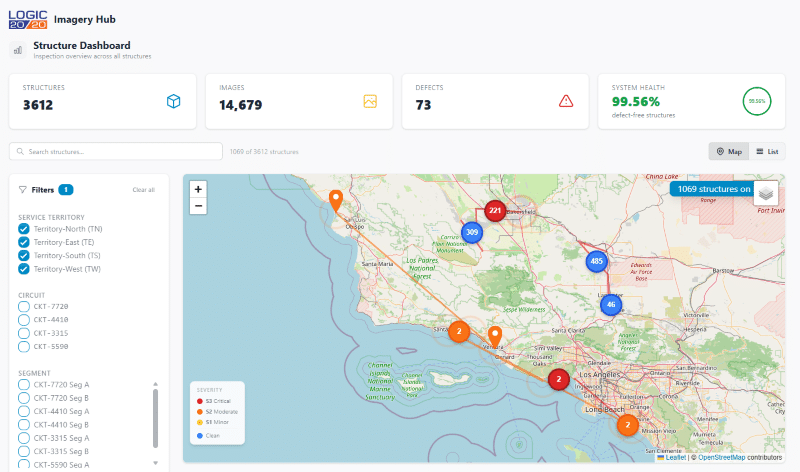
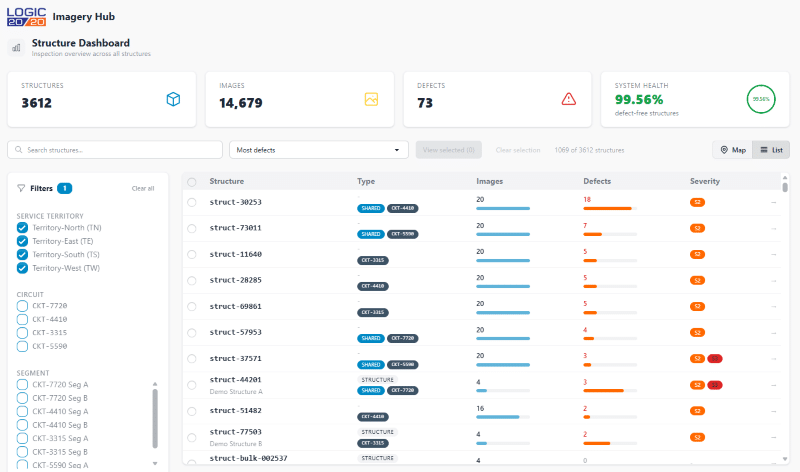
To illustrate how this approach functions in practice, Logic20/20 developed a working demo. The image viewer application presents centralized, asset-linked data using images that have been standardized and consolidated into a single repository through both map and list-based views, allowing users to navigate from system-level visibility to individual structures and review associated images and defects in context. Users can
- Filter by territory or circuit
- Compare inspection results over time
- Identify areas that require follow-up
Logic20/20 Imagery Hub: Map View
Logic20/20 Imagery Hub: List View
See how asset-linked imagery works in practice
A working image viewer demonstrates how teams navigate assets, review inspection history, and move from inspection to planning within a single workflow.
Applying asset imagery in day-to-day workflows
With imagery tied to assets and accessible across systems through an image viewer application, users begin to apply the data directly in operational work. The impact shows up quickly in inspection practices, planning activities, and asset decisions.
Remote asset review
Engineers and planners review assets remotely using high-resolution imagery. Early-stage assessments no longer require immediate field visits, allowing engineers and planners to validate conditions and narrow scope before dispatching crews.
Shared view of asset condition
Engineering, asset management, and operations functions work from the same set of images. Asset condition discussions reference a common visual baseline rather than separate interpretations or secondhand inputs.
Time-based analysis
Historical imagery supports comparison across inspection cycles. Analysts track changes over time and identify patterns in asset degradation.
Shorter decision cycles
Less effort is required to locate and validate imagery, and fewer handoffs are required between inspection, engineering, and planning functions.

Unlocking the power of asset image analytics: 9 key strategies for success
9 essential strategies for utilities to leverage asset image analytics for enhancing operational efficiency and predictive maintenance capabilities
Building toward analytics and integrated workflows
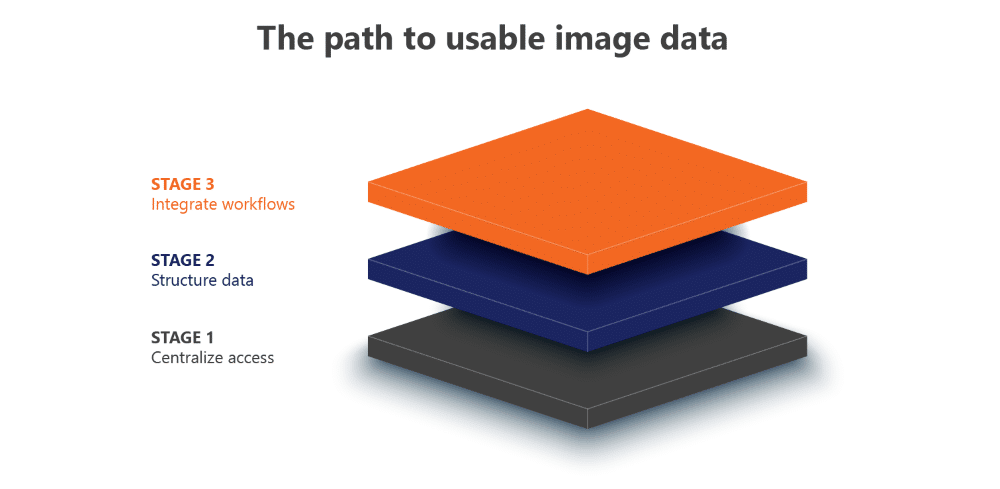
Organizations typically move through a progression as imagery becomes more usable. Early efforts focus on access. Over time, attention shifts to data structure and, eventually, to integrating insights into operational workflows.
Stage 1: Centralize access
Consolidate images into a centralized repository, link them to individual assets, and make the data searchable across the organization. Users can locate and review relevant images without navigating multiple systems or relying on intermediaries.
Stage 2: Structure data
Standardized taxonomy and metadata bring consistency to asset, component, and defect identification, allowing data to be compared, aggregated, and reused across functions.
Stage 3: Integrate workflows
Analytics applied to structured image data identify assets and detect defects at scale. The effectiveness of these analytics depends on consistent, high-quality image capture and structured data alignment. Outputs connect to planning and work management processes, linking inspection data to maintenance decisions and execution.
A large California utility applied this approach to wildfire risk mitigation, using computer vision and asset-linked imagery to identify vegetation and equipment conditions across assets. Inspection data moved directly into risk scoring and work prioritization, allowing asset management and operations functions to focus mitigation efforts on higher-risk assets rather than following fixed inspection cycles.
Translating operational improvements into business impact
As imagery becomes accessible, structured, and integrated into workflows, organizations see impact in cost, prioritization, and analytical capability.
Lower inspection cost
Fewer repeat site visits and more targeted deployment reduce the cost per inspection. Field resources are used where conditions require on-site validation rather than for initial assessment.
More effective maintenance prioritization
A complete view of asset condition across time and location supports identification of higher-risk assets. Maintenance planning reflects observed conditions rather than fixed schedules, improving allocation of capital and labor.
Faster progression from inspection to planning
Inspection results move into planning workflows with fewer delays. Reduced dependency on manual validation and handoffs shortens the time between data capture and maintenance decisions.
Foundation for scalable analytics
Structured, accessible imagery supports model development and validation. Consistent inputs enable analytics to scale across assets and inspection cycles, extending the value of inspection data beyond individual use cases.

Building a data foundation for asset image analytics
To adapt to growing complexity, utilities need to establish a solid data foundation for an image analytics program that is up to the task of enhancing operational efficiency and reliability.
The advantage of making image data usable
Most utilities already capture more inspection data than they can readily apply. As volumes increase, engineering and planning functions spend more time locating, validating, and assembling imagery, which slows its use in planning.
In some environments, that extra effort becomes part of the workflow. Engineers and planners pull images from multiple systems and check inspection dates. They compare different views of the same asset before moving ahead with planning or field maintenance decisions.
In others, users work directly from asset-linked imagery within a single process. They access relevant images by asset and inspection date and move from inspection to planning without assembling data from multiple systems.
Inspection technology will continue to expand coverage and increase data volume. The advantage will come from using that data to plan work, prioritize risk, and direct resources where they matter most.
Use inspection imagery in your planning workflows
Teams often have the data but spend time locating and validating imagery before planning. Reviewing how that data is organized and accessed can highlight where workflows slow down and where changes can simplify planning.
Learn more about asset image analytics

Building a data foundation for asset image analytics
How utilities can address escalating amounts of metadata to feed their analytics platforms

Unlocking the power of asset image analytics
9 essential steps to help utility leaders ensure they are prepared to harness asset image analytics to its full potential

Making the business case for asset image analytics
How we helped a utility make the business case for expanding their drone analytics program