
Executive summary: Once foundational capabilities are in place, utilities face more complex decisions about governance, coordination, and operational integration. In this second article of our series (read Part One here), we focus on how utilities can put Distribution System Operator capabilities into action—drawing on early deployments and coordination challenges across market structures, the transmission-distribution interface, data exchange, and flexible interconnection. The goal is not perfection, but progress: building scalable practices that maintain reliability while enabling greater flexibility.
7-minute read
Distribution System Operator (DSO) models are gaining traction as utilities respond to growing DER-driven complexity at the grid edge. Many are finding that the ability to manage constraints, scale DER participation, and coordinate across system layers requires more than incremental upgrades. It requires a shift in how planning, operations, and governance align.
The first article in our series focused on where DSO readiness begins: not in the control room, but in planning. Those planning fundamentals—grounded in visibility, forecasting discipline, and a shared understanding of flexibility and constraints—set the stage for what comes next.
Once foundational capabilities are in place, DSO readiness becomes less about analysis and more about interaction. DERs begin serving multiple purposes, aggregators engage across system layers, and coordination challenges move from theoretical to operational. In this operational stage, utilities face decisions that shape how flexibility is governed, how roles are defined, and how reliability is protected.
In this article, we focus on what it takes to operationalize DSO capabilities. We examine coordination across market structures, the transmission-distribution interface, data exchange, and flexible interconnection—viewed not as isolated initiatives, but as connected elements of a broader operating model. The emphasis is practical, not prescriptive: utilities don’t need a market to move forward, but they do need clarity around accountability, interaction, and scale.
Table of contents (click to expand)
- Operationalizing DSO through enabling systems
- Do DSO models require a distribution market? A practical perspective
- The transmission-distribution interface: where DSO readiness proves its value
- Governing data exchange for DSO operations
- Flexible interconnection: a proving ground for DSO capabilities
- Governance and change management: the quiet work that makes the model real
- Looking ahead: from pilot to posture
Redefining distribution operations: What DSO means in practice
Amid the growing complexity of the grid, utilities are expanding their role to that of system integrator. A DSO model reflects that evolution, enabling a utility to identify and address local constraints proactively, often by activating DERs as part of routine operations.
There is no single definition of Distribution System Operator. Instead, the model takes shape based on what a utility aims to achieve and the expectations it must meet, whether that involves integrating more non-wires solutions or improving reliability in a DER-rich environment. Often, the push for and design of the DSO model originates with regulators, as seen in the UK under Ofgem’s guidance.
In the United States, aggregators are already participating in wholesale markets, and the scale of committed-but-not-operating capacity (queue backlog) is growing: projects representing more than 400 gigawatts already have interconnection agreements but are not yet delivering power. At the same time, the median time from interconnection request to commercial operation now exceeds four years in many regions, highlighting the need for better distribution-level insight, planning, and coordination.
Against this backdrop, DSO models offer a structured approach to aligning planning, operations, and coordination with the realities of a DER-rich grid. The need is already evident in the widening gap between interconnection demand and operational readiness.
Article continues below.
White paper: Unlocking the ROI of AMI 2.0
A strategic approach to prioritizing use cases for maximum impact
We will never sell your data. View our privacy policy here.
Operationalizing DSO through enabling systems
As utilities scale DSO capabilities, operational integration becomes critical. This integration includes deploying systems that support DER registration, telemetry, and dispatch, as well as ensuring they work together across control centers, field devices, and DER aggregators.
Systems such as DERMS and AMI streamline DER engagement, while SCADA and DMS maintain grid visibility and operational safety. Successful integration depends not only on the right technology stack, but also on clear governance frameworks that define how systems interact and who holds decision rights at each step.
Key systems that support DSO operations
- DERMS: Enables registration, dispatch, and monitoring of DERs
- AMI: Provides granular, near-real-time data on load and voltage
- SCADA: Ensures centralized visibility and control across distribution assets
- EMS/DMS: Coordinates distribution operations with system-wide objectives

DERMS: Essential strategies for implementation
4 starting steps to help utilities ensure optimized integration of a distributed energy resource management system (DERMS) with their existing data platforms
Do DSO models require a distribution market? A practical perspective
Not every DSO model includes a formal distribution market, but every utility must determine how to coordinate, value, and integrate services provided by DERs. The right structure depends on regulatory context, system needs, and the degree of interaction between distribution and wholesale operations.
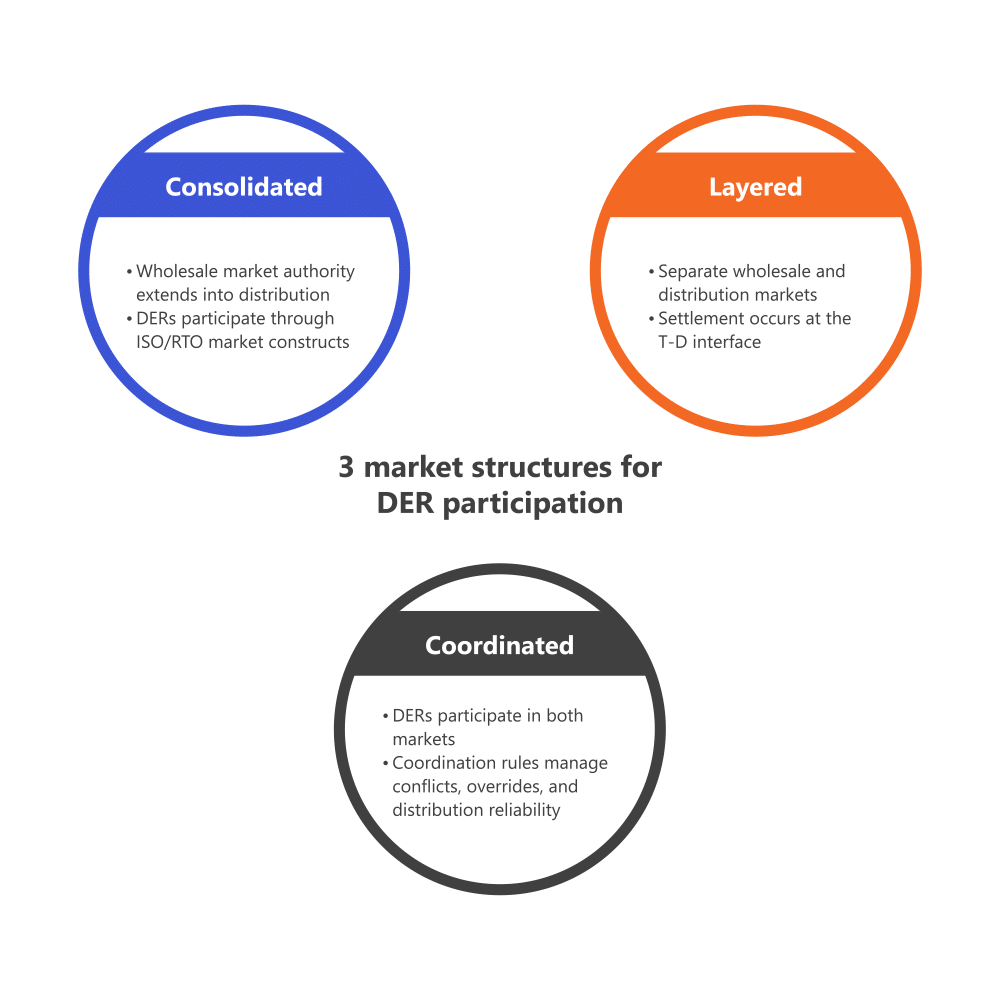
Three high-level market structures are commonly referenced when evaluating how DERs can participate in distribution and wholesale services:
- Consolidated: Extending wholesale market constructs deeper into the distribution system, effectively merging distribution services into existing ISO/RTO mechanisms
- Layered: Maintaining a clear interface between distribution and wholesale markets, with settlements occurring at the transmission-distribution boundary
- Coordinated: Allowing DERs to participate in both markets, with clear rules to prevent conflicting instructions, double counting, or overlapping incentives
Each model reflects a different regulatory and operational posture, not a prescriptive path. For many utilities, the coordinated model offers a practical middle ground: it supports DER participation across system layers while maintaining utility authority over distribution reliability and safety.
Broader trends are pushing coordination models to the forefront. Under FERC Order No. 2222, DER aggregators are gaining access to ISO and RTO markets. With the growth of DER aggregations, utilities face increasing pressure to formalize processes for constraint identification, data sharing, and override protocols. Regardless of formal market structures, these coordination mechanisms are becoming essential to maintain reliability and ensure equitable participation.
Article continues below
The transmission-distribution interface: where DSO readiness proves its value
Growing DER prevalence and capability are blurring the traditional boundary between transmission and distribution. The Department of Energy’s Electricity Advisory Committee describes DER integration as a paradigm shift that requires rethinking roles, responsibilities, and coordination mechanisms at the T-D interface.
This redefinition brings tangible operational and planning challenges that many utilities already face:
- Real-time impacts at the T-D interface challenge traditional forecasting methodologies, especially when DER output varies with weather, market signals, or customer behavior.
- DERs serving both local and bulk needs may receive conflicting dispatch instructions, creating operational risk across system layers.
- Cost allocation for transmission and distribution upgrades becomes more complex, particularly when DER-driven impacts cross jurisdictional or ownership boundaries.
- Utilities need clearer standards and role definitions to ensure reliability as DER behavior becomes more autonomous and grid-interactive.
Coordination gaps typically emerge during planning and investment, where misalignment can lead to reactive interconnection decisions, inefficient upgrades, or unclear prioritization, ultimately delaying projects and driving up costs.
Improving T-D interface coordination allows utilities to anticipate and address these impacts earlier, before they reach the control room. By clarifying how power flow, operational control, and market data are exchanged across entities, utilities can better manage growth, reduce uncertainty, and deliver value across multiple time horizons.

A new era of data-driven T&D investment planning
Utilities are being challenged to change their approach to transmission and distribution investments. Find out how AI-driven technologies offer a solution.
Governing data exchange for DSO operations
DSO readiness relies on reliable, governed data and scalable integration. As DER aggregators and OEM ecosystems expand their role in grid operations, utilities need systems that can exchange information reliably across diverse platforms and participants.
At the core of this challenge is interoperability. Utilities should align systems and protocols to support telemetry, control, and dispatch, while adopting consistent integration patterns—such as APIs and standard communication protocols—to reduce friction and support growth. The objective is not to standardize every system, but to create predictable, governed interactions that support coordination at scale.
At the executive level, the conversation centers on governance. Platform choices will evolve, but the need for role clarity, validation rules, and fallback protocols remains constant. Effective governance defines which signals are trusted, how exceptions are handled, and who holds decision rights at key points in the exchange.
Three categories of signals typically require structured governance:
- Telemetry: Real-time data on DER status, availability, and performance
- Dispatch and control: Instructions across entities, including mechanisms for confirmation and override
- Registration and eligibility data: Information on enrolled DERs, participation terms, and associated permissions
Defining these patterns early creates a durable foundation for reliable operations and smooth integration with future coordination or market models.
Flexible interconnection: a proving ground for DSO capabilities
Flexible interconnection is emerging as an entry point for distribution coordination and flexible dispatch. While sometimes framed as a transitional solution, it can serve two purposes: enabling near-term capacity while traditional upgrades are planned, or functioning as a permanent non-wires solution where ongoing flexibility meets system needs.
Recent guidance from the Department of Energy and the National Renewable Energy Laboratory positions flexible interconnection as more than a contractual mechanism. DOE and NREL define flexible interconnection as a complete lifecycle extending from scenario analysis through ongoing operations. This approach encourages utilities to update how they evaluate hosting capacity, manage DER variability, and allocate capacity in real time.
Flexible interconnection projects demonstrate what it takes to move from static assumptions to dynamic operating envelopes—grounded in planning discipline, clear coordination protocols, and cross-functional alignment. These same capabilities form the foundation of DSO readiness, making flexible interconnection an effective proving ground for broader transformation.
Utilities that approach flexible interconnection as a strategic capability, rather than a stopgap, often gain an early edge in building the situational awareness and planning confidence needed for a more dynamic grid.

Unlocking grid potential with flexible interconnection via DERMS
Learn how a major West Coast Utility began implementing DERMS to address increasing demands to enhance grid efficiency, integrate DERs, and meet escalating customer expectations.
Governance and change management: the quiet work that makes the model real
The most difficult aspects of DSO readiness are often organizational rather than technical. Delivering on the model requires coordinated change across people, processes, and technology, supported by clear accountability, structured decision-making, and active stakeholder engagement.
Experience shows that readiness stalls when decision rights are undefined. Critical questions go unanswered—Who sets distribution-level constraints? Who validates them? Who holds override authority? Who represents the utility in external coordination? Without clear ownership, even well-structured planning and control strategies can lose momentum.
Establishing a shared operating rhythm that bridges organizational silos is essential. Planning, operations, IT, and regulatory teams need aligned timelines, consistent data sources, and a common understanding of responsibilities. Gaps in communication or sequencing can slow progress, introduce risk, or limit the effectiveness of new tools and processes.
Looking ahead: from pilot to posture
For many utilities, the DSO model reflects a broader evolution in how value is planned, coordinated, and delivered across the grid. As DERs move from the margins to assume a central role in grid operations, the systems that manage them must evolve to match. Reliability, affordability, and flexibility now depend on clearer roles, trusted data, and governance frameworks that extend across organizational and system boundaries.
Progress depends on sequences of scalable decisions. Defining responsibilities, building coordination protocols, and scaling integration efforts create a foundation that holds up under pressure.
At the distribution edge, complexity comes into focus—and innovation accelerates. As utilities strengthen their Distribution System Operator capabilities, they’re building the operational posture needed to lead through transformation.
You might also be interested in ...
4 essential DERMS use cases for a smarter, more resilient grid
Four powerful DERMS use cases that help utilities boost grid reliability, optimize energy distribution, and accelerate the clean energy transition

AMI 2.0 and DERMS: A powerful combination
Learn how integrating AMI 2.0 with DERMS enhances grid visibility, voltage management, and operational control as utilities expand distributed energy resources.
Webinar: Grid-edge DERMS for utility resilience and modernization
How grid-edge DERMS help utilities respond to regulatory shifts, integrate customer-owned assets, and coordinate DERs

Powering a sustainable tomorrow
We partner with utilities to help them build a more resilient grid and move towards a cleaner, brighter future through
- AI-driven automation
- Asset image analytics
- DERMS implementation
- Analytics & predictive insights
- Cloud optimization

Ali Kazmi is a Manager in Logic20/20’s Grid Operations practice, where he advises utilities on DERMS deployment, grid modernization, and regulatory strategy. He brings deep experience in financial modeling, vendor selection, and implementation planning, and has supported Department of Energy initiatives focused on clean energy and consumer savings. Ali is known for helping utilities translate complex technical and regulatory challenges into practical, scalable operating models.

Dayanna Palacios is a Senior Manager in Logic20/20’s Grid Operations practice, where she leads grid modernization, AMI 2.0, and DER initiatives for utilities. She brings deep experience developing value frameworks and business cases that quantify reliability, efficiency, and customer benefits, and has led large-scale modernization programs across AMI, DER integration, and transportation electrification. Dayanna is known for aligning technology strategy, regulatory requirements, and operational execution to deliver measurable utility outcomes.