

Original publication date: July 29, 2025
Executive summary: Agentic AI has moved from promise to production. One year after our original guide, we cover what enterprises have learned, how multi-agent workflows changed the picture, and where the major platforms fit.
A year ago, most conversations about agentic AI started with a definition. That question has been answered. Every major software vendor now ships agents, and the standards that let them work together are in place.
The harder question is what actually works. Gartner reports that while more than 60 percent of organizations expect to deploy AI agents within two years, only 17 percent have done so, and the firm predicts over 40 percent of agentic AI projects will be canceled by the end of 2027 over rising costs, unclear value, or weak risk controls. That gap between ambition and production is what this update is about.
This update keeps the fundamentals that still hold, revises what a year of real deployments has changed, and adds two topics that barely existed in their current form last July: orchestrated multi-agent workflows and the enterprise agent platforms now competing for your stack.
Modernizing compliance: a playbook for governing technology-driven risk
Learn how leading organizations are modernizing compliance practices to keep pace with evolving technology risk and regulatory expectations.
We will never sell your data. View our privacy policy here.
What is agentic AI?
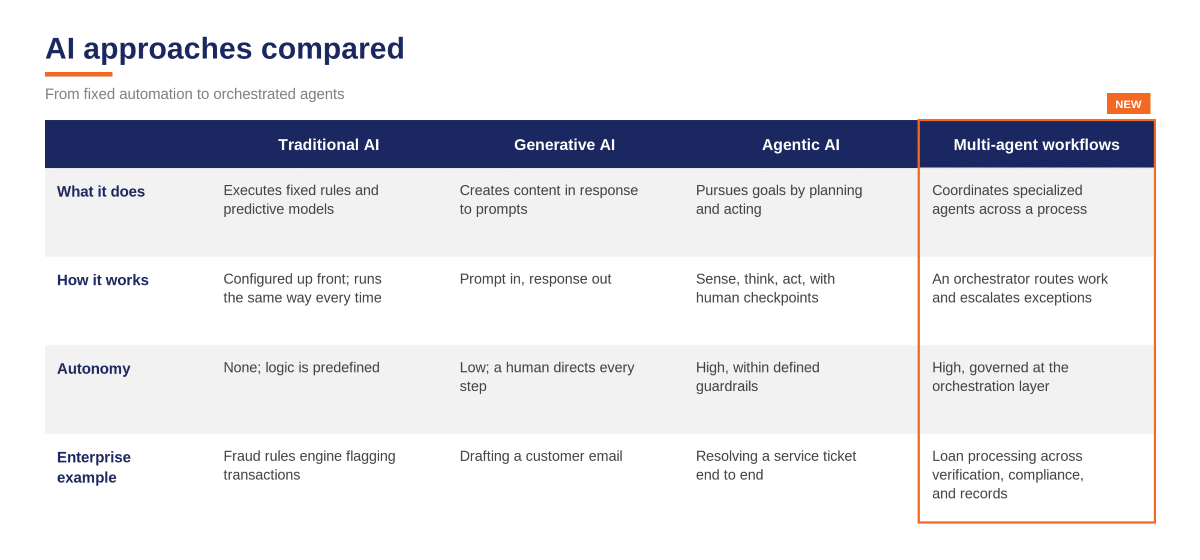
Agentic AI is artificial intelligence designed to operate with agency. Rather than responding to instructions one at a time, an agentic system can set sub-goals, make decisions, and execute multi-step tasks across connected systems. It combines three capabilities:
- Perception: Gathering and interpreting data from multiple sources
- Reasoning: Analyzing inputs, weighing trade-offs, and selecting a course of action
- Action: Executing workflows and adapting to real-time feedback with minimal human oversight
This "sense-think-act" cycle separates agents from generative AI tools that produce content on request. A chatbot answers a question; an agent completes a task. A year ago that distinction was mostly conceptual. Today it describes systems running in production.
One year later: how agentic AI evolved
Three shifts define the year since the original article.
From single agents to agentic workflows
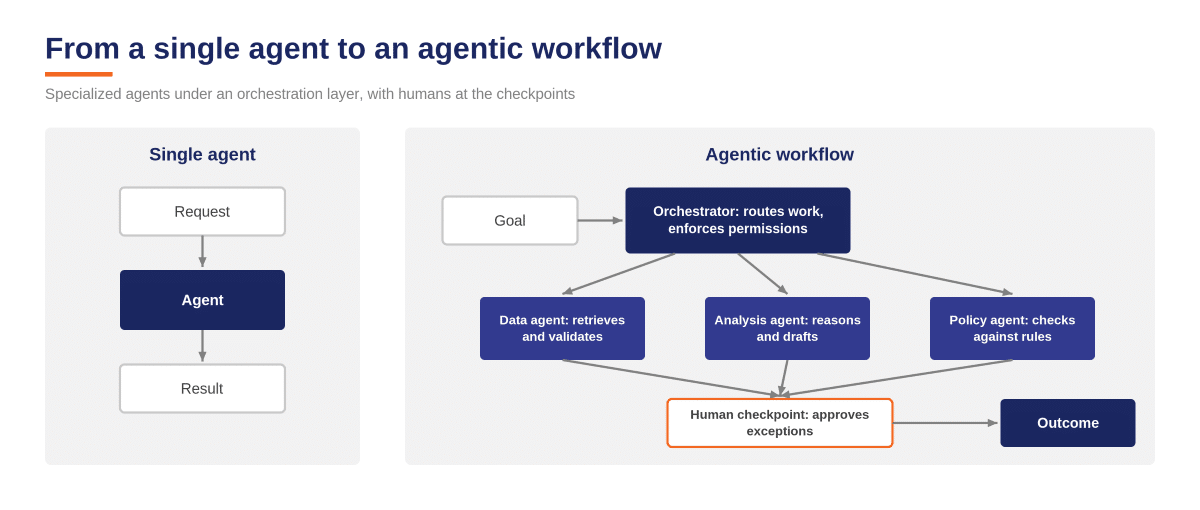
The first generation of enterprise agents worked alone: one agent, one task, one pilot. The past year belonged to the agentic workflow, where specialized agents divide a process under an orchestration layer that routes work, enforces permissions, and escalates exceptions to humans. Multi-agent orchestration is now generally available across the major platforms.
The reason matches what we found building our own systems: specialized agents outperform generalists. When one agent handles too much, performance degrades. Splitting the work improves accuracy and makes failures traceable.
Example: In financial services, a loan-processing workflow might use separate agents for document verification, compliance checks, and record updates, with the orchestrator escalating exceptions to a human reviewer.
Two design principles matter more than any tooling choice. Human checkpoints are architecture, not afterthought: the most reliable systems define exactly which decisions an agent may make alone, and which require sign-off, before the first agent is deployed. And observability is the difference between a pilot and production. If you can't trace why an agent acted, you can't govern it.
Interoperability became real
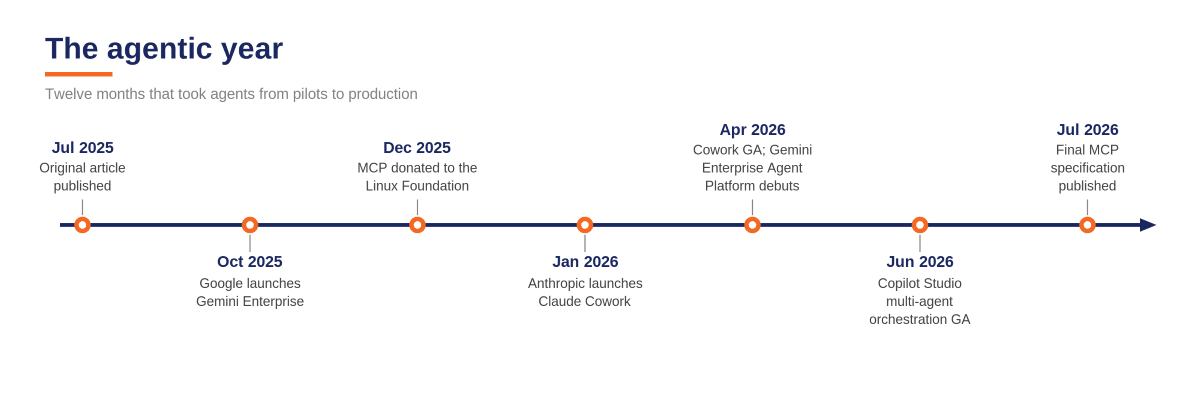
Connecting an agent to your systems used to mean custom integration work for every tool. The Model Context Protocol (MCP) solved most of that. Created by Anthropic and adopted by OpenAI, Google, Microsoft, and Amazon, it was donated to the Linux Foundation's Agentic AI Foundation in December 2025, and the finalized specification arrived in July 2026. The Agent2Agent (A2A) protocol now covers agents handing work to other agents, including across vendors.
For enterprises, this changes the procurement math. An MCP server built for one platform's agents can serve another's, so agent investments carry far less lock-in risk than they did a year ago.
Agents came to the desktop
Building an agent used to require engineers. In January 2026, Anthropic launched Claude Cowork, a desktop agent environment for general knowledge work, with general availability in April and web and mobile in July. More than 90 percent of Cowork sessions involve no coding at all: users delegate research, reporting, and document work. Microsoft and Google embedded agents in Microsoft 365 and Workspace the same way. Agentic AI is now a workforce capability, not just an engineering initiative.
The platform landscape
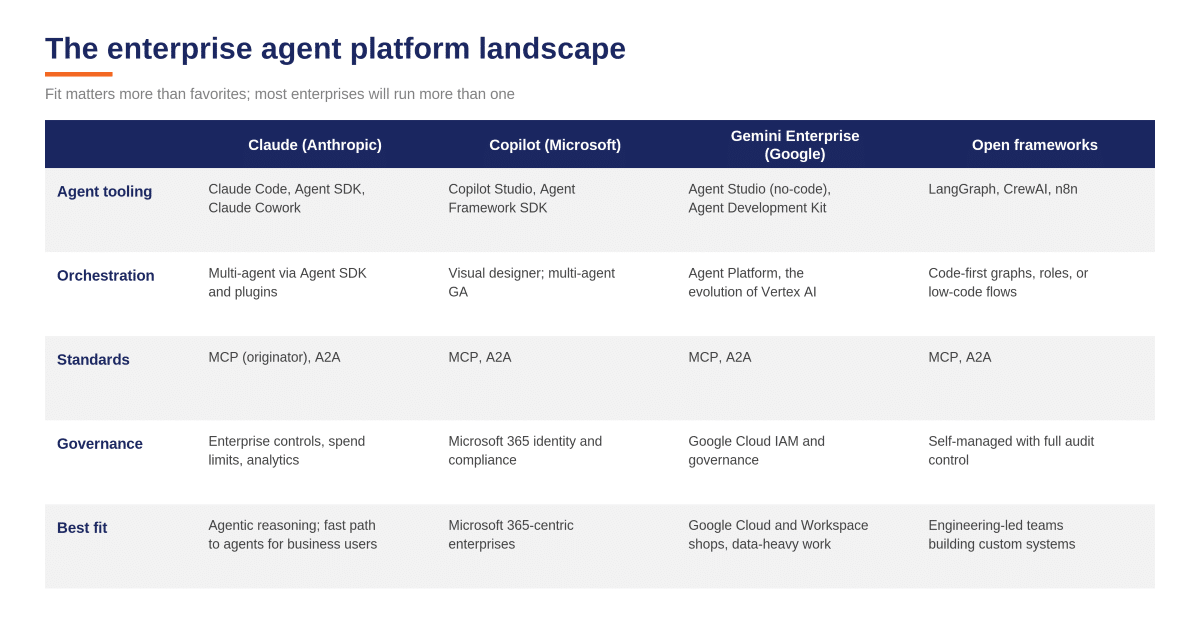
Enterprises no longer choose whether to use agents; they choose which platforms to standardize on, and most will run more than one. Logic20/20 advises clients across all of them, so our interest is fit, not favorites.
Anthropic (Claude): Claude Code for engineering teams, the Agent SDK for custom agents, and Claude Cowork for business users, plus MCP's origins and maturing enterprise controls. Best fit: organizations that want strong agentic reasoning and a fast path to agents for non-technical staff.
Microsoft (Copilot and Copilot Studio): Multi-agent orchestration is generally available in a visual designer, backed by the Agent Framework SDK, with agents inheriting Microsoft 365 identity and compliance tooling. Best fit: Microsoft 365-centric enterprises that want agents governed by infrastructure they already run.
Google (Gemini Enterprise): Consolidated from Agentspace in October 2025, with the Gemini Enterprise Agent Platform launched at Cloud Next 2026 as the evolution of Vertex AI, offering no-code and pro-code agent building and 200+ models. Best fit: Google Cloud and Workspace shops with data-heavy workloads.
Open frameworks: Frameworks such as LangGraph, CrewAI, and n8n give engineering-led teams full control, audit trails, and freedom from platform constraints, and they speak the same MCP and A2A standards as the commercial platforms. LangGraph's graph-based orchestration maps cleanly to production requirements like rollback points; CrewAI organizes agents around roles; n8n adds a low-code visual layer for teams that want faster iteration. Best fit: teams building deeply customized agent systems, or prototyping before committing to a platform.
How to get started (and why 40 percent of projects fail)
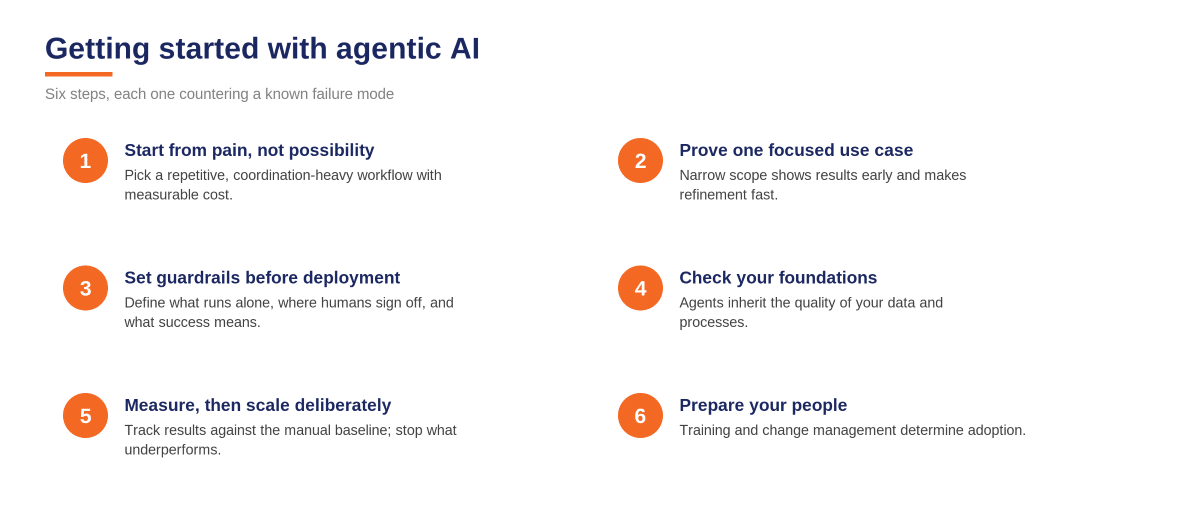
Gartner's cancellation prediction is a map of what goes wrong: costs that outrun value, use cases chosen for hype, and governance added too late. The firm also warns of "agent washing," estimating that of thousands of self-described agentic vendors, only about 130 are real. Each step below counters a known failure mode.
- Start from pain, not possibility. Pick a repetitive, coordination-heavy workflow with measurable cost: outage ticket triage in utilities, loan pre-approval checks in financial services. Projects anchored to a real pain point survive budget scrutiny.
- Prove one focused use case end to end. Narrow scope makes results visible early and refinement fast.
- Set guardrails before deployment. Define what the agent does alone, where it pauses for human input, and what metrics define success. Match oversight to risk.
- Check your foundations. Agents inherit the quality of the data and processes beneath them. Assess your automation and data readiness first, or start with our 5x5 AI Readiness Assessment.
- Measure, then scale deliberately. Track cycle time, accuracy, and cost against the manual baseline. Shut down what the numbers don't support.
- Prepare your people. With agents in everyday desktop tools, training and change management determine adoption as much as engineering does.
Lessons from our delivery work
Building our Advanced Voice Assistant (AVA) prototype, a multi-agent system that turns compliance documentation into guided voice conversations, taught us three lessons that generalize:
- Specialized agents outperform generalists. Assigning speech recognition, document search, and question formulation to separate agents improved accuracy and made troubleshooting tractable.
- Testing agentic systems requires new approaches. Pass/fail tests can't handle systems with multiple valid answers, so we built AI-driven simulations that stress-test conversations at scale.
- Fast iteration beats big design. Two-week cycles surfaced requirements no upfront spec would have caught.
These lessons now shape how we help clients move beyond proofs of concept to production.
Governance and measurement
Autonomy raises the stakes on oversight, and the past year gave the industry a shared vocabulary for managing it.
- Agent-specific threats are now mapped. The OWASP agentic AI threat model covers risks like tool misuse, memory poisoning, and privilege compromise. Mitigations include strict permissioning, sandboxing, and detailed activity logging.
- Identity applies to agents, not just people. Production deployments increasingly give each agent its own identity, scoped permissions, and audit trail, so access can be governed and revoked the same way it is for employees.
- Measurement pairs business and technical metrics. Track cycle time, cost, and compliance adherence alongside accuracy, latency, and error rates, and monitor continuously. Drift is normal; undetected drift is a governance failure.
The fundamentals from the original article still stand: encrypt data in transit and at rest, run regular security audits, maintain explainability, and keep humans accountable for high-stakes decisions.
What's next for agentic AI
Last year we predicted agents would collaborate in teams and act proactively. Both arrived faster than expected. Four developments are worth planning for now:
- Ambient, always-on agents. Agents that monitor, act, and report in the background will shift the human role from operator to supervisor, raising the bar for observability and alerting.
- Cross-vendor agent ecosystems. With MCP and A2A settled, a Copilot agent handing work to a Claude agent will be unremarkable.
- Agent governance as a discipline. Regulation is catching up, and boards already demand traceability and ROI. Organizations that build governance now will move faster later, not slower.
- Orchestration as the control point. As agents commoditize, the durable value sits in the orchestration layer: permissions, routing, evaluation, and monitoring. That's where today's architecture decisions will matter most in three years.
Frequently asked questions (FAQs)
What is agentic AI?
AI that acts autonomously to achieve defined goals: it perceives its environment, plans, and executes multi-step tasks, escalating to humans at defined checkpoints.
What is an agentic workflow?
A business process executed by multiple coordinated AI agents under an orchestration layer. Each agent handles a specialized task while the orchestrator routes work and escalates exceptions.
What is the difference between generative AI and agentic AI?
Generative AI creates content in response to prompts. Agentic AI uses the same underlying models but adds planning and action: it completes tasks rather than producing outputs for a human to act on.
What is the Model Context Protocol (MCP)?
An open standard for connecting AI agents to tools and data. Created by Anthropic, now governed by the Linux Foundation, and supported across major platforms, so integrations built for one ecosystem can be reused in another.
Copilot or Claude for enterprise agents?
It depends on your stack. Copilot fits organizations that want agents governed by existing Microsoft 365 infrastructure; Claude fits organizations prioritizing agentic reasoning and desktop agents for business users. Many run both, and MCP makes that practical.
Should we build a single agent or a multi-agent system?
Start with a single focused agent to prove value on one workflow. Move to multi-agent orchestration when the process spans multiple specialized tasks; focused agents consistently outperform one agent asked to do everything.
Why do agentic AI project fail?
Gartner cites escalating costs, unclear business value, and inadequate risk controls. In our experience the root causes sit upstream: use cases chosen for novelty, weak data foundations, and governance bolted on after deployment.
Key takeaways
Agentic AI crossed from experiment to enterprise capability this year. Multi-agent workflows are in production, open standards made agents interoperable, and desktop tools put agents in front of every knowledge worker. Platform choice matters less than discipline. Decision-makers should pick one high-friction workflow that can show results within a quarter, choose platforms on fit with their stack and governance, and build the orchestration and human-checkpoint architecture that scales from one agent to many.

Streamline operations with agentic AI automation
Logic20/20 helps you deploy intelligent agents that act autonomously, adapt in real time, and orchestrate workflows across your enterprise. Our team delivers scalable solutions through:
- Agentic AI use case discovery
- AI agent design and development
- Integration with enterprise systems
- Governance and deployment strategy

Carson Wright is a Program Lead with extensive experience in process engineering, change management, and business readiness. Over the past decade, he has led cross-functional teams to deliver organizational transformation initiatives, helping enterprises optimize operations and adopt emerging technologies. Carson’s expertise spans go-to-market strategy, sustainability programs, and large-scale business process optimization, equipping him with a results-driven perspective on the opportunities and challenges of agentic AI.