

Executive summary: As regulatory demands continue to grow, many organizations are rethinking how compliance work gets done. This article explores what effective compliance automation looks like in practice, drawing on a real-world platform to illustrate how structured workflows can reduce manual effort, improve visibility, and support better decision-making across the organization.
7-minute read
Compliance teams are feeling the strain of rising regulatory demands, shrinking timelines, and increasing scrutiny across every industry. At the same time, many organizations still manage reviews through spreadsheets, static documents, and long email threads. The result is often a process that consumes resources, limits visibility, and makes missed requirements more likely. It’s no surprise that only 8 percent of risk and compliance professionals feel extremely confident in their organization’s ability to keep pace.
Beyond the operational burden, regulatory complexity carries real financial weight. The average U.S. firm spends up to 3.3 percent of its total wage bill on compliance-related activities, a figure that grows as requirements expand and manual processes fail to scale. As expectations continue to rise, traditional workflows fail to scale effectively, making their long-term viability increasingly questionable.
In response, organizations are increasingly turning to automation to lighten the load. Moving from a document-driven process to a structured, dynamic workflow helps teams improve portfolio-level visibility and respond more efficiently to regulatory documentation demands. In this article, we look at what an effective automated workflow can include and share an example of a web application our team built for a global technology enterprise.
Why outdated workflows can’t keep up
Compliance requirements continue to evolve across regions and regulatory bodies, forcing teams to track more obligations and interpret more nuance than they did even a few years ago. Faster responses and more detailed documentation are becoming the norm, straining resources that were already stretched thin.
In practice, many workflows still rely on tools that are not designed for cross-functional coordination or downstream reporting. Word documents, spreadsheets, and PowerPoint decks often end up in multiple versions across shared drives, email threads, or individual desktops. Intake forms differ from team to team, which makes comparing submissions and applying consistent standards a challenge. As reviews move between engineering, legal, product, and compliance teams, each handoff introduces opportunities for rework or misalignment.
These fragmented methods create predictable pain points:
- Teams duplicate effort when similar questions show up in different documents.
- Missing or unclear information adds extra review cycles and back-and-forth communications.
- Compliance managers have limited visibility into which reviews are underway and where bottlenecks are emerging.
- Compliance teams must manually assemble information to respond to regulatory requests, increasing effort and response time.
- Leaders lack a clear view of organizational risk, limiting their ability to plan and allocate resources effectively.
When compliance activities run through disconnected tools and ad hoc processes, organizations often find themselves reacting to issues instead of preventing them. Questions surface late in the product lifecycle—when changes cost more—and documentation turns into a scramble rather than a reliable practice. Over time, these patterns increase workload and regulatory exposure, reinforcing the need for workflows that help teams stay aligned and avoid last-minute surprises.
Article continues below.
Compliance as a Service (CaaS) ebook
We will never sell your data. View our privacy policy here.
Why automation is essential
As compliance expectations grow more complex, teams need processes that reduce administrative overhead and create more space for thoughtful review. Automation helps make this possible by streamlining the tasks that most often slow teams down—gathering information, validating inputs, and routing submissions—so people can focus on interpreting requirements and advising the business.
One of the most practical benefits of compliance automation is standardized, structured intake. When reviews begin with consistent questions and clear requirements, teams produce higher-quality data, and reviewers spend less time clarifying details. Dynamic workflows extend this approach by tailoring each review to its specific context. Instead of navigating long, static forms, users see only the questions relevant to their scenario, reducing unnecessary steps and improving accuracy. Over time, this structure also makes it possible to analyze trends and compare submissions in ways that are difficult to achieve with unstructured formats.
These capabilities support both operational efficiency and long-term readiness:
- Teams spend more time analyzing risk and less time managing paperwork.
- Structured data becomes easier to reuse for reporting and regulatory documentation.
- Dynamic logic lowers the likelihood of errors by removing irrelevant steps and unnecessary decision points that add confusion, while also streamlining the process for compliance teams.
- Consistent workflows generate documentation that strengthens audit preparedness.

Building a framework for regulatory response readiness
Learn how a regulation-agnostic framework enables businesses to navigate complex and evolving compliance landscapes with flexibility, efficiency, and resilience.
What effective compliance automation looks like: a real-world example
A concrete example helps show how modern compliance workflows operate in practice. Our team recently built a customized compliance web application for a large global organization. The tool consolidates intake, review, and documentation into a single platform and adapts dynamically based on the details of each submission.
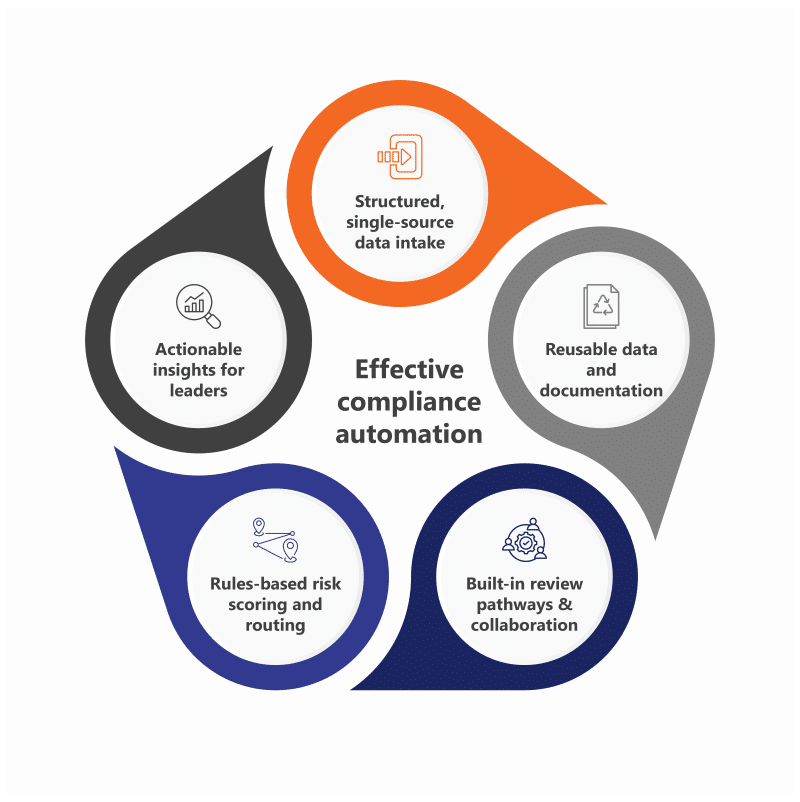
The demo video below shows an anonymized version of the application in action, walking through how the workflow functions end to end. While every organization’s needs are unique, this example reflects the five core characteristics of effective compliance automation that reduces manual effort, strengthens accuracy, and supports more predictable compliance operations.
Article continues below.
Structured, single-source intake
A strong workflow begins with a centralized and consistent intake process. When teams enter information through a single form with standardized questions and definitions, reviewers receive higher-quality data and spend less time sorting out confusion. Automated branching improves the intake experience by presenting only the questions relevant to the situation.
In our web application, the menu adjusts in real time, adding or removing pages based on attributes such as region, audience, or whether children’s data is collected. By tailoring the experience, the tool avoids unnecessary steps and helps submitters stay focused, which in turn improves the accuracy of the information provided.
Reusable data and documentation
In many cases, compliance reviews call for similar information across different assessments and regulatory outputs. An effective workflow captures information once and enables it to be reused later.
The web application prompts users to answer relevant questions for in-scope data types or processing activities. This approach creates structured, repeatable data that feeds downstream documentation needs, such as a Record of Processing Activities (ROPA) or Data Protection Impact Assessment (DPIA), without additional rework. Centralized attachments also support reuse by allowing teams to store data flow diagrams and supporting documentation in a central location.
Built-in review pathways and collaboration
Different stakeholders step in at different points as reviews progress. Automated workflows simplify review coordination by supporting clear routing and role-based access. Compliance managers, product owners, and legal reviewers see the sections relevant to their responsibilities, and standardized review and feedback cycles replace ad hoc conversations.
In practice, our web application applies access controls that allow reviewers to focus on the items assigned to them while preventing changes once a submission is locked or approved. Automated alerts notify the right individuals when an item is ready for their attention, reducing delays and improving coordination.
Rules-based risk scoring and routing
Automation does more than organize information; it also helps teams prioritize effort. Risk scoring logic evaluates inputs and classifies submissions as low, medium, or high risk. Lower-risk items can be processed quickly, while higher-risk items receive more detailed review.
Our client’s web application solution applies risk scoring logic that evaluates submissions in real time and can automatically approve the lowest-risk cases. Automated actions such as routing, case creation, and documentation generation further shorten review cycles and reduce the administrative burden on both submitters and reviewers.
Actionable insights for leaders
Alongside day-to-day efficiency, an effective workflow should also support organizational awareness. Aggregate reporting helps leaders understand trends and review timelines, concentrations of risk, and patterns across teams or product lines. User experience metrics also highlight process friction within compliance automation workflows, enabling ongoing improvement.
Our application captures time-to-complete data for each page of the assessment. Over time, these insights show where users struggle and where refinements may have the most impact. With better information, leaders can make informed decisions about resource allocation, process updates, and emerging compliance needs.
Turning compliance into a catalyst for better decision-making
As organizations grapple with rising regulatory expectations, the instinct is often to see compliance as a constraint that slows momentum or adds friction to already complex initiatives. Yet the shift toward automated, structured workflows points to a different possibility. When compliance is managed through thoughtful design rather than ad hoc coordination, it becomes a source of clarity that strengthens decision-making across teams.
The real value emerges in how teams work, not just in how they document. Structured intake encourages teams to examine how compliance activities operate day to day. Dynamic routing surfaces the right expertise at the right moment. Built-in intelligence exposes patterns that might otherwise remain hidden—recurring risk themes, inefficient review cycles, or product areas needing deeper attention. Over time, these insights help leaders make more informed decisions about where to invest, where to streamline, and where emerging risks might be forming.
Automation also encourages a more mature organizational mindset. Instead of viewing compliance as a final step before launch, teams begin to treat it as a foundational part of product development, woven into planning, design, and stakeholder coordination. As workflows evolve to support broader domains—such as digital safety, responsible AI, and data governance—the lines between “compliance” and “strategy” grow thinner. The same processes that reduce operational burden can help shape more ethical, transparent, and user-centric products.
Modernizing compliance is not about adopting a specific tool or technology. It’s about creating workflows that illuminate risk, support faster decision-making, and adapt to the realities of a changing business landscape. Organizations that commit to this approach gain more than efficiency; they build a stronger and more resilient foundation for innovation.
You might also be interested in …

Optimizing compliance response
Learn how to optimize compliance response in a rapidly shifting regulatory landscape, with a focus on proactive documentation and streamlined inquiry management.

Compliance process automation: Improve processes, reduce risk
Compliance automation can reduce risk and improve accuracy when it’s implemented with a strategic, data-centric approach.

Building a strategic compliance office
Transforming compliance into a strategic asset drives innovation, reduces risk, and positions the organization for lasting success.

Streamline compliance with expert guidance
Logic20/20 delivers the regulatory knowledge, operational know-how, and technical expertise to help you meet compliance obligations and remain ready to respond to regulatory inquiries.
- Compliance managed services
- Compliance process optimization
- Regulatory response readiness
- Compliance automation