

5-minute read
Executive summary: Copilot Studio governance helps teams build agents faster by matching controls to the business consequences of each agent’s work. Clear ownership, a consistent development lifecycle, and reusable components support broader adoption while maintaining control over agent access and actions.
Your teams already see what Copilot Studio agents can do. A project manager wants an agent that surfaces open issues and past resolutions without digging through logs. A finance analyst wants one that flags billing anomalies before monthly closing. To turn that interest into enterprise adoption, you need a way for teams to develop agents quickly while maintaining control over the systems their agents access and the actions they take.
Governance provides that balance between rapid development and control. A consistent framework helps teams determine how much autonomy an agent needs and which controls are appropriate for the business consequences of its work.
A framework only works if someone runs it. One effective model gives an agentic center of excellence (CoE) responsibility for governance across the organization.
“One set of rules for every agent” slows everyone down
Most organizations start with a simple assumption: every agent should follow the same rules. On paper that feels safe. In practice it creates two problems at once.
An agent that drafts meeting notes gets the same approvals as one that recommends a grid switching sequence. Too many roadblocks mean employees building low-stakes agents give up and stop experimenting. Meanwhile, the high-stakes agents still lack the specific controls they need. You end up over-governing some work and under-governing the rest.
Without a shared approach, agents also multiply out of sight. Nobody can say how many exist, who owns them, or which ones touch sensitive systems. Those gaps in oversight are where shadow AI starts.
Govern the work, not the technology: the AI agent governance framework
Our team uses a framework we call governed autonomy. The principle: match an agent's autonomy to the business consequences of the work it performs. Two agents built on the same platform can require very different approaches to oversight, because the cost of getting the work wrong is different.
Before an agent is deployed, ask three questions:
- How involved should a human be in the decision?
- What are the business consequences if the work is done incorrectly?
- Which systems will the agent access, and which actions will it be permitted to take?
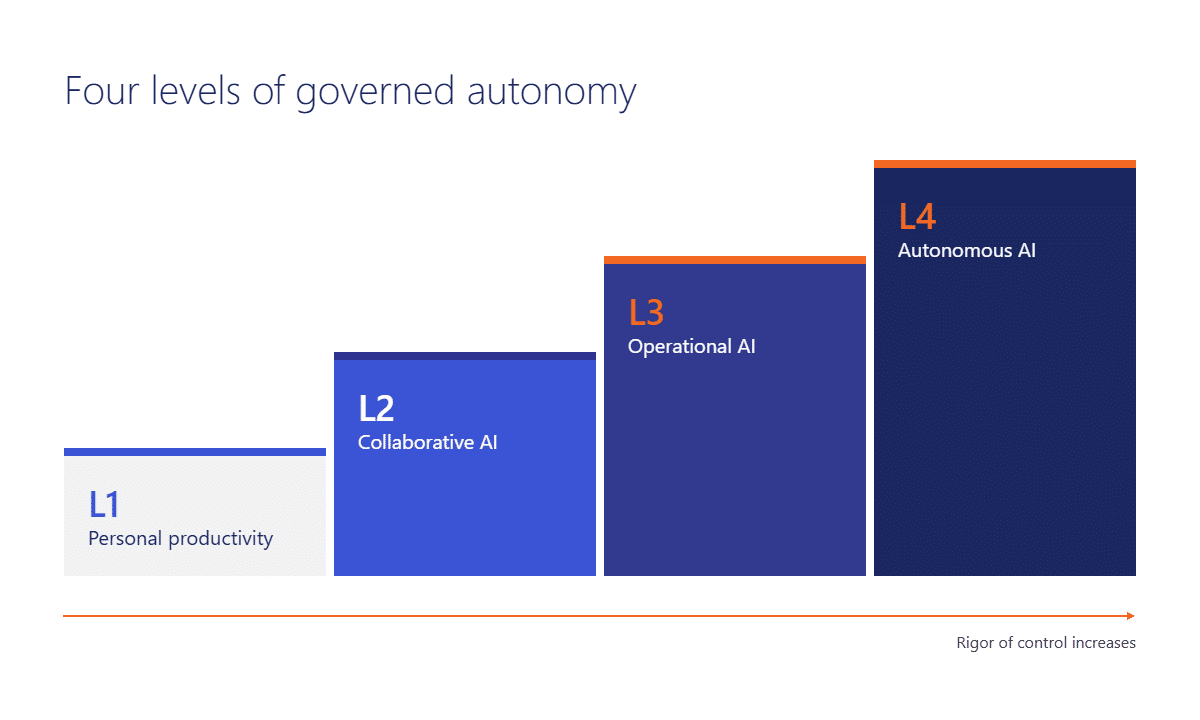
You can use the answers to classify every agent into one of the four levels in our framework:
- L1: Personal Productivity: AI informs; humans decide. Example: Summarizing, drafting, and knowledge retrieval, with read-only access.
- L2: Collaborative AI: AI executes; humans approve. Example: Routing and tagging work orders, with reversible actions in low-stakes internal systems.
- L3: Operational AI: AI acts within guardrails for high consequence actions. It recommends, e.g. flags a billing anomaly, and a named process owner approves every recommendation before it proceeds.
- L4: Autonomous AI: AI orchestrates; humans govern. Example: Invoice reconciliation and payment within pre-approved rules and spend limits, with an executive sponsor accountable.
Once an agent is classified, the governance model is clear. The builder doesn't have to invent one.
Same controls, different rigor
Every agent benefits from an appropriate level of governance. What changes by level is the rigor of control. An L1 agent uses the employee's own login and gets spot checks. An L4 agent has its own tracked identity, a full record of every decision, continuous testing for changes in behavior or performance, an off switch, and limits on execution speed and spending.
Define those standards once per level. New agents then inherit them, so a team building its fifth agent moves faster than it did on its first.
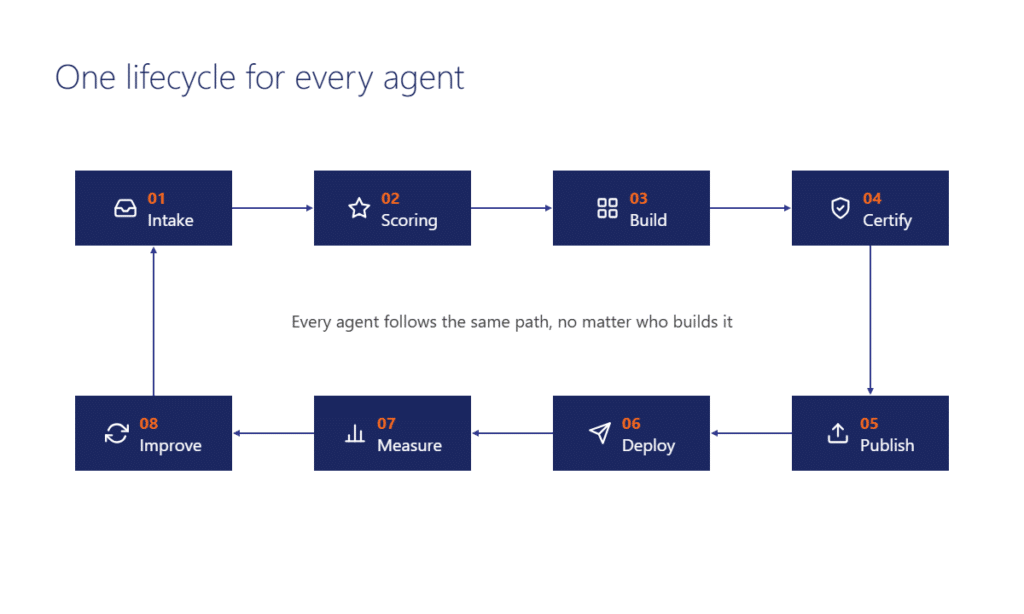
The same logic runs through the agent’s lifecycle. We use a single flow for every agent, whether a citizen maker builds it in Copilot Studio or a central team does:
- Intake: Capture the business need in a structured form.
- Scoring: Rate value and feasibility so the best ideas rise first.
- Build: Start from approved patterns and reusable components.
- Certify: Test against the standards for the agent's level.
- Publish: Make it available to the right audience.
- Deploy: Incorporate it into daily work.
- Measure: Compare actual hours saved and adoption with the estimate from intake.
- Improve: Refine the agent and review its classification as the work changes.
Governed at the center, self-service at the edge
A framework only works if someone runs it. One effective model gives an agentic center of excellence (CoE) responsibility for governance across the organization. The CoE owns scoring rubrics, prompt libraries, patterns, and output standards. Lines of business submit ideas and build within the framework, with no technical background required to get started.
As agents take on more responsibility, new roles appear around them. Some organizations name them formally. Others spread the work across existing product, security, and operations teams. Either way, capabilities need an owner:
- AI Product Owner prioritizes use cases and decides when an agent is ready for the next level.
- Agent Operations Lead oversees agents in production and manages exceptions.
- Agent Assurance Specialist validates outcomes and catches drift early.
- Non-Human Identity Administrator manages agent identities and permissions.
Accountability also rises with the level. At L3, a named process owner approves every recommendation. At L4, an executive sponsor owns the outcome.
Make the governed path the easy path
Citizen makers are more likely to follow governance when it saves them time. So give them a head start: build guides, templates, a pattern library, and reusable components such as a document summarization service or a SharePoint connector. An agent built from approved parts reaches certification faster and carries less technical debt.
Open L1 and L2 broadly. Low-consequence work is where employees build fluency and where you refine the governance model before higher-stakes agents arrive. Hands-on workshops help here, because people who build an agent themselves see it take the busywork while they stay in control.
Moving an agent up a level is a readiness check, not a training exercise. Confirm the controls, the owner, and the people overseeing it before you expand what it can do.
What it looks like in practice
One large utility we work with had Copilot deployed, but adoption across the enterprise was slower than executives wanted. Intake wasn't fully structured, governance and compliance mechanisms were limited, and no use cases were prioritized. Ten business units were involved in the Copilot adoption strategy.
Together, we launched a Copilot value acceleration program that structured intake and scoring, developed agent patterns and a reusable component library, established an agentic CoE, and delivered 101, 201, and 301 build-a-thons for more than 300 employees. In 10 months, the program went from pilot to scale:
- 90+ agents built by the team, with 60+ more in the backlog
- 4,000+ citizen-built agents
- 70,000+ estimated annual hours saved (2026 estimate)
- 9 of 10 workshop participants recommend the program
The program paired governance with reusable tools and employee training to support agent development at scale.
Define the controls before expanding autonomy
You don't need every role and control in place on day one. Start by classifying the Copilot Studio agents you already have into L1 through L4. That inventory shows where you are over-governing, where you have gaps, and which low-consequence work you can open up right away.
From there, set the standards for each level, put a single intake in front of new ideas, and name owners for anything at L3 or L4. Governance enables scale, scale enables adoption, and adoption delivers measurable enterprise value.
Build with control
If you're working out how to empower your teams to build agents without losing control, let's talk through the options.
Learn more about AI agent governance

Scale agentic AI without losing control
Explore a four-level governed autonomy framework for matching AI agent oversight, accountability, and controls to business consequences.

Prioritizing AI opportunities for enterprise impact
Learn how structured AI readiness assessments and use case scoring can help organizations prioritize high-value opportunities while strengthening governance.

What is agentic AI? Benefits, challenges, and how to implement it
Discover practical steps for deploying autonomous agents with appropriate guardrails, human oversight, security controls, and continuous monitoring.
About the author

Lionel Bodin leads Logic20/20’s Digital Strategy & Transformation practice, helping organizations set digital and AI strategy, build the operating models to sustain it, and move agentic AI from experimentation into core operations. With more than 20 years in consulting and technology leadership, he has led transformation programs across utilities, financial services, insurance, and enterprise technology.