

Executive summary: For U.S. utilities in 2026, operating models are under increasing pressure from accelerating large-load growth, expanding DER penetration, and tighter planning and execution timelines. We examine five grid operations trends shaping how utilities are strengthening coordination, improving grid-edge intelligence, and evolving planning and operating capabilities to manage uncertainty, control risk, and sustain reliability as system conditions change.
15-minute read
For decades, U.S. utilities planned around stability, based on assumptions of predictable load growth, centralized generation, and passive customer behavior. Infrastructure investment followed steady cycles aligned with long-term planning horizons. Grid operations evolved at a measured pace. That reality is changing faster than planning models were built to accommodate.
In Texas alone, large-load interconnection requests surged to roughly 230 gigawatts in 2025, nearly quadrupling the prior year, with more than 70 percent tied to data center developers. On a national level, data centers are projected to consume up to 12 percent of total U.S. electricity by 2028. These figures are not abstract forecasts. They represent near-term decisions that will shape reliability, capital allocation, and operational risk for years to come.
At the same time, utilities are contending with expanding penetration of distributed energy resources (DERs), aging infrastructure, and rising expectations for reliability and resilience. Planning processes built for incremental change are being stretched by compressed timelines and greater uncertainty, widening the gap between system evolution and operational readiness.
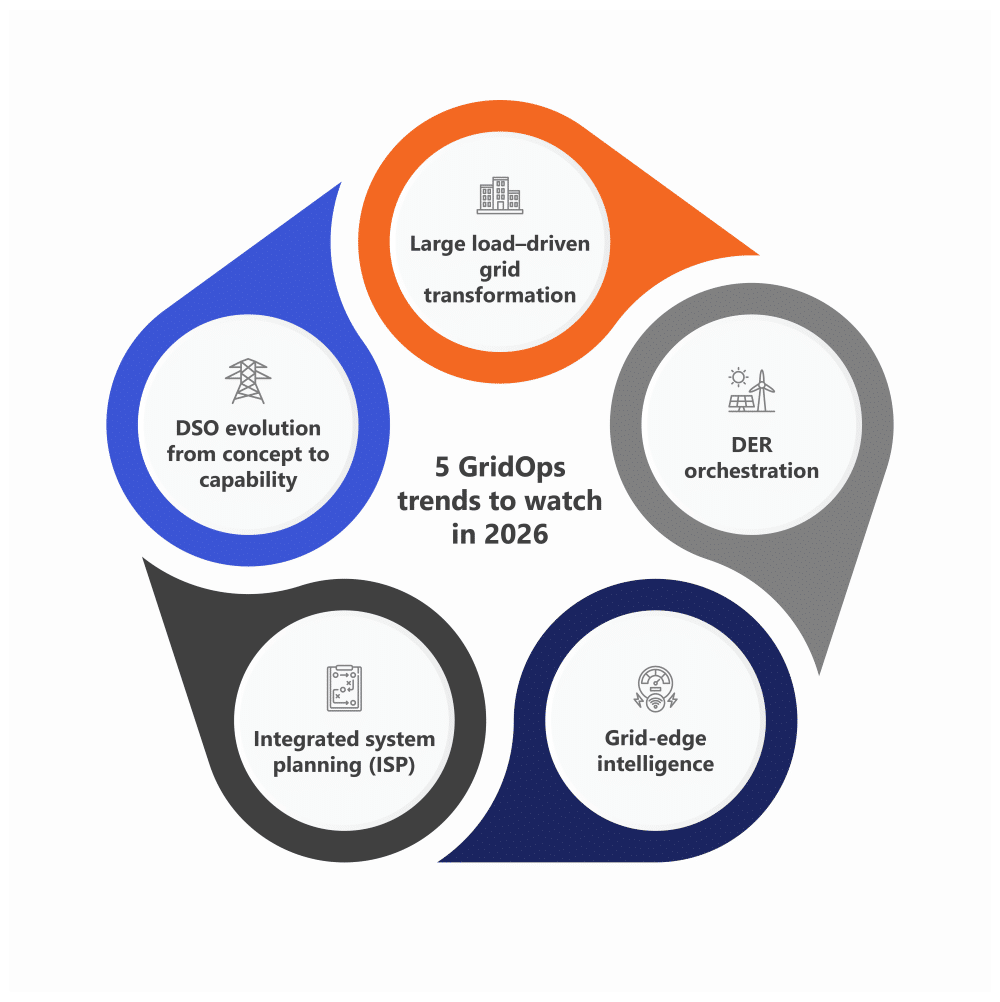
In this article, we examine five grid operations trends influencing how U.S. utilities operate in 2026. Together, these trends reflect a move toward coordinated, flexible approaches to managing the transmission and distribution grid, as leaders work to balance growth, reliability, and long-term resilience.
Table of contents (click to expand)
- Trend 1: Large load–driven grid transformation
- Trend 2: Beyond DER integration to DER orchestration
- Trend 3: Grid-edge intelligence as a foundation for modern grid operations
- Trend 4: Integrated system planning as a response to grid complexity
- Trend 5: Distribution system operator evolution from concept to capability
- Defining the next era of grid operations
Trend 1: Large load–driven grid transformation
Data centers and other emerging large loads are no longer just bigger customers on the system. At today’s scale, these loads are system-shaping assets that influence planning timelines, infrastructure investment, and operational risk across both distribution and transmission networks.
Large-load growth—driven by data centers alongside advanced manufacturing, hydrogen electrolysis, crypto mining, and electrification clusters—is outpacing assumptions embedded in many traditional planning cycles. Large interconnection requests are emerging faster than utilities can study, model, and sequence infrastructure upgrades. The challenge is not simply the amount of new load, but its speed and geographic concentration, which compress timelines and strain processes designed for gradual growth.
Concentrated load and grid assumptions
The clustering of large loads, including data centers and other energy-intensive facilities, is reshaping long-standing assumptions about grid design and operations. Distribution and transmission teams are increasingly planning for scenarios that were once uncommon, including:
- High-capacity feeders and substations coming online on compressed timelines
- Transmission investments being pulled forward to support near-term demand
- Operational impacts that extend beyond infrastructure, affecting forecasting, outage management, and real-time coordination
Microgrids and resilience
Reliability expectations add another layer of complexity. Many large loads demand extremely high uptime or operational flexibility, driving interest in microgrids, on-site generation, and hybrid architectures that combine utility supply with customer-owned resources. While these approaches can reduce outage exposure, they also introduce coordination risk when microgrids and distributed energy resource management systems (DERMS) intersect with system-level reliability goals.
Regulatory and interconnection implications
Interconnecting large-load customers frequently necessitates major upgrades to distribution substations and feeders and may also trigger upstream transmission investments. These requirements introduce immediate questions around cost responsibility and risk allocation, particularly when loads are proposed on accelerated timelines or speculative development schedules.
A central challenge is cost recovery. Utilities must determine who pays for upgrades upfront and how costs are treated if the load is delayed, declines, or never materializes. Contributions in aid of construction (CIAC), refundability, and “used and useful” determinations are increasingly scrutinized as large-load requests inflate infrastructure plans ahead of confirmed demand.
At the same time, utilities are exploring flexible interconnection concepts for load, including phased energization tied to upgrade completion and enforceable capacity caps. These approaches allow utilities to manage risk while accommodating growth, but they also require clearer operating rules and monitoring capabilities.
Operational coordination adds another layer of complexity. Emerging large loads place new demands on data collection, forecasting, and modeling, particularly when customers seek to connect within one- to two-year windows. Traditional planning processes are often not equipped for this pace. As a result, utilities are increasingly focused on:
- Verified dynamic load models rather than nameplate megawatt assumptions
- Clear telemetry and data-sharing requirements
- Defined disturbance response and coordination protocols
Regulatory frameworks are evolving alongside these challenges, but often more slowly than load materializes. This gap reinforces the need for grid operations strategies that can manage uncertainty, enforce limits, and adapt as large-load behavior and timelines change.
Executive takeaways
- Large-load demand requires faster adaptation in planning and operations.
- Treating large loads as core grid operations considerations, rather than one-off planning exceptions, helps utilities reduce risk and avoid overbuilding.
- Utilities that align operational readiness with large-load growth are better positioned to support economic development while maintaining long-term system flexibility.
Article continues below.
On-demand webinar
Grid-edge DERMS:
Orchestrating behind-the-meter assets for utility resilience and modernization
Our experts explore how utilities can harness grid-edge technologies and DERMS to enhance reliability, optimize load management, and accelerate the transition to a more flexible, resilient grid.
Watch on demand at your convenience.
We will never sell your data. View our privacy policy here.
Trend 2: Beyond DER integration to DER orchestration
DER integration approaches are reaching practical limits. Point-to-point connections linking individual assets to operational systems worked when DER adoption was modest. At scale, these models introduce fragmentation, manual workarounds, and operational blind spots that are difficult to manage.
The distinction between integration and orchestration is operational, not semantic. For grid operations, that difference marks a shift from managing individual devices to coordinating aggregate capacity and performance across the distribution system. This coordination can be achieved through multiple mechanisms, including price signals, autonomous control schemes, and behavioral or programmatic strategies that influence how distributed resources respond to grid conditions. Growing DER portfolios make orchestration a strategic requirement rather than a technical enhancement.
Why traditional DER integration is reaching its limits
Several factors are pushing utilities beyond traditional DER integration models:
- Growing DER volumes increase operational complexity and data management burden.
- Asset diversity creates variability across technologies, ownership models, and performance characteristics.
- Point-to-point integrations become costly and difficult to maintain over time.
- Limited coordination constrains the ability to capture system-level value from DERs.
DER orchestration as an operational capability
Orchestration shifts operational focus from asset connectivity to system performance. Instead of monitoring individual devices, utilities gain the ability to manage capacity at the portfolio level, apply constraints consistently, and influence DER behavior with real-time grid conditions. This capability supports more predictable operations while reducing manual intervention and operational risk associated with fragmented integrations.
DERMS plays a central role in enabling this shift by providing:
- Aggregated visibility across DER portfolios
- Centralized coordination and dispatch capabilities
- Support for use cases beyond interconnection compliance
- Support for multiple orchestration mechanisms, including dispatch, price-based coordination, and programmatic control
Operational value at scale
Orchestration matters because it changes the role of DERs in grid operations. Coordinated DER portfolios can support peak management, outage response, voltage regulation, and localized resilience strategies. These outcomes depend on portfolio-level control and predictable performance, regardless of whether control is achieved through direct dispatch, pricing signals, or behavioral response.
Capturing this value requires disciplined attention to data integration, system interoperability, and operational workflows. Utilities are prioritizing DERMS implementation strategies that emphasize scalability, interoperability, and long-term operational fit over narrow, single-use deployments. Clearly defined use cases help anchor investment decisions and guide operational maturity as orchestration capabilities expand.
Operating model and organizational implications
Coordinated DER operations often span multiple operational functions. Clear ownership models and governance structures become essential as utilities move beyond interconnection-centric management toward coordinated grid operations that rely on multiple orchestration mechanisms.
Executive takeaways
- Orchestration enables utilities to manage DERs as coordinated portfolios using a mix of price-based, autonomous, and programmatic mechanisms.
- Utilities should have a well-defined DER orchestration capability roadmap.
- DERMS provides an operational foundation for flexibility, resilience, and reliability at scale.
- Treating DER orchestration as an operating model shift positions distributed resources as controllable grid assets aligned with strategic objectives.
Article continues below.
Trend 3: Grid-edge intelligence as a foundation for modern grid operations
Advanced metering infrastructure (AMI) is evolving beyond its original role as a billing and revenue assurance platform to become a key contributor to grid-edge intelligence. When combined with other field, operational, and third-party data sources, AMI supports stronger visibility, coordination, and decision making across the distribution system.
Why AMI modernization decisions are increasingly operational
Utilities are under growing pressure to improve grid-edge visibility and support data-driven planning and operations, particularly in areas where traditional SCADA coverage and planning models provide limited insight.. Expanding DER portfolios require granular insight into load, voltage, and system behavior, while regulators and stakeholders expect clearer evidence of operational efficiency and value.
When AMI data remains isolated from other grid-edge and operational data sources, much of this potential goes unrealized. Integration becomes the differentiator, positioning AMI data as an active enabler of grid operations and orchestration.
Integrating AMI data with operational and grid-edge systems
Integrated grid-edge environments connect meter-level insights with core operational platforms such as outage management systems, distribution management systems, and DERMS, alongside data from sensors, devices, and third-party sources at the edge. This integration supports coordination across planning and operations.
In practice, utilities are using grid-edge data, including AMI, to enhance functions such as load forecasting, voltage monitoring, and flexibility program enablement. When paired with DERMS, AMI data also supports more accurate aggregation, targeting, and performance monitoring across distributed resource portfolios.
Enabling distribution-level orchestration
Grid-edge intelligence plays a critical role in distribution operations that require timely awareness of local conditions and constraints. Granular, time-synchronized data supports coordinated control strategies, improves response timing, and reduces uncertainty as DER volumes increase. This capability enables coordinated control strategies, improves response timing, and reduces uncertainty as DER volumes increase.
Utilities are also leveraging improved grid-edge data to strengthen regulatory alignment and demonstrate operational value. Improved data quality and traceability support compliance reporting, cost recovery discussions, and ROI narratives tied to grid modernization initiatives.
Business considerations: ROI and long-term scalability
The value of grid-edge intelligence investments depends on scalability and sustained operational relevance as system conditions evolve. Standalone deployments tied to narrow use cases limit returns over time. Integrated architectures that connect AMI data to operational and orchestration platforms create value as use cases expand.
Utilities prioritizing scalability are focusing on architecture, interoperability, and data governance alongside deployment strategy. Clear alignment between AMI investments and operational outcomes strengthens the business case and helps unlock the full return potential of AMI programs.
Executive takeaways
- AMI is becoming a foundational component of broader grid-edge intelligence.
- Integration with operational and grid-edge systems unlocks value beyond billing and revenue assurance.
- AMI data strengthens outage intelligence, forecasting, flexibility programs, and DER orchestration.
- Viewing AMI as part of a broader grid operations strategy improves ROI and scalability over time.

How AMI 2.0 data supports regulatory alignment and drives utility ROI
Learn how high-fidelity AMI datastrengthens rate-case filings, supports compliance obligations, and clarifies the operational impacts of modernization efforts.
Trend 4: Integrated system planning as a response to grid complexity
Grid planning has traditionally been organized around distinct functional domains. Resource planning, transmission planning, distribution planning, and customer programs are planned through separate processes, on different timelines, and with different data sets. This structure worked when load growth was predictable and change was incremental, but today, silos have become a liability.
Limits of traditional planning approaches
Segmented planning struggles because assumptions no longer hold consistently across the system. Distribution forecasts may diverge from transmission needs. Large loads can compress timelines and overwhelm long-range plans built on gradual change.
These gaps surface in:
- Misaligned investment timing across key planning areas
- Inconsistent assumptions about load growth, DER penetration, and system constraints
- Limited ability to assess trade-offs across infrastructure, flexibility, and non-wires alternatives
Without a cohesive view, planning decisions become more difficult to defend and to sequence.
Linking planning domains into a cohesive process
Integrated system planning (ISP) addresses these challenges by integrating planning processes across key planning areas. ISP focuses on system-wide outcomes, shared assumptions, and aligned decision timelines. This approach supports clearer evaluation of options across infrastructure investment, flexibility programs, and resource portfolios.
Capital prioritization, regulatory compliance, and resilience
A coordinated planning framework improves capital prioritization by making trade-offs explicit and comparable across domains. It strengthens regulatory compliance by grounding investment decisions in consistent assumptions and transparent analysis. It also supports resilience by identifying dependencies and risks that siloed planning can overlook.
Integrated system planning provides a line of sight between near-term decisions and long-term outcomes.
The enabling role of data and analytics
ISP depends on robust data integration and advanced analytics. Shared data environments, consistent models, and scenario-based analysis help planners assess interactions across the system. Analytics enable faster iteration, clearer comparison of alternatives, and stronger alignment between planning and operations.
Executive takeaways
- Planning silos create risk as load growth, DER adoption, and infrastructure needs intersect.
- Integrated system planning aligns key planning areas such as resource planning, transmission planning, distribution planning, and customer programs around shared assumptions and outcomes.
- Coordinated planning improves capital prioritization, regulatory compliance, and system resilience.
- Data integration and advanced analytics are foundational to making ISP effective and scalable.

Building DSO capabilities: Planning for a DER-rich grid
What DSO readiness means, why it starts in planning rather than the control room, and how most organizations evolve through a maturity path that reflects real-world adoption patterns
Trend 5: Distribution system operator evolution from concept to capability
The distribution system operator (DSO) model has long been discussed as a regulatory or market construct. Increasingly, utilities are framing DSO as an expansion of capabilities, processes, and responsibilities needed to manage growing complexity at the distribution level. This shift reflects a growing recognition that distribution has become the locus of change, where DER adoption, load variability, and local constraints intersect.
DSO evolution is a capability-driven journey, focused less on formal designation and more on readiness across planning, coordination, and coordination.
Why DSO discussions are resurfacing
Renewed interest in DSO models is being driven by a widening gap between planning models and real-time grid conditions. Visibility gaps, unclear constraint awareness, and fragmented coordination make it harder to manage growth without increasing operational and reliability risk. As a result, utilities are revisiting DSO concepts not as abstract frameworks, but as a response to real operational pressure.
DSO readiness starts with planning, not the control room
Although DSO is often associated with real-time operations, readiness begins in planning. Planning discipline and early constraint identification form the foundation for effective coordination later on. Without clear visibility into emerging system constraints and available operational flexibility, strategies remain reactive. A planning-led approach aligns investment decisions with evolving grid conditions rather than static worst-case assumptions.
A phased path toward DSO-like functions
Progress toward a DSO model occurs incrementally, shaped by infrastructure maturity, regulatory context, and operational readiness. Common phases include:
- Strengthening planning discipline and DER visibility to support confident forecasting and investment decisions
- Enabling targeted programs that use DER-provided services to address local constraints and grid needs
- Formalizing coordination across planning, operations, and the transmission-distribution interface
- Preparing for more structured interaction with aggregators or markets where appropriate
This phased approach allows utilities to build capabilities in sequence, creating options rather than commitments as system complexity grows.
Supporting long-term grid modernization
DSO capabilities support broader grid modernization efforts by enabling safer coordination, improved resilience, and more flexible use of DERs at the distribution level. Stronger alignment between planning and operations reduces uncertainty and improves the ability to integrate new resources without compromising reliability.
Executive takeaways
- Planning silos create risk as load growth, DER adoption, and infrastructure needs intersect.
- Integrated system planning aligns key planning areas such as resource planning, transmission planning, distribution planning, and customer programs around shared assumptions and outcomes.
- Coordinated planning improves capital prioritization, regulatory compliance, and system resilience.
- Data integration and advanced analytics are foundational to making ISP effective and scalable.
Defining the next era of grid operations
The pressures reshaping grid operations are already influencing planning cycles and investment decisions, but many operating models were not built for their speed or scale. The differentiator is whether operating models can adapt without increasing risk.
Taken together, these trends point to a clear operating reality. Operating models designed for stability are being tested by compressed timelines, concentrated load growth, and rising coordination demands at the grid edge. Utilities that invest in visibility, coordination, and scalable operating capabilities are better positioned to respond decisively without increasing exposure.
This shift also reframes the value equation for modernization investments. Individual programs matter less than the capabilities they reinforce across planning and operations. Initiatives that strengthen coordination, improve data quality, and shorten decision loops create durable value, while isolated solutions struggle to keep pace.
Data sits at the center of this evolution. When treated as operational infrastructure rather than a reporting byproduct, integrated data enables clearer accountability, more defensible decisions, and smoother execution across the organization.
Grid transformation is not about predicting every outcome. It is about building an integrated model that remains effective as conditions change. Utilities that focus on durable capabilities, processes, and people are better positioned to support growth with confidence and sustain reliability in a more dynamic energy landscape.
You might also be interested in ...
Digital twin infrastructure for utilities: Why interoperability determines operational impact
How digital twin infrastructure helps utilities connect data across systems and apply digital twins to planning, operations, and investment decisions

Meeting data center demand: How utilities can modernize operations for a high-load future
Surging data center growth is reshaping utility planning. To keep pace, utilities must balance capacity expansion with flexibility.

What the Common Information Model (CIM) means for U.S. utilities
The CIM offers a shared structure for representing network data, giving leaders a clearer, more actionable view of their operations.

Powering a sustainable tomorrow
We partner with utilities to help them build a more resilient grid and move towards a cleaner, brighter future through
- AI-driven automation
- Asset image analytics
- DERMS implementation
- Analytics & predictive insights
- Cloud optimization

Michael Emmanuel is a Manager of Grid Operations with over 10 years of experience in utilities. He previously worked as a research engineer at the National Renewable Energy Laboratory, where he helped utilities implement DERs and hosted capacity studies on non-wire alternatives and economic dispatch models. Michael’s areas of expertise include DER hosting capacity analysis, DERMS, ADMS, and production cost modeling.

Managing Director of Grid Operations Alex Lago has over 30 years of experience in power system operations, wholesale power market operations, SCADA/EMS/GMS/DMS/OMS systems, and system/application design and implementation. He is passionate about advising companies on large-scale transformational projects and implementation of complex real-time operation systems.