

Executive summary: AI agents are becoming a practical solution for organizations looking to streamline operations, improve decision-making, and deliver faster, more consistent customer experiences. These autonomous systems interpret information, reason through options, take action, and learn from results, creating a continuous cycle that advances work with minimal oversight. As businesses seek scalable ways to modernize workflows and support growing demands, AI agents offer a flexible foundation for efficiency and long-term digital transformation.
13-minute read
The rapid rise of artificial intelligence is reshaping the way people work and the way businesses operate. New tools are beginning to interpret information, respond to changing conditions, and step into tasks that previously needed hands-on oversight. As organizations look for ways to streamline operations and improve customer experiences, many are experimenting with more autonomous systems to support that shift.
AI agents have become a key part of this shift toward more autonomous systems. These systems can read the context of a situation and determine a practical next step that moves them toward a defined goal. Their level of independence goes well beyond earlier automation approaches, which makes them appealing to teams aiming to reduce repetitive work and speed up everyday processes.
Interest in agentic AI is climbing as companies explore systems with more flexible reasoning. Adoption is already taking shape: Twenty-nine percent of organizations report that they are using agentic AI today, and nearly half plan to implement it within the next year.
In this article, we outline the essentials—what AI agents are, how they work, where they’re appearing across industries, and what their rise means for the future of business and technology.
Table of contents (click to expand)
Introduction to artificial intelligence
Artificial intelligence refers to systems that process information in ways that help people spot patterns and make more informed decisions. Earlier approaches depended on rigid rules and predictable inputs, but that model has changed. Modern tools now interpret context, weigh options, and adjust their responses with much greater nuance.
This shift has contributed to what many now call agentic AI—a direction in which systems evaluate a situation and choose steps that support a specific objective. AI agents are one expression of this trend, bringing added autonomy into daily workflows and reducing the need for continual oversight.
Article continues below.
PLAYBOOK
We will never sell your data. View our privacy policy here.
Types of AI agents
AI agents come in several forms, each suited to different kinds of work. These differences help explain why some agents handle immediate decisions well while others support longer, more involved tasks.
Reactive agents
Reactive agents, also known as simple reflex agents, respond only to what’s happening in the moment, without drawing on past interactions.
A typical example is a system that flags suspicious login attempts using real-time signals. It evaluates each attempt independently and acts without delay, which makes this approach useful for work that relies on speed and consistent rules.
Deliberative agents
Some agents take more time to evaluate the full situation before choosing a next step.
For instance, a scheduling agent might look at technician availability, travel time, and the complexity of upcoming jobs before assigning work. It weighs those factors to plan an efficient path forward, supporting tasks that need structured reasoning or coordination.
Hybrid agents
Hybrid models combine quick reactions with deeper analysis when situations call for it.
A customer support agent, for example, may answer common questions right away but shift into a deeper analysis when conditions require it. This flexibility makes hybrid agents a good fit for environments where demand shifts throughout the day.
These three approaches illustrate the range of ways AI agents support real-world work—some tasks rely on speed, others on analysis, and many on a mix of the two.

What is agentic AI? Benefits, challenges, and how to implement it
Learn what agentic AI is, how it is evolving, and practical steps for integrating it into your enterprise strategy.
Characteristics of intelligent agents
Intelligent agents share several traits that shape the way they operate and the value they provide. These qualities influence the way an agent interprets information, decides what to do next, and adapts as conditions shift.
Autonomy
Autonomy gives an agent the freedom to move ahead without constant direction. Once it has a goal, it can decide the next step and keep progressing without step-by-step input.
Perception
Through perception, an agent draws information from systems, data feeds, or user interactions. By interpreting these signals in context, it can understand what’s going on and spot when something needs attention.
Reasoning
Reasoning allows an agent to look at a situation, weigh its options, and choose an action that supports its objective. This becomes especially helpful when a workflow involves multiple variables or competing priorities.
Adaptation
With adaptation, an agent adjusts its behavior as new information comes in. When conditions change or past results reveal a better approach, it can shift its strategy to stay effective.
Goal orientation
Goal orientation keeps an agent focused. Instead of treating each action as a one-off, it stays aligned with a defined outcome and uses its capabilities to move toward that target.
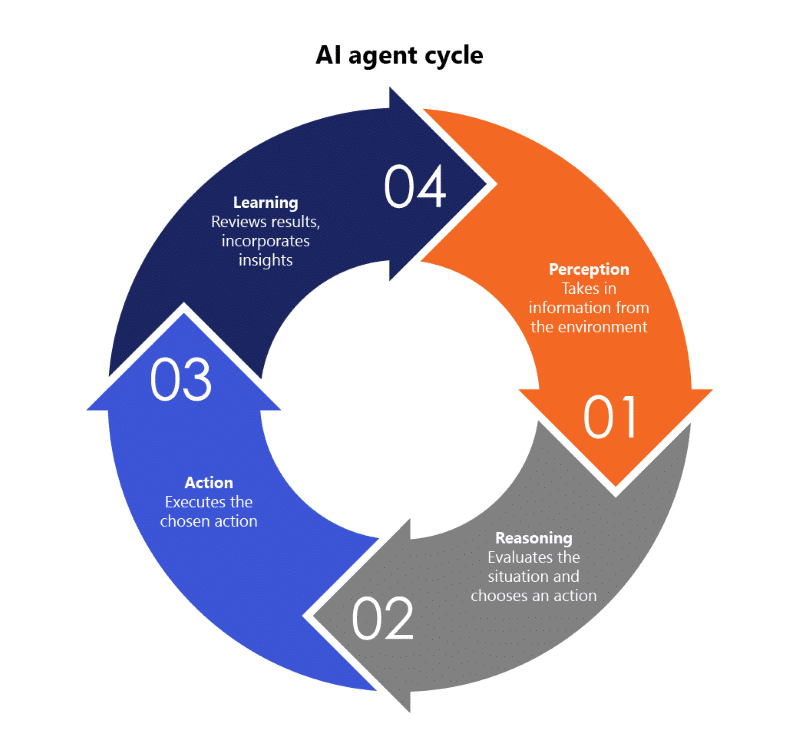
Cycle of perception, decision, action, and learning
These traits come together in a cycle that guides the way an agent operates. It starts by taking in information, evaluates the situation, and chooses an action. After acting, it reviews the result and folds that insight into future decisions. This loop helps agents stay flexible and adjust as situations evolve.
When autonomy, context awareness, decision-making, and adaptation work together, agents can support more reliable and efficient workflows. They respond quickly when the task is straightforward, pause to assess situations that demand closer evaluation, and reduce the amount of manual effort needed to keep operations running smoothly.
Article continues below.
Applications of AI agents
Use cases for AI agents are emerging in a wide range of industries, each with its own priorities and constraints. Agents’ ability to understand context and move work forward helps organizations reduce repetitive tasks and bring more consistency to daily operations.
Financial services
Financial institutions often rely on agents that can evaluate information quickly and with precision. An agent might review transactions for indications of fraud, check documentation for compliance teams, or pull portfolio insights that help advisors prepare for client conversations. Together, these capabilities help institutions respond more quickly to risks and deliver more personalized customer experiences.
Utilities
In utilities, AI agents support both system reliability and customer engagement. They can help triage outage reports and generate timely updates, or assist with scheduling field crews by factoring in location, skills, and urgency.
Many utilities also use agents to monitor equipment through IoT sensors, flag irregularities, and prioritize maintenance. On the customer side, they frequently support self-service tasks such as billing questions or service requests. As grid-modernization work progresses, agents help interpret sensor and grid-performance data and highlight the actions most likely to strengthen grid reliability.
Healthcare
Healthcare organizations use agents to reduce administrative workload and strengthen patient support. Agents can coordinate appointments, offer symptom-based triage guidance, or summarize clinical information securely. They can also send preparation instructions or follow-up reminders, giving staff more time to focus on direct care.
Technology and telecom
In technology and telecom environments, AI agents keep complex systems operating smoothly. They can act as automated service-desk resources that diagnose issues, initiate fixes, or escalate problems when needed. Agents also track infrastructure for anomalies, open tickets, and provide real-time updates on system status—support that helps teams maintain uptime and reduce hands-on troubleshooting in large-scale environments.

Agentic AI in action: Lessons from building the Advanced Voice Assistant
Logic20/20’s Advanced Voice Assistant (AVA) prototype demonstrates agentic AI in action—turning complex, manual reporting into guided, conversational workflows.
Multi-agent systems
As AI capabilities expand, many organizations are beginning to explore multi-agent systems. Rather than relying on a single agent, this approach brings together several that coordinate their efforts toward a shared goal.
Scalability and resilience
Bringing multiple AI agents together makes it easier to scale complex workloads. Tasks can be distributed so the system can handle more activity without slowing down. These networks also add resilience: if one agent hits an unexpected condition, another can pick up the work or adjust its own approach to maintain continuity of work.
Parallel problem-solving
Multi-agent systems can divide work that would be inefficient for a single agent to manage. Several agents can evaluate information or try out different options at the same time, which shortens cycle times and gives a more complete view of a problem.
Examples of these systems show up in many operational settings:
- In transportation or logistics, agents can share real-time information to coordinate routes and adjust plans as conditions change.
- In data environments, multiple agents may analyze different parts of a large dataset and combine their findings to create a fuller picture.
- In customer operations, one agent may read a request, another pull context from internal systems, and a third carry out the needed action.
Together, these systems provide a practical way to expand capacity, maintain continuity, and support complex workflows—while still keeping human oversight where it adds the most value.
Role of intelligent agents in business
Intelligent agents are enhancing organizations’ ability to streamline operations and meet rising expectations. Rather than simply accelerating existing tasks, they take a more proactive role by spotting what needs attention and advancing tasks without frequent intervention.
Using AI agents can lead to significant cost savings, increased productivity, and enhanced customer experiences, making them an asset to any organization.
Driving productivity
Many businesses introduce AI agents to manage work that touches multiple systems or steps. Instead of coordinating each handoff manually, an agent can complete an entire workflow—updating records, gathering details, and prompting follow-up where needed. This approach reduces the time teams spend on routine processes and helps shorten cycle times.
Increasing accuracy and consistency
Routine decisions often require reviewing structured information and applying the same criteria repeatedly. AI agents are well suited to this sort of work. By interpreting data in a consistent way, they reduce errors that can arise during busy periods or under tight deadlines—an important advantage in regulated or customer-facing environments.
Improving customer experiences
Customer expectations continue to rise, especially around response time. Agents can quickly interpret a request, determine the next step, and provide an immediate reply. The impact is already noticeable: by 2029, agentic AI is predicted to autonomously resolve 80 percent of common customer service issues, reducing operational costs by 30 percent. Faster responses and clearer information create smoother, more predictable interactions.
Supporting strategic focus
As AI agents take on more administrative and transactional work, employees gain time for activities that require judgment, creativity, or relationship-building. This shift helps organizations make better use of their teams—especially in areas where expertise is scarce or customer expectations call for a more personalized approach.
AI agent technology
AI agents rely on several technical elements that work together to interpret information, reach decisions, and carry out actions. Although the architecture varies across organizations, many implementations share a core set of capabilities.
Core components
Language models or other reasoning engines sit at the center of an AI agent, helping it understand context and choose an appropriate next step. Once that decision is made, additional components ensure the agent can act effectively:
- APIs allow the agent to update records, retrieve data, or initiate workflows within business systems.
- An orchestration layer manages the sequence of those activities and ensures that each step receives the right inputs.
- Guardrails define approved boundaries for the agent’s actions, and monitoring tools give teams the information they need to refine behavior over time.
Organizations that want to strengthen these capabilities often bring together expertise in data science, AI and machine learning, and enterprise agentic AI solutions to support good design and governance.
How AI agents are built
Building an AI agent starts with defining clear goals. Teams begin by determining the agent’s objective, the systems it must interact with, and the kinds of decisions it needs to support. Designers then map the workflow, outline expected inputs and outputs, and specify the way the agent should behave in routine and exceptional situations. Safe execution depends on role-based controls, validation checkpoints, and ongoing monitoring that confirms the agent is performing as intended.
From virtual agents to autonomous systems
The technology that supports AI agents has advanced steadily over the past decade, driven by improvements in language models, integration frameworks, and real-time data processing. Earlier virtual agents—often referred to as “chatbots”—were built around scripted interactions or predefined responses. Modern agents operate with far more independence: they understand complex scenarios, anticipate next steps, and execute tasks across multiple systems. This progression reflects broader improvements in AI and the growing confidence organizations place in tools that can reason and adapt in real time.

Is your automation ready for agentic AI?
6 critical steps every organization must take to get automation ready for agentic AI, from defining use cases and strengthening data foundations to building governance and scaling responsibly
Real-world examples of AI agents
AI agents already support everyday workflows across many sectors, often handling tasks that require context awareness and the ability to move work forward without supervision.
Customer support agent
Customer support teams can use an AI agent to read incoming messages, interpret the issue, and recommend the next step. In many cases, the agent drafts a response for review, updates the case record, or gathers background details from internal systems. By advancing these steps, the agent shortens wait times and reduces manual follow-up.
Procurement agent
Procurement teams rely on agents to monitor inventory levels and surface items that fall below defined thresholds. When supplies need replenishment, the agent may collect relevant details, review approved vendors, and start an order based on established guidelines. This workflow helps teams maintain continuity without spending time on routine checks.
Research assistant agent
A research-oriented AI agent can pull information from several sources and organize the findings into a clear summary. In some cases, the agent highlights insights or proposes next steps that support fast decision-making. Teams gain quick access to the information they need without sorting through large volumes of information.
System monitoring agent
Operations teams can use a monitoring agent to review logs and performance indicators for signs of unusual activity. When an issue requires attention, the agent may begin corrective actions, notify the appropriate team, or escalate according to predefined rules. Early detection supports stable operations and helps prevent minor problems from interrupting service.
Future trends in agentic AI
Although AI agents are still early in their adoption curve, the direction of the technology is starting to come into focus. As organizations gain experience with autonomous systems, several trends are shaping the way agents will evolve and where they are likely to create long-term value.
Growth of autonomous workflows
Many businesses are moving beyond simple task automation toward workflows that progress with minimal intervention. AI agents are becoming part of these environments by interpreting information, coordinating steps, and managing exceptions as they arise. As the technology improves, more processes will move from partially automated sequences toward workflows that adapt on their own when conditions shift.
Collaborative multi-agent ecosystems
Use of multi-agent systems is expanding as organizations experiment with distributing work across specialized agents. Instead of assigning an entire workflow to one agent, teams can rely on several that contribute different capabilities and share data among themselves. This model supports stronger problem solving, faster responses, and more resilient operations.
Deeper integration with enterprise platforms
AI agents are connecting more closely with the platforms businesses use daily. Stronger integrations will allow agents to pull information from core systems, complete transactions across multiple tools, and maintain a clear view of the work environment. Increased connectivity supports more accurate execution and enables more sophisticated decision making.
Increased emphasis on governance
As AI agents take on greater responsibility, governance is becoming a central priority. Organizations are focusing on transparency, role-based controls, auditability, and continuous monitoring to ensure agents behave as intended. Responsible AI practices guide model selection, data use, and the review of automated actions.
A long-term digital transformation enabler
AI agents are emerging as long-term components of digital transformation strategies. Their ability to enhance productivity, strengthen customer experiences, and modernize workflows makes them durable investments rather than short-term tools. As more enterprises adopt AI-enabled operations, agents will help connect technologies, teams, and processes across the organization.
Many businesses are moving beyond simple task automation toward workflows that progress with minimal intervention. AI agents are becoming part of these environments by interpreting information, coordinating steps, and managing exceptions as they arise.
Staying ahead of the agentic AI curve
The growing use of AI agents marks more than a technical milestone. It signals a shift in the way organizations think about work, decision-making, and the pace at which expectations change. Businesses that treat AI agents as long-term strategic partners—not just tools for short-term efficiency gains—will be better prepared to adapt as demands outpace team capacity.
Timing plays a meaningful role. AI agents have moved past the experimental stage; the technology is developing quickly and still evolving. That combination creates an opening for organizations willing to modernize workflows, strengthen data foundations, and put governance structures in place that ensure teams trust autonomous systems in practice.
Leaders who start exploring use cases now stand to benefit as the technology evolves. Prototyping responsibly and investing in the capabilities that support AI agents helps teams prepare for broader adoption. Leaders who delay adoption may find themselves behind the curve in adapting to customer and employee expectations that have already shifted toward faster, more intelligent interactions.
AI agents are beginning to influence how work gets done and how organizations create value. Choices made today will shape not only the speed at which teams gain the benefits of this shift but also the resilience and competitiveness of the organization as intelligent systems become standard across industries.
FAQs
What are AI agents?
AI agents are software systems designed to interpret information, make decisions, and take action toward a defined goal. Their autonomy allows them to move work forward without step-by-step direction, which sets them apart from traditional automation tools.
How do AI agents differ from virtual agents or chatbots?
Virtual agents—formerly known as chatbots—focus primarily on conversation and usually follow scripts or narrow logic paths. AI agents operate more broadly. They can analyze context, plan ahead, and act across multiple systems, which gives them a wider and more flexible role in enterprise settings.
Are AI agents part of agentic AI?
Yes. Agentic AI refers to systems that can analyze a situation, determine a next step, and act with limited oversight. AI agents bring these capabilities into specific workflows and business processes.
How do AI agents work?
AI agents follow a perception–reasoning–action cycle. They gather information from systems or user inputs, evaluate the situation using a reasoning model, and advance the workflow by taking an appropriate step. After acting, the agent incorporates feedback to adjust later decisions.
Which industries benefit the most from implementing AI agents?
Industries with high transaction volume or complex coordination needs—such as financial services, utilities, healthcare, retail, and technology—see strong gains from AI agents. These environments often require quick turnaround and steady performance, making them a good fit.
What skills are needed to build an AI agent?
Teams typically combine data science skills, workflow design expertise, and system integration experience. Effective deployment also depends on strong governance, testing, and monitoring practices that ensure safe and reliable operation.
Do AI agents replace human workers?
AI agents are designed to support teams rather than replace them. They manage repetitive or multistep tasks so people can focus on work that requires judgment, creativity, or interpersonal connection. Most organizations use agents as digital collaborators.
How can businesses get started with AI agents safely?
A well-scoped use case with clear objectives provides a good starting point. From there, organizations can define guardrails, set up monitoring practices, and test agent behavior before expanding to broader workflows. A disciplined approach helps teams build confidence and align the technology with business and responsible-AI goals.
You might also be interested in …

What is responsible AI and why does it matter?
How responsible AI fosters ethical, transparent, and trustworthy AI systems to drive innovation while minimizing risks

Enhance customer experiences: Gen AI’s self-service growth
Generative AI is enhancing customer portals and other self-service tools through advanced interactive capabilities.
Scaling AI starts here: 5 foundations every enterprise needs
5 foundational focus areas that enable organizations to move beyond pilots and turn AI into a sustainable, enterprise-wide capability

Streamline operations with agentic AI automation
- Agentic AI use case discovery
- AI agent design and development
- Integration with enterprise systems
- Governance and deployment strategy